




Plinko Explained: How the Game Works and What Changes the Odds
Learn how online Plinko works, why centre slots hit more often, how rows and risk settings change payouts and what provably fair Plinko actually proves.

Share this article
Key Takeaways
- Plinko works by mapping a sequence of left/right decisions into a final payout slot.
- Centre slots are more likely because far more possible paths reach them.
- More rows create more decisions, more possible paths and usually more extreme payout tables.
- Risk settings mainly change volatility and the payout distribution.
- RTP varies by provider and game configuration, so check the exact game.
- Provably fair Plinko should let you verify the generated path and the multiplier paid for the final slot.
Plinko Explained: How the Game Works and What Changes the Odds
Online Plinko looks like pure chaos.
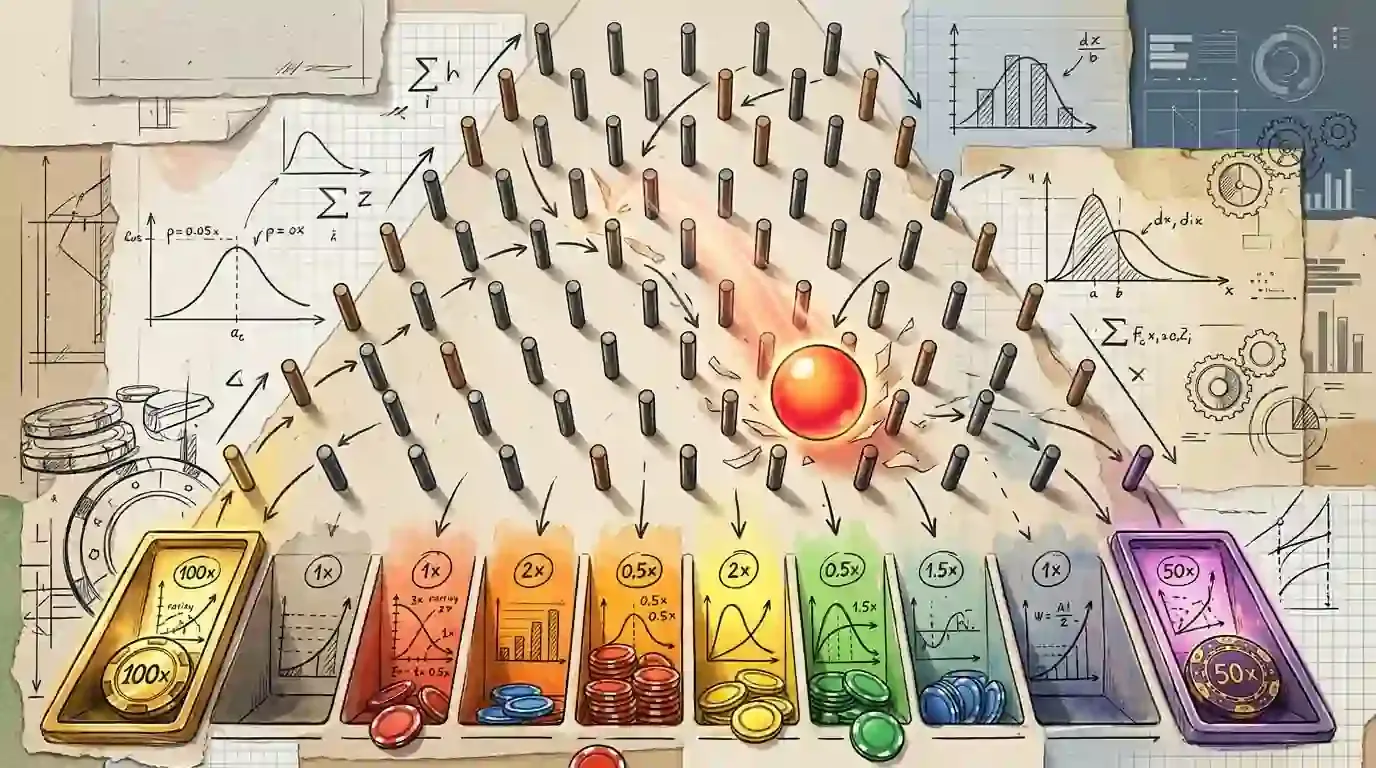
A ball drops from the top of a peg board, bounces left and right, then lands in a payout slot at the bottom.
But the important part is not the animation.
Underneath it is a probability tree.
Every left-or-right move changes where the ball can finish, and the centre slots can be reached by far more possible paths than the extreme edges. That is why the tiny-looking edge multipliers can pay so much more.
The exact rows, risk settings and payout table vary by provider, so there is no single universal Plinko chart.
If you want the fairness mechanics behind instant games first, our provably fair instant games guide explains how Plinko paths can be generated and verified.
How online Plinko works
A typical round looks like this:
- Choose your stake.
- Select the number of rows or board size.
- Choose a risk level where the game offers one.
- Drop the ball.
- The ball moves left or right once per row.
- Its final position determines the multiplier.
- Your stake is multiplied by that payout.
Suppose you bet €1 and the ball lands in a 2x slot.
You receive €2 in total.
Land in a 0.5x slot and the €1 stake returns €0.50.
Land in a 50x slot and the €1 becomes €50.
The multiplier table is doing most of the mathematical work.
Why the centre slots are more common
Imagine a simple eight-row Plinko board where every step has an equal chance of going left or right.
Eight decisions create:
2⁸ = 256 possible paths
But they do not produce 256 different final slots.
They produce nine.
The centre slot can be reached through many different combinations of left and right moves.
The far-left edge has only one path: left every single time.
The far-right edge also has only one: right every time.
On an idealised eight-row board:
- either extreme edge has 1 possible path out of 256, about 0.39%
- the exact centre has 70 possible paths out of 256, about 27.34%
That is the key to Plinko.
Nine visible slots do not mean each slot has a one-in-nine chance.
What changes when you add more rows?
More rows mean more left-or-right decisions before the ball lands.
That creates more possible paths and more final slots.
It also lets the game use more extreme payout tables.
A short board may have relatively modest multipliers on the edges.
A taller board can support rarer outcomes and much larger headline multipliers because getting all the way to an extreme slot becomes less likely.
More rows do not automatically mean "better odds".
They change the distribution.
The exact effect depends on the payout table the provider has attached to that row setting.
What does the risk setting change?
Many online Plinko games let you choose something like:
- Low risk
- Medium risk
- High risk
This usually changes the payout table, not the physical idea of the ball travelling down the board.
A low-risk setting tends to keep more of the central payouts closer to 1x.
A high-risk setting tends to make the middle less rewarding while pushing much larger multipliers towards the edges.
So high risk feels more violent:
- more losing or sub-1x results
- fewer meaningful wins
- much larger payouts when a rare edge result arrives
That is volatility.
It is not proof that the high-risk table has a worse RTP.
Two risk settings can have similar long-run RTP while distributing the return completely differently.
Does dropping from the same place change the odds?
In most online Plinko games, the animation is a visual representation of a digitally generated result.
You are not physically nudging a real ball from slightly different positions.
The outcome comes from the game's RNG or provably fair system.
That means trying to "aim" the ball based on where it appeared to leave the top of the board is usually meaningless.
The thing to inspect is the game's published rule set:
- number of rows
- risk level
- multiplier table
- RTP
- fairness mechanism
Not the animation.
What does RTP mean in Plinko?
RTP is the long-run percentage of all stakes that the game is designed to return as prizes.
The exact figure varies by provider and sometimes by game settings.
Do not assume every Plinko game has the same RTP just because the boards look similar.
A casino can have two games both called Plinko with different:
- payout tables
- row counts
- risk settings
- house edges
- fairness systems
Open the information panel on the exact game you are playing.
Our casino comparison tool is useful for comparing operators, but the RTP of the actual Plinko game still comes from the game itself.
Is Plinko provably fair?
Some crypto casinos offer provably fair versions.
A common design turns cryptographic output into one left-or-right decision for each row.
For example, the system may generate a sequence like:
R, L, R, R, L, L, R, L
Those eight directions create the ball's complete path.
The number of rightward moves then determines which final slot it reaches.
A proper verifier should let you reproduce:
- the seed or commitment
- the cryptographic output
- each left/right decision
- the final slot
- the payout attached to that slot and risk setting
That last part matters.
A valid path is not enough if the displayed multiplier does not match the published table.
Our step-by-step provably fair guide explains how to check that chain rather than trusting a green "verified" badge.
Does Plinko have a strategy?
You can choose a risk profile.
You cannot choose a sequence of bets that changes the underlying house edge.
Common ideas include:
- raising the stake after losing balls
- switching risk settings after a bad run
- waiting for an edge multiplier because it has not appeared recently
- using only the centre because it lands there most often
None of those makes the previous outcomes influence the next one.
The centre is more likely because more mathematical paths reach it, not because the game tries to "balance" the board.
Likewise, an edge multiplier can fail to appear for a long time without becoming due.
Why a huge multiplier can be misleading
A 1,000x or 10,000x edge slot is visually powerful.
It tells you almost nothing by itself about the value of the game.
You need the probability of reaching it.
A million-to-one event paying 10,000-to-one would still be terrible value.
The payout and the probability always belong together.
That is why the full payout table and RTP matter more than the largest number printed on the edge.
If you are browsing crypto casinos that offer in-house games, our BC.Game review looks at the wider platform around provably fair titles rather than judging them by one headline multiplier.
The simple way to think about Plinko
Plinko is a probability tree disguised as a bouncing ball.
More paths end near the middle.
Very few paths reach the extreme edges.
Rows and risk settings change how that distribution is turned into payouts.
The animation makes it feel physical. The maths underneath decides what the board is actually worth.

Diego Morales
Global Casino Expert
Diego pays attention to the stuff players actually notice right away. How fast can you sign up? How easy is it to deposit, especially with crypto? Where are the hidden traps in the bonus offers? And does support actually help when something goes wrong, or do they just send generic replies? He's good at taking complicated legal terms and casino rules and turning them into plain English. So you know exactly what you're agreeing to. He also has a sharp checklist for spotting the usual withdrawal problems like endless verification requests, unclear limits, and rules that aren't properly explained. His goal is to help players avoid the typical headaches and frustration.
Share this article