

Provably Fair Gambling Explained: How It Protects You
Learn how provably fair gambling works, how seeds and hashes verify outcomes, and why this system gives players real transparency and control.

Key Takeaways
- A pre-bet commitment becomes useful only when the operator later reveals the seed and the player can reproduce the same result.
- Complete verification requires the correct client seed, nonce, cryptographic method, byte conversion and game-result mapping.
- A matching result does not remove the house edge or prove withdrawal reliability, licensing or every part of operator conduct.
Provably fair gambling starts with a simple promise. The casino commits to hidden data before a bet. It reveals that data later. You can then check that the commitment never changed.
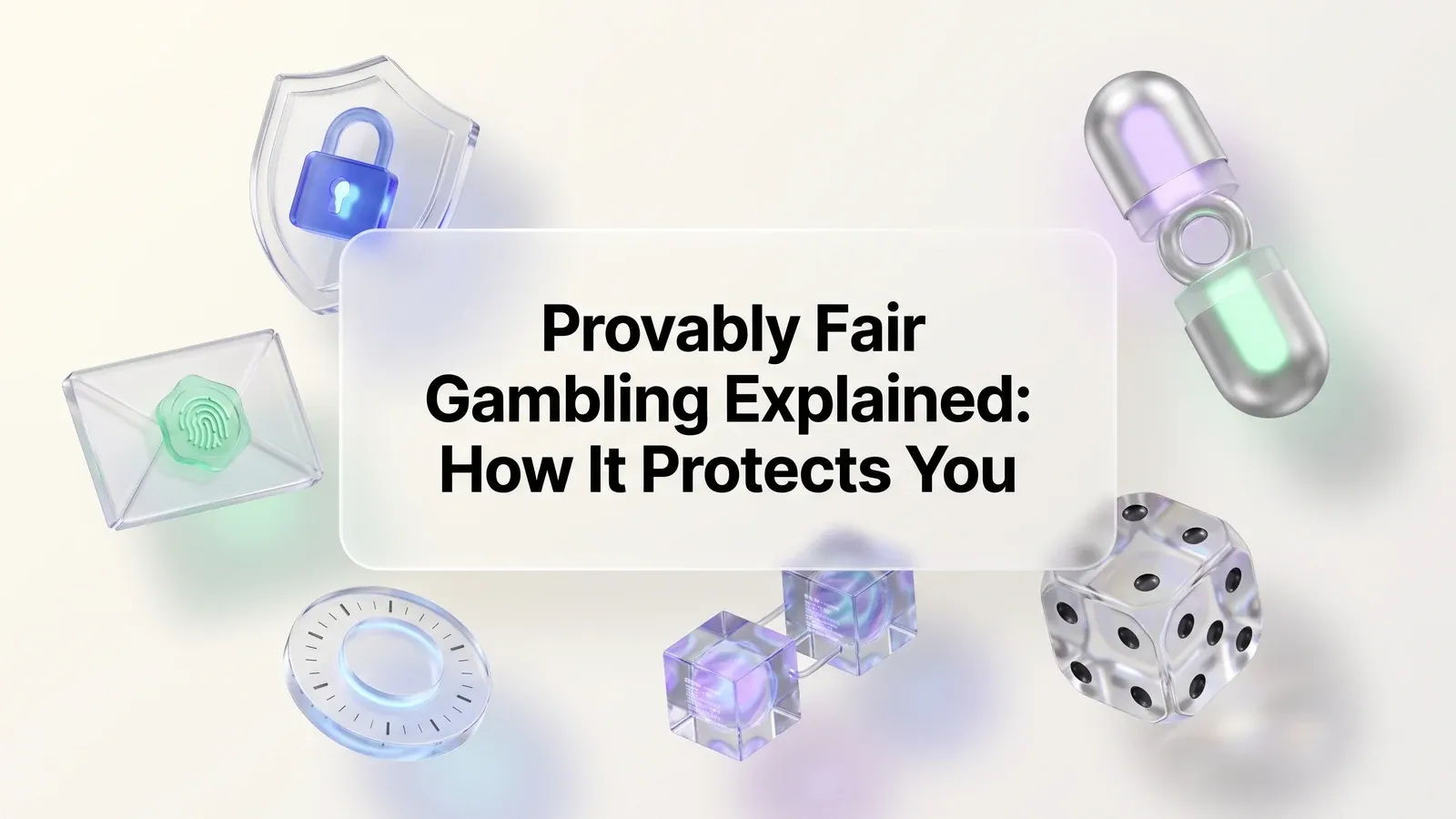
Think of it as a sealed envelope with a digital fingerprint on the front. You cannot read the note inside at first. Once the envelope is opened, you can fingerprint the note yourself. If the fingerprints match, the casino did not replace that note after seeing your bet.
That is useful. It is also narrow. Provably fair technology can help verify a game calculation. It cannot prove that an entire casino is safe, licensed, solvent, or likely to pay a withdrawal.
What provably fair actually means
A provably fair game gives players enough information to reproduce a result. The platform commits to a secret value before the round. It later reveals that value. The player can check the commitment and repeat the published calculation.
The process is deterministic. The same inputs should always produce the same output. Change one character and the output changes.
This is different from simply displaying a “fair” badge. A real implementation needs a pre-round commitment, recorded inputs, a disclosed calculation, and a way to verify the final result.
The label also applies at game level. A casino may offer provably fair dice, crash, mines, or card games while using conventional random number generators for its other titles. Never assume the label covers the whole lobby.
What the system proves and what it does not
Provably fair is evidence about a calculation. It is not a universal trust certificate.
What it can help prove
- The revealed server seed matches the hash shown before play.
- The recorded inputs reproduce the same cryptographic output.
- The published mapping produces the displayed game result.
- The committed seed was not replaced after the bet.
- A specific round followed the disclosed process.
What it cannot prove
- The casino will approve or pay your withdrawal.
- The operator is licensed, solvent, or well run.
- The house edge is low or favourable to you.
- The interface and bet history contain no other errors.
- Every game on the platform uses that process.
A verified loss is still a loss. The system does not remove the house edge. It does not turn a negative-expectation game into an investment.
The four building blocks
Most implementations use four important inputs or tools. Names and formulas vary. Their jobs are usually similar.
Server seed
The server seed is a secret value created by the operator. The casino does not reveal it before play. Revealing it too early could let players calculate future outcomes.
Instead, the casino publishes a hash of the seed. This hash acts as the commitment. When the seed is retired, the original value is revealed. Players can hash it and compare the result with the earlier commitment.
Client seed
The client seed is a player-side input. A site may generate it automatically. Better implementations also let you inspect or change it.
The client seed reduces the operator's unilateral control over the final input. That only matters if the published algorithm actually uses it. A text box alone proves nothing.
Nonce
A nonce is usually a round counter. It may start at zero and increase after every bet.
Without a changing value, the same server seed and client seed would create the same output again. The nonce makes each round distinct. It also helps you match a calculation to a specific entry in your bet history.
Hash and HMAC
A cryptographic hash turns an input into a fixed-length string. It is designed to be one-way. You can hash a revealed seed and compare it with an earlier hash. You should not be able to recover the secret seed from the hash alone.
A hash is not encryption. Encryption is designed to be reversed with the correct key. Hashing is used here as a commitment.
Many games also use HMAC. HMAC combines a cryptographic hash with a secret key. One common design uses the server seed as the key, then uses the client seed and nonce as the message. The exact order, punctuation, encoding, and algorithm all matter.
NIST documents the technical foundations. See the Secure Hash Standard and the HMAC specification. A casino still needs to disclose how it uses those tools.
How a provably fair round works
A typical round follows this sequence:
- The casino creates a secret server seed.
- It shows you a hash of that seed before play.
- A client seed is selected.
- A nonce identifies the round.
- The published function combines those inputs.
- The resulting digest is mapped to a game result.
- The server seed is later retired and revealed.
- You reproduce the hash, digest, and result.
The commitment check is only the first half. Matching the revealed seed to the earlier hash shows that the seed did not change. It does not yet show that the game converted the inputs into the correct result.
You must also check the calculation and the result mapping.
A worked toy example
Here is a small teaching example. It uses SHA-256 and HMAC-SHA256. It is not a universal casino formula.
Suppose the inputs are:
- Server seed:
guru-server-seed-2026 - Client seed:
player-seed-42 - Nonce:
7 - HMAC message:
player-seed-42:7
Before play, the casino would show this SHA-256 commitment:
e491dbd2eb3aa6b55af544bba16bff1ae5348b87fdff2b69e2371d8f445c2017
After the seed is revealed, hashing guru-server-seed-2026 should produce that exact value. If it does not, the commitment check fails.
Using the server seed as the HMAC key and player-seed-42:7 as the message produces this digest:
acce043ed3cbefd6ca89f0dd8ff88d021adc3ec19766860735eb6e04223dc678
That digest is not yet a dice roll, card, or crash multiplier. The game needs a published rule that converts selected bytes into a result. You must follow that rule exactly.
Real platforms may use different algorithms. They may arrange inputs differently. They may add cursors, round identifiers, or multiple nonces. Always follow the documentation for the game you are checking.
How a digest becomes a game result
This is where many shallow explanations stop too early.
A digest is a long string of bytes. A game must transform some of those bytes into a usable result.
A dice game might convert bytes into a number within a fixed range. A crash game might convert a large integer into a multiplier. A mines game might use repeated outputs to place hazards. A card game might use them to create a deterministic shuffle.
Slots can be more complicated. The system may need to select reel stops, symbols, paylines, bonus triggers, and payouts. A visible seed commitment does not explain those rules by itself.
The mapping can also contain the house edge. A result can be honestly calculated and still favour the operator over time. “Provably fair” does not mean “even odds.”
Our Crash games fairness comparison looks more closely at how this issue appears in crash games.
How to verify a real round
Do not stop when the casino's verifier shows a green check mark. A useful check should be reproducible outside the original game screen.
- Save the commitment. Record the server-seed hash shown before the round.
- Record the inputs. Save the client seed, nonce, and any cursor or round identifier.
- Reveal the server seed. This usually happens after you rotate to a new seed pair.
- Hash the revealed seed. Confirm that it matches the original commitment.
- Recreate the digest. Use the exact algorithm, key, message order, separators, and encoding.
- Apply the mapping. Convert the digest into the game result with the published formula.
- Check the bet history. Confirm that the reproduced result matches the recorded round.
- Repeat the test. Check more than one nonce when practical.
An operator-provided verifier is convenient. An independent script is stronger. Open code is easier to inspect than a black-box form that accepts only a bet ID.
For a more practical walkthrough, read our provably fair game verification guide.
Provably fair systems and certified RNGs
Provably fair technology is often presented as the opposite of conventional casino randomness. That comparison is too simple.
A provably fair system gives the player round-level reproducibility. You can take known inputs and repeat a published calculation.
A conventional random number generator may be tested by an independent laboratory. Regulators may also require controls around software changes, logging, access, and game behaviour. Players usually cannot reproduce each round from seeds. The oversight sits elsewhere.
These models answer different questions.
Provably fair asks: “Can I reproduce this result from committed inputs?”
Independent testing asks: “Was this system examined for correct implementation and expected statistical behaviour?”
A strong operator may use transparent verification, external testing, and regulatory oversight together. None of them should be treated as a substitute for the others.
Red flags in weak implementations
Some casinos use cryptographic language as decoration. Look for the details.
Be cautious when:
- no server-seed hash is visible before play;
- the original server seed is never revealed;
- the client seed cannot be inspected;
- bet history omits the nonce;
- the algorithm is not published;
- the result-mapping formula is missing;
- the verifier accepts only an internal bet ID;
- the explanation talks about blockchain without showing reproducible inputs;
- every check depends on a tool controlled by the operator.
Complex documentation is not proof of fraud. Missing inputs are still a problem. If an ordinary player cannot reproduce the calculation, the claim has limited practical value.
Use proof without confusing it with protection
Provably fair gambling can answer a useful question. Did these recorded inputs produce this recorded result under the published rules?
It cannot answer every other question about a casino. It does not confirm licensing. It does not test customer support. It does not guarantee withdrawals. It does not reduce the house edge.
Verify first if the feature matters to you. Check the complete path from commitment to displayed result. Do not increase your stake because a game is provably fair.
Set a budget before you play. Set a time limit too. Stop when the session stops being entertainment.
The best systems do not ask for blind trust. They provide the inputs, publish the rules, and let independent tools reach the same answer.

Diego Morales
Global casino reviewer
Diego pays attention to the stuff players actually notice right away. How fast can you sign up? How easy is it to deposit, especially with crypto? Where are the hidden traps in the bonus offers? And does support actually help when something goes wrong, or do they just send generic replies? He turns complicated bonus rules and legal terms into plain English, so you know what you're agreeing to. He also has a sharp checklist for spotting the usual withdrawal problems like endless verification requests, unclear limits, and rules that aren't properly explained.
Share this article