




Blackjack Basic Strategy Chart: When to Hit, Stand, Double or Split
Use our blackjack basic strategy chart for hard hands, soft hands and pairs. Learn when to hit, stand, double, split or surrender and how table rules work.

Share this article
Key Takeaways
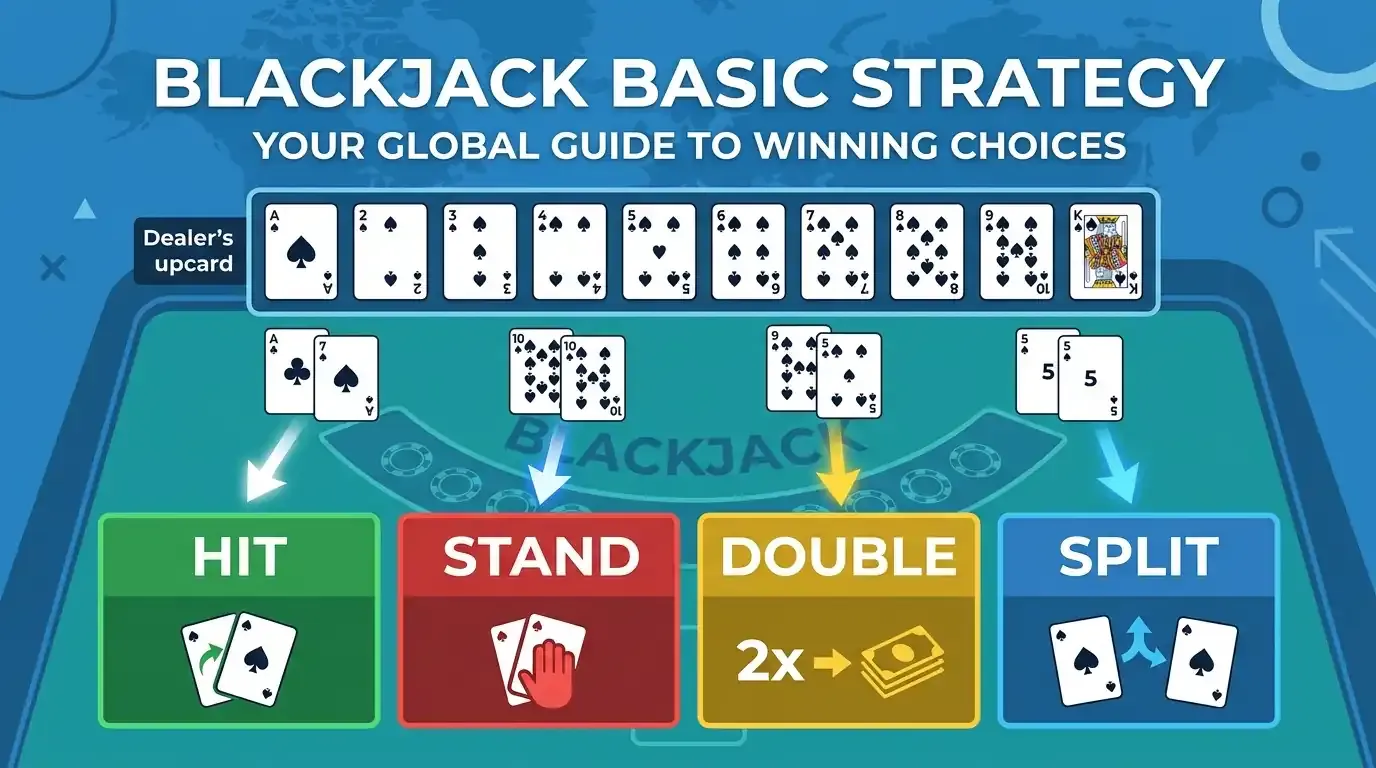
- Basic strategy is rule-specific. The chart above assumes 4 to 8 decks, S17, DAS and late surrender.
- Always split aces and eights. Never split tens or fives.
- A dealer 2 through 6 is generally weaker, which is why you stand more often with middling totals.
- Blackjack paying 3:2 is substantially better than 6:5.
- Basic strategy reduces mistakes and house edge. It does not guarantee a winning session.
Blackjack Basic Strategy Chart: When to Hit, Stand, Double or Split
Blackjack is one of the few casino games where your decisions genuinely change the house edge.
That does not mean there is a system that guarantees profit. It means there is a mathematically better and worse decision for each combination of your hand and the dealer's visible card.
That decision table is called basic strategy.
There is one catch: no single chart is perfect for every blackjack table. Deck count, whether the dealer hits soft 17, surrender rules and whether you can double after splitting can all change individual decisions.
The chart below uses a common baseline:
- 4 to 8 decks
- dealer stands on soft 17, usually shown as S17
- double after split allowed, or DAS
- late surrender available
- blackjack pays 3:2
If your table uses different rules, check the adjustments further down before following the chart blindly.
You can also browse our Global casino reviews and filter for blackjack if you are comparing where different table games are available.
What the blackjack strategy letters mean
| Code | Action |
|---|---|
| H | Hit |
| S | Stand |
| D | Double if allowed, otherwise hit |
| P | Split |
| R | Surrender if allowed, otherwise follow the normal hit/stand play |
The dealer's card is the upcard, the card you can see.
Hard totals basic strategy chart
A hard hand either contains no ace or contains an ace that must count as 1 to avoid busting.
| Your total | Dealer 2 | 3 | 4 | 5 | 6 | 7 | 8 | 9 | 10 | A |
|---|---|---|---|---|---|---|---|---|---|---|
| 8 or less | H | H | H | H | H | H | H | H | H | H |
| 9 | H | D | D | D | D | H | H | H | H | H |
| 10 | D | D | D | D | D | D | D | D | H | H |
| 11 | D | D | D | D | D | D | D | D | D | H |
| 12 | H | H | S | S | S | H | H | H | H | H |
| 13 to 14 | S | S | S | S | S | H | H | H | H | H |
| 15 | S | S | S | S | S | H | H | H | R | H |
| 16 | S | S | S | S | S | H | H | R | R | R |
| 17 or more | S | S | S | S | S | S | S | S | S | S |
The pattern is easier to remember than the table initially makes it look.
Dealer 2 through 6 are relatively weak upcards. With middling hard totals such as 13 to 16, you normally stand and let the dealer take the risk of drawing.
Against 7 through ace, the dealer starts from a stronger position, so you usually need to hit those same weak totals.
Soft totals basic strategy chart
A soft hand contains an ace currently counted as 11.
For example, A-6 is soft 17. You cannot bust by taking one card because the ace can fall back to 1.
| Your hand | Dealer 2 | 3 | 4 | 5 | 6 | 7 | 8 | 9 | 10 | A |
|---|---|---|---|---|---|---|---|---|---|---|
| A-2 / A-3 | H | H | H | D | D | H | H | H | H | H |
| A-4 / A-5 | H | H | D | D | D | H | H | H | H | H |
| A-6 | H | D | D | D | D | H | H | H | H | H |
| A-7 | S | D | D | D | D | S | S | H | H | H |
| A-8 | S | S | S | S | S | S | S | S | S | S |
| A-9 or better | S | S | S | S | S | S | S | S | S | S |
Soft hands are where beginners often play too cautiously.
Because the ace protects you from busting on the next card, there are several situations where doubling is mathematically stronger than simply standing.
Pair splitting strategy chart
When your first two cards match, you may be allowed to split them into two separate hands.
| Pair | Dealer 2 | 3 | 4 | 5 | 6 | 7 | 8 | 9 | 10 | A |
|---|---|---|---|---|---|---|---|---|---|---|
| 2-2 | P | P | P | P | P | P | H | H | H | H |
| 3-3 | P | P | P | P | P | P | H | H | H | H |
| 4-4 | H | H | H | P | P | H | H | H | H | H |
| 5-5 | D | D | D | D | D | D | D | D | H | H |
| 6-6 | P | P | P | P | P | H | H | H | H | H |
| 7-7 | P | P | P | P | P | P | H | H | H | H |
| 8-8 | P | P | P | P | P | P | P | P | P | P |
| 9-9 | P | P | P | P | P | S | P | P | S | S |
| 10-10 | S | S | S | S | S | S | S | S | S | S |
| A-A | P | P | P | P | P | P | P | P | P | P |
Two rules are worth memorising immediately:
Always split aces and eights. Never split tens or fives.
Splitting aces gives you two chances to start with an ace. Splitting eights turns a horrible hard 16 into two fresh hands.
Tens are already 20, one of the best totals in blackjack. Fives are better treated as a hard 10, which creates strong doubling opportunities.
What changes if the dealer hits soft 17?
Many tables use H17, meaning the dealer must hit A-6 rather than stand.
That changes a handful of decisions in a multi-deck game.
Common H17 adjustments include:
- double 11 against a dealer ace
- double soft 18 against dealer 2
- double soft 19 against dealer 6
- surrender more aggressively against a dealer ace where the table allows it
H17 is also slightly worse for the player than S17.
So before memorising a chart, read the table rules.
Why 3:2 blackjack matters
The payout on a natural blackjack is one of the first things we check.
A standard blackjack pays 3:2. Some tables pay only 6:5.
That seemingly small change is expensive. Under otherwise comparable rules, 6:5 blackjack adds roughly 1.39 percentage points to the house edge compared with 3:2.
We would rather play a slightly less convenient 3:2 table than a flashy 6:5 table with better graphics.
If you are comparing casino products rather than one table, our casino comparison tool lets you look at broader factors such as games, bonuses and payout speed too.
Should you ever take insurance?
For normal basic strategy, no.
Insurance is a separate side bet on the dealer having blackjack when an ace is showing. Without card-counting information, the price is not favourable enough to make it part of standard basic strategy.
The same logic applies to "even money", which is effectively insurance offered when you have blackjack against a dealer ace.
Does basic strategy guarantee you will win?
No.
Basic strategy does not predict the next card, change the shuffle or make the casino lose its edge.
It simply chooses the action with the best expected value from the options available.
You can follow every cell perfectly and still lose a session. You can also make terrible decisions and get lucky for ten minutes.
The difference appears over a large number of hands.
A favourable blackjack table played with correct strategy can have a house edge well below 1%, but the exact number depends on the rules. Changing from S17 to H17, removing double-after-split or paying 6:5 all moves the maths against you.
BitStarz, for example, includes blackjack within a much larger casino catalogue, but the rules inside the exact blackjack game still matter more than the operator name when deciding how to play a hand.
The easiest blackjack strategy to memorise
If the full chart feels overwhelming, start with the structural rules:
- Stand on hard 17 or more.
- Hit hard 11 or less unless the chart gives you a double.
- Stand on hard 13 to 16 against dealer 2 to 6.
- Hit hard 12 against 2 or 3, stand against 4 to 6.
- Always split aces and eights.
- Never split tens or fives.
- Treat 5-5 as hard 10.
- Do not take insurance.
- Check whether the dealer hits or stands on soft 17 before relying on the finer decisions.
That is not a replacement for the full chart, but it gets the basic shape into your head.
Basic strategy still does not make blackjack an investment
Blackjack is unusual because skill affects expected return, but the casino still has the mathematical edge under normal rules.
Set a session budget before you play. Do not increase stakes because you are "due", and do not treat a losing run as something strategy guarantees you will recover.
Our responsible gambling guide covers practical limits and support options worldwide.

Diego Morales
Global Casino Expert
Diego pays attention to the stuff players actually notice right away. How fast can you sign up? How easy is it to deposit, especially with crypto? Where are the hidden traps in the bonus offers? And does support actually help when something goes wrong, or do they just send generic replies? He's good at taking complicated legal terms and casino rules and turning them into plain English. So you know exactly what you're agreeing to. He also has a sharp checklist for spotting the usual withdrawal problems like endless verification requests, unclear limits, and rules that aren't properly explained. His goal is to help players avoid the typical headaches and frustration.
Share this article