Blackjack Rules: How to Play Blackjack for Beginners
Learn blackjack rules step by step: card values, how you win or push, when to hit, stand, double, split or surrender, and the table rules that matter.

Key Takeaways
- The goal is to beat the dealer, not to reach exactly 21. You can win with 18 if the dealer finishes on 17 or busts.
- Number cards keep their face value, Jacks, Queens and Kings are worth 10, and an Ace can count as 1 or 11.
- Table rules matter. A 3:2 blackjack payout is much better than 6:5, and rules such as dealer soft 17, doubling after a split and surrender change the maths.
Blackjack looks more strategic than most casino table games, but the rules themselves are pretty simple. You get a hand, the dealer gets a hand, and your job is to finish as close to 21 as you can without going over.
The big difference is that your decisions matter. Unlike baccarat, where the third-card rules are automatic, blackjack asks you whether to hit, stand, double, split or sometimes surrender. That is why learning the rules first is worth it before you worry about strategy.
How blackjack works
A normal round follows the same basic flow:
- Place your main bet before betting closes.
- You receive two cards. The dealer shows an ‘upcard’ (the card with its face up). The dealer then may deal a second card immediately or later, depending on the table.
- You check your hand and choose whether to ‘hit’ (add another card), ‘stand’ (change nothing), ‘double’ (double your original bet), ‘split’ (if you have two equal cards, you can break them into two separate hands) or surrender if the option is available.
- The dealer completes their hand according to the table's fixed dealer rules.
- Your final hand is compared with the dealer's. Wins are paid, pushes are returned and losing bets are collected.
You are playing against the dealer, not the other people at the table. Another player getting 21 does not make your 20 lose. Your hand only matters against the dealer’s.
Blackjack card values are the easy part
- 2 through 10 are worth their face value.
- Jacks, Queens and Kings are worth 10.
- An Ace can count as 1 or 11, whichever gives you the best legal total.
That last rule creates soft and hard hands. Ace-6 is a soft 17 because the Ace can count as 11 without busting. If you draw a 10, the Ace drops to 1 and the hand becomes a hard 17.
Ten-7 is already a hard 17. If you draw a 5 next, for example, there is no Ace that can change value to rescue the hand.
A blackjack is not the same as any 21
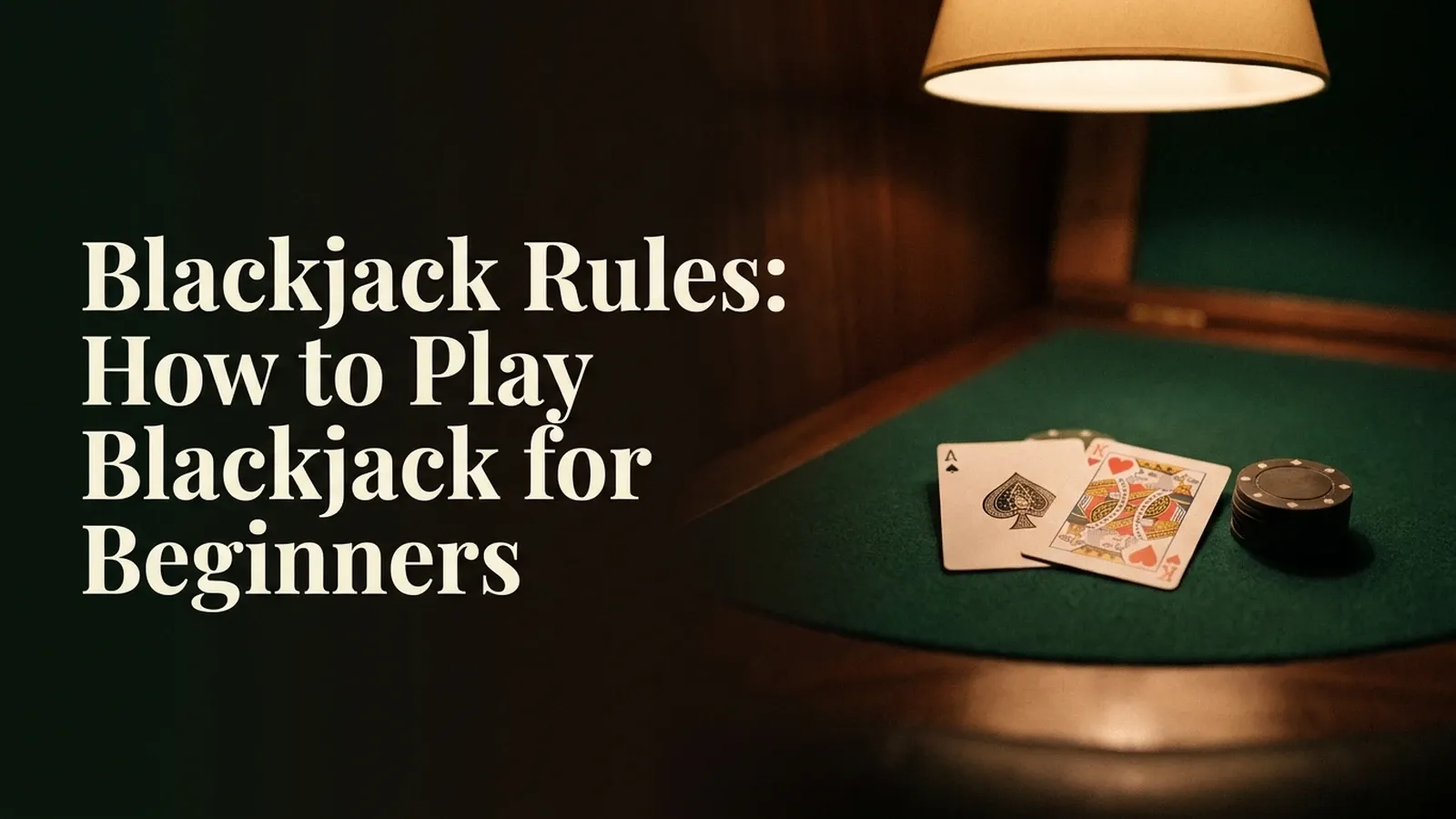
A natural blackjack is an Ace plus any 10-value card in your first two cards. Ace-King and Ace-10 are both blackjacks.
Three cards adding up to 21, such as 7-7-7, are still just 21. That distinction matters because a natural blackjack usually receives a special payout and beats a dealer's multi-card 21.
At a good standard table, blackjack normally pays 3:2. A $10 bet blackjack would therefore return $15 profit plus your original $10 stake. Some tables pay 6:5 instead, which is much worse for the player: on otherwise identical rules, it adds about 1.4% to the house edge, according to Wizard of Odds rule-variation figures. The blackjack payout is one of the first rules worth checking before you sit down.
How you win, lose or push
- You win if your legal hand total is higher than the dealer's.
- You win if the dealer busts and you have not already busted.
- You lose immediately if your hand goes over 21, even if the dealer later busts.
- You lose if the dealer finishes with a higher legal total.
- You push if you and the dealer finish with the same qualifying total. Your main bet is normally returned.
Natural blackjacks have their own settlement priority. If both you and the dealer have blackjack, the result is normally a push. If you have a natural blackjack and the dealer reaches 21 with three or more cards, your blackjack wins.
What hit, stand, double, split and surrender mean
Hit
Take another card. You can normally keep hitting until you stand or your total goes over 21.
Stand
Keep your current total and take no more cards.
Double
Increase your main wager, usually by an amount equal to your original bet, take exactly one more card and then stand automatically. Some tables restrict which starting totals can be doubled.
Split
If your first two cards are an eligible pair, you can split them into two separate hands by placing a second wager. Each original card starts a new hand and receives another card. Rules for resplitting, split Aces and doubling after a split vary by table.
Surrender
If surrender is offered, you can give up your first two cards and normally lose half of your main bet instead of playing the hand out. It is not available at every table, and the exact timing can differ.
Insurance is a separate side bet
When the dealer shows an Ace, some tables offer insurance. You can normally wager up to half of your main bet, and insurance usually pays 2:1 if the dealer has blackjack.
It sounds protective, but that name is doing a lot of work. For a normal player following basic strategy, insurance is generally a poor bet because the price is worse than the chance that the dealer's hidden card is worth 10. A 2:1 payout needs the dealer to have blackjack at least one time in three to break even, and with an Ace showing it happens less often than that.
The dealer follows fixed rules
The dealer does not decide whether they feel like hitting or standing. The table rules make the decision for them.
A common rule is that the dealer hits 16 or below and stands on 17 or more. The important exception is soft 17, such as Ace-6. Some tables use S17, meaning the dealer stands on soft 17. Others use H17, meaning the dealer hits it. H17 is slightly worse for the player, adding about 0.2% to the house edge.
The dealer's hidden-card procedure can vary too. Some games deal a hole card immediately. Others use a no-hole-card format where the dealer receives or reveals the second card later. That difference matters. In many no-hole-card games, if the dealer turns over blackjack after you have doubled or split, you can lose those extra bets too, unless the table pays 'original bets only'. Check the exact game information rather than assuming every blackjack table works identically.
The table rules that actually change the maths
Two blackjack tables can look almost identical while having slightly different odds. These are the rules that matter most:
- Blackjack payout: 3:2 is much better than 6:5.
- Dealer soft 17: S17 is generally better for the player than H17.
- Doubling rules: More flexible doubling, including double after split, can improve the theoretical return.
- Surrender: Having the option can reduce losses in certain bad situations.
- Number of decks: Single, double, six-deck and eight-deck games all exist. Fewer decks can help in some rule sets, but the rest of the rules still matter.
- Split rules: Resplitting, split-Ace restrictions and double after split can change the best decision.
This is also why blackjack does not have one universal RTP number. The theoretical return depends on the exact table rules and on how well the player makes decisions. You can enter your own table's rules into the Wizard of Odds house edge calculator. If you want a clearer explanation of the difference between RTP and house edge, our RTP and volatility guide covers the underlying maths.
Basic strategy is where blackjack stops being guesswork
Basic strategy is the mathematically strongest normal decision for your hand against the dealer's upcard under a defined set of table rules. It is not a winning system, and it does not remove the house edge. It simply stops you giving more money away through avoidable decisions. With good table rules and perfect basic strategy, the house edge is roughly 0.4% to 0.5%: the Wizard of Odds example game works out at about 0.43%.
The correct chart can change slightly depending on whether the dealer hits soft 17, whether doubling after a split is allowed and whether surrender is available. Our blackjack basic strategy chart uses a clearly stated rule set and shows when to hit, stand, double, split or surrender.
That makes blackjack very different from roulette. In standard roulette, changing from red to a single number changes how often you win and how much you win, but it does not magically remove the built-in house edge. In blackjack, a bad decision can directly make the expected return worse. Our roulette rules guide explains that contrast in more detail.
Common blackjack mistakes beginners make
- Trying to beat other players instead of the dealer.
- Thinking you need exactly 21 to win.
- Treating any 21 as a natural blackjack.
- Ignoring the difference between a 3:2 and 6:5 blackjack payout.
- Taking insurance because it sounds protective rather than because the maths supports it.
- Using a strategy chart without checking whether its table-rule assumptions match your game.
The first three are rules mistakes. The last three are money mistakes. Avoiding both will do more for a beginner than memorising a flashy betting system.
Safer gambling: blackjack's low house edge still favours the casino over time, so set a session budget before you sit down. Our responsible gambling guide covers practical spending limits and worldwide support options.
Frequently asked questions
Does the dealer hit on 17?
On hard 17, the dealer normally stands. Soft 17 is table-specific. An S17 table stands on soft 17, while an H17 table hits it.
What happens if you tie the dealer?
A normal tie is a push and your main stake is returned. A natural blackjack has settlement priority over a multi-card 21, so not every total of 21 is treated identically.
Can an Ace be 1 or 11?
Yes. The Ace automatically takes the value that gives your hand the best legal total. It can switch from 11 to 1 if another card would otherwise make you bust.
How many decks are used in blackjack?
Single-deck, double-deck, six-deck and eight-deck blackjack all exist. Live and online tables are commonly multi-deck, but the exact number is part of the individual game's rules.
Can you win blackjack without 21?
Yes. You only need a better legal result than the dealer. An 18 beats a dealer's 17, and any legal total can win if the dealer busts.

Diego Morales
Global casino reviewer
Diego pays attention to the stuff players actually notice right away. How fast can you sign up? How easy is it to deposit, especially with crypto? Where are the hidden traps in the bonus offers? And does support actually help when something goes wrong, or do they just send generic replies? He turns complicated bonus rules and legal terms into plain English, so you know what you're agreeing to. He also has a sharp checklist for spotting the usual withdrawal problems like endless verification requests, unclear limits, and rules that aren't properly explained.
Share this article