


How to Play Poker: Texas Hold'em Rules for Beginners
Learn Texas Hold'em rules, betting rounds, blinds, hand rankings and side pots, with an example hand and straightforward beginner advice.
Key Takeaways
- In Texas Hold'em, each player gets two private cards and can use any combination of them with five shared cards to make the best five-card hand.
- There are two ways to win a pot: show the strongest hand at the end or make every other player fold before then.
- Learning when to check, call, raise and fold is just as important as knowing which hands beat which. Betting order also changes after the flop.
How to Play Poker: Texas Hold'em Rules for Beginners
Poker has two ways to win. You can show the best five-card hand at the end, or you can bet until everyone else folds. That's why poker is different from a game where you simply wait to see what the cards pay.
The easiest place to start is Texas Hold'em, the version with two private cards for each player and five shared cards in the middle. A hand has four possible betting rounds: preflop, flop, turn and river. Learn who acts first and what each action means, and you can follow a full hand without guessing. The more complicated strategy can come later.
The goal of poker is to win the pot
A pot is the collection of chips players have put into the current hand. You win it by being the last player left after everyone else folds, or by holding the best five-card poker hand at a showdown, when the remaining players reveal their cards.
That second part is easy to miss: you do not have to turn over an amazing hand to win. If you bet and everyone folds, the hand ends and the pot is yours. Bluffing is possible because opponents cannot see your private cards, though a bluff is not automatically a good decision just because it sometimes works.
Standard Texas Hold'em uses a 52-card deck, without jokers, and is usually played with between two and ten people. We'll use no-limit Hold'em here, which allows players to bet up to the chips they have in front of them.
Before the cards: the button, small blind and big blind
Every hand starts with a disc called the dealer button. It identifies the dealer position and determines where the forced bets go. On tables with three or more players, the person immediately to the left of the button puts in the small blind, and the next person puts in the big blind. Those chips start the pot before anyone has seen a card.
Imagine a table with blinds of 1 and 2 chips. The small blind contributes 1, the big blind contributes 2, and then everyone gets two private cards, also called hole cards. The dealer button moves one seat clockwise after each hand, so the positions and blinds rotate around the table.
Before the flop, the first player to act is immediately to the left of the big blind. That player is often called 'under the gun'. The action then continues clockwise. If nobody raises, the big blind can check when the action comes back, because their forced bet already covers the minimum.
Some games also use an ante, an extra forced contribution before the deal. It might be paid by everyone or posted as a big blind ante, depending on the rules. The idea is simply to give players more chips to compete for.
How a hand of Texas Hold'em works
There are four betting rounds if the hand reaches the end. Players make decisions at each stage, and the pot grows as calls, bets and raises are added. A round normally finishes when everyone still in has matched the current bet, or when the remaining players have checked. If only one player remains, the hand stops immediately.
1. Preflop: two private cards
Everyone looks at their own two cards. With a 2-chip big blind, you can fold and give up your hand, call the 2 chips to stay in, or raise to a higher total. You don't have to play every hand. In fact, folding weak starting cards is one of the first sensible habits to learn.
2. Flop: three shared cards
The dealer places three community cards face up in the middle. Everyone still in the hand can use them. A new betting round begins with the first active player to the left of the button, not the player to the left of the big blind as before the flop.
3. Turn: a fourth shared card
One more community card is dealt. There is another betting round, in the same order as after the flop. A pair might become two pair, a draw might complete, or nothing might change. What matters is the best five-card hand that can now be made.
4. River: the fifth and final shared card
The last community card is dealt and the final betting round takes place. If at least two players remain after the betting is settled, the hand goes to showdown. Each player chooses the strongest possible five-card combination from the seven cards available to them: their two hole cards plus the five on the board.
What check, bet, call, raise and fold actually mean
Most beginner mistakes at a poker table are about the action, not which hand is stronger. These are the choices you'll encounter:
- Check: Stay in the hand without adding chips. You can only check when there is no bet for you to match in the current round.
- Bet: Put the first wager into a betting round when nobody has bet yet.
- Call: Match the outstanding bet or raise to stay in the hand.
- Raise: Increase the existing bet. The other players must then call the new total, raise again or fold.
- Fold: Give up your cards and any chips you've already put into the pot. You cannot win that hand afterward.
- All-in: Commit all the chips you have left. That doesn't guarantee a win, and it doesn't let you win chips you never matched.
Here's a small detail that trips people up. With blinds of 1 and 2 chips, the smallest normal opening raise before the flop is to 4 chips total, not 3. If someone raises from 2 to 6, the next full minimum raise is to 10, because the previous raise increased the bet by 4. An all-in for fewer chips can be treated differently under the table's minimum-raise rules.
This is no-limit betting. Pot-limit poker restricts the maximum raise by the pot size, and fixed-limit poker uses set bet increments. The cards may be the same, but the amount you are allowed to risk on each decision changes.
A complete example hand, from first bet to winner
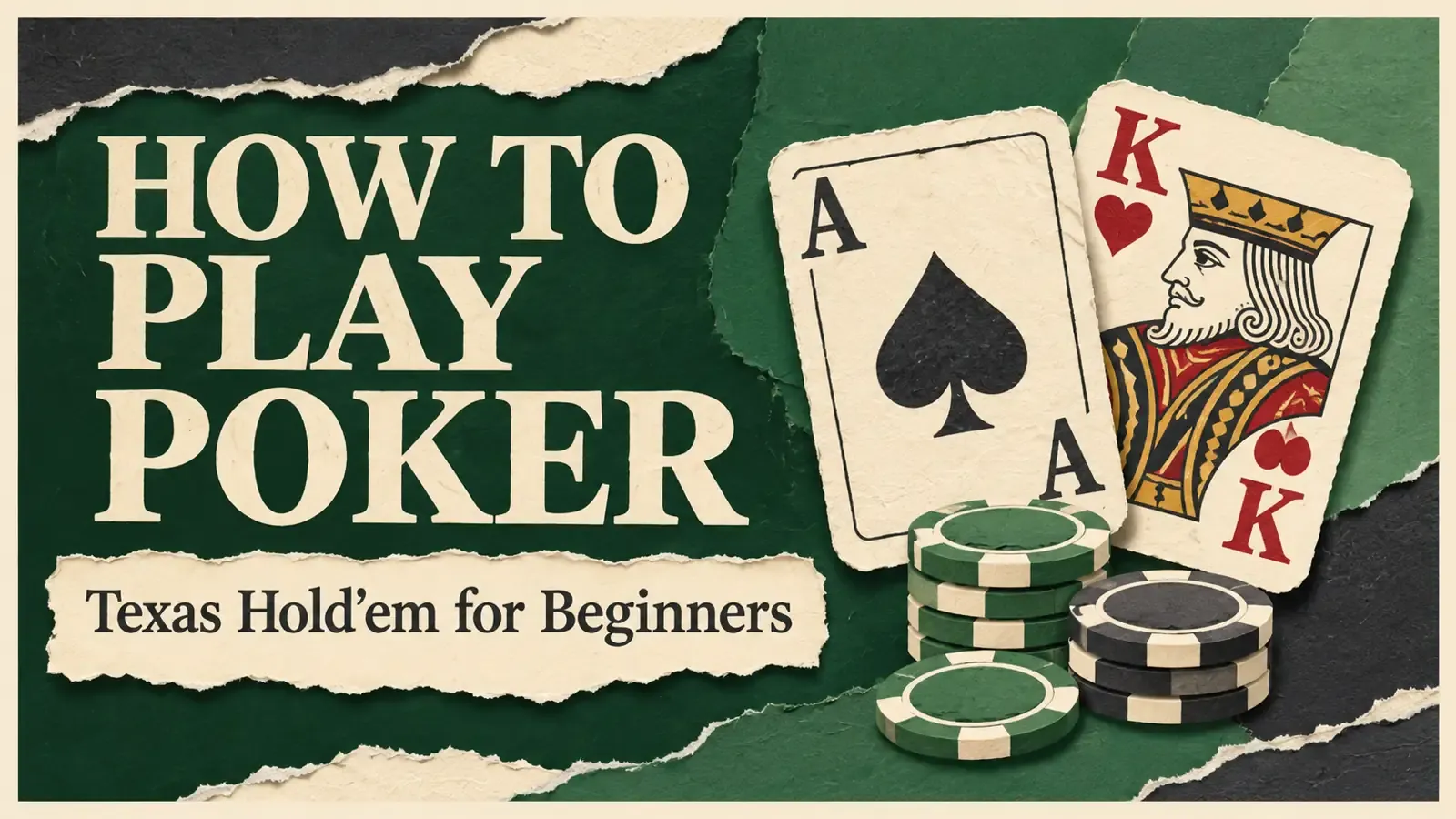
Suppose the blinds are 1 and 2 chips at a six-player table. You're on the button with A♠ K♠. Everyone before you folds. You raise to 6 chips, the small blind folds and the big blind calls another 4 chips with K♥ Q♥. That means you both have 6 chips invested, while the folded small blind's 1 chip stays in the pot.
The flop comes K♦ 9♣ 3♥. The big blind checks, you bet 8 chips and they call. The turn is 7♠, and you both check. The river is 2♦. Your opponent bets 10, you call, and it's time to compare cards.
You both have one pair of kings. But you hold A♠ alongside your king, while the other player has Q♥. Your ace is the highest spare card, known as a kicker, so your pair of kings beats their identical pair of kings. A bigger-looking bet on the river doesn't change which five cards are strongest.
Notice how a player with a perfectly respectable pair still loses. That's normal in poker. The best hand is relative to what your opponents have, not to whether your two cards look strong in isolation.
Which poker hands beat which?
Traditional high poker has ten hand categories. The order below is strongest to weakest. You only need a short version here; our poker hand rankings chart has the full examples, tie rules and printable reference.
- Royal flush: Ace, king, queen, jack and ten, all in one suit.
- Straight flush: Five consecutive cards in the same suit.
- Four of a kind: Four cards of the same rank.
- Full house: Three of one rank plus a pair.
- Flush: Five cards of the same suit, not in sequence.
- Straight: Five consecutive ranks, with suits allowed to differ.
- Three of a kind: Three cards of the same rank.
- Two pair: Two separate pairs.
- One pair: Two cards of the same rank.
- High card: No pair, straight, flush or stronger combination.
A flush beats a straight, and a full house beats a flush. In standard Hold'em, the suits themselves do not outrank one another. An ace can be high, or low in A-2-3-4-5, but a sequence such as Q-K-A-2-3 is not a straight.
You don't have to use both hole cards, either. You may use both, just one, or neither. If the five shared cards are A♣ K♦ Q♥ J♠ 10♣, every player still in has the same ace-high straight and the pot is split. Having an extra ace in your hand doesn't improve that particular straight.
Position matters because acting later gives you more information
The button is powerful because, after the flop, the player on the button usually acts last if they're still in the hand. They can see whether the other players check, bet or raise before making their own decision.
An early-position player has less information. When there are several people still waiting to act, opening a weak hand is usually more awkward than playing that same hand later. Position doesn't change the cards in the deck, but it changes what you know when you decide how many chips to commit.
There is one heads-up exception worth knowing. When only two players are seated, the button posts the small blind and acts first before the flop. After the flop, the big blind acts first and the button acts last.
Beginner poker strategy without the magic tricks
Play fewer weak hands, especially early
You do not get extra credit for seeing more flops. Premium starting hands such as A-A, K-K and A-K are generally easier to play than disconnected low cards, particularly when you have several opponents behind you. A suited hand can be attractive, but two matching suits don't make every starting hand worth a call.
Bet for a reason, not just because you can
A bet can build the pot when you think worse hands will call, or it can make an opponent fold a hand that would otherwise have a chance to win. That's what a bluff tries to do. Against someone who calls almost everything, bluffing repeatedly is a fairly expensive idea.
Understand the price of a call
Suppose 80 chips are in the pot and an opponent bets another 20 on the river. There are now 100 chips in front of you, and calling costs 20 more. If you call, the final pot is 120 chips. Ignoring any room fee, you need to win more than 20 ÷ 120, or about 16.7% of the time, for that call to be profitable in the long run.
That calculation is called pot odds. It doesn't tell you whether your opponent is bluffing or how often your hand wins. You still need a sensible estimate of those chances. But it stops you treating a 20-chip decision the same way whether the pot contains 20 chips or 200.
All-in players and side pots
Going all-in doesn't mean the other players must match a bet larger than their available stacks, and a player with fewer chips doesn't automatically lose. Under the usual table-stakes rules, a player can contest only the portion of the pot covered by their own contribution.
Imagine three players each started the hand with different stack sizes. Player A can commit only 30 chips, while Players B and C each put in 50. The main pot is 90 chips, made up of 30 from each player. The extra 20 from B and 20 from C form a separate 40-chip side pot.
If Player A has the strongest hand, A can win the 90-chip main pot but cannot win the 40-chip side pot. B and C compete for that. It's a common situation in tournaments, and it is much simpler once you see the chips separated.
Cash games, tournaments and other poker variants
In a cash game, your chips have a cash value, and you can generally leave between hands. The blind amounts normally stay the same. Poker rooms typically charge a fee called rake, often taken from pots up to a cap, so even good decisions do not mean every session will be profitable.
In a tournament, you pay an entry fee for a starting stack of tournament chips. The blinds usually rise at scheduled intervals, players are eliminated when they run out of chips, and the prize structure depends on finishing position. If you're new, the rising blinds are worth checking before you enter. A comfortable starting stack can become shallow surprisingly quickly.
The word 'poker' also covers several games with different rules. Omaha gives each player four private cards and requires exactly two of those plus three community cards. Five Card Draw deals five private cards and lets players exchange cards before a final betting round. Seven Card Stud has its own dealing sequence and no five-card community board. Don't use Hold'em's 'any five from seven' rule for Omaha.
And watch the wording at casino tables. Ordinary Texas Hold'em is usually player against player, with the poker room charging a fee. A game advertised as Casino Hold'em is typically played against a dealer under a separate paytable and betting rules. If you're familiar with blackjack rules or with how baccarat's third-card rule works, that's a useful distinction: those games use house-banked payouts and fixed dealing rules, rather than an opponent who can choose to bet, call or fold.
Common poker rules questions
Can you win poker without showing your cards?
Yes. If everyone else folds, the remaining player wins without needing to reveal their hand. If two or more players reach the showdown, the applicable room rules determine how their cards must be shown.
How many cards do you get in Texas Hold'em?
Two private cards per player, plus up to five shared cards on the table. You make the best five-card combination available to you, not a seven-card hand.
Does a player have to call an all-in to stay in the hand?
Not if they don't have enough chips. They can call for their remaining stack and stay eligible for the main pot covered by that amount. Further betting among other players creates a side pot.
The sensible way to learn
Play a few hands with free chips before using real money. Work out who has the button, where the blinds are, which betting round you're on and how many chips it costs to call. If you can explain those four things, the rest of a beginner's hand stops feeling mysterious.
Poker has a skill element, but it also has variance: good decisions can lose and poor decisions sometimes win. Set a playing budget you can afford to lose, choose legal games where you live and don't treat losses as a reason to raise your stakes. Our responsible gambling guidance explains practical limits and where to find help.
Share this article
Related articles
 Casino games
Blackjack Basic Strategy Chart: Hit, Stand, Double or Split by Table Rules

 Casino games
Blackjack Rules: How to Play Blackjack
 Casino games
Crazy Time Strategy Guide: Odds, RTP and What Actually Matters
 Casino games
Provably Fair Gambling Explained: How It Protects You
 Casino games
How to Verify a Provably Fair Bet Step by Step
 Casino games
Why Provably Fair Matters in Instant Games