





Poker Terms Explained: A Practical Glossary for Beginners
Learn poker terms from three-bets and blinds to pot odds, GTO, equity and ICM, with easy examples and a practical alphabetical glossary.

Key Takeaways
- Most poker slang falls into a few groups: betting actions, seat positions, hand strength, odds and tournament stuff. Learn those and a hand history stops reading like code.
- A three-bet is a re-raise, not three times the bet. Under the gun acts first preflop, while the button usually gets to act last after the flop.
- Pot odds are the price of a call, and equity is your share of the pot. Once you get the difference, most poker decisions start making sense.
Poker players can make a completely ordinary hand sound like rocket science. 'UTG opens, the button three-bets and the big blind cold-calls' just means one player raised, another re-raised and a third called without having put any money in voluntarily before that.
It gets a lot easier once you know three things: who's acting, which cards are out there and what a decision costs. This glossary sticks mostly to Texas Hold'em, since that's the game most people learn first, and flags the tournament and Omaha differences where they matter.
How a poker hand sounds when you understand the words
Here's a typical hand description: 'UTG raises to 3 BB. The button three-bets to 9 BB and UTG calls. On a K♣ 7♦ 2♠ flop, UTG checks, the button c-bets and UTG check-raises.'
In plain English: the first player to act raises before any shared cards come out. The button raises again, and the first player calls. Then the first three community cards land. The first player checks, the button bets, and the first player comes back over the top with a raise. Nothing unusual happened there. It's a normal hand, just squashed into poker shorthand.
If it's the cards themselves you're unsure about, our poker hand rankings chart explains what beats what, including kickers and tied hands.
Poker terms A to C
Action: The betting and decisions in a hand, or the player's turn to act. 'Action is on you' means it's your turn, and the table's waiting for you.
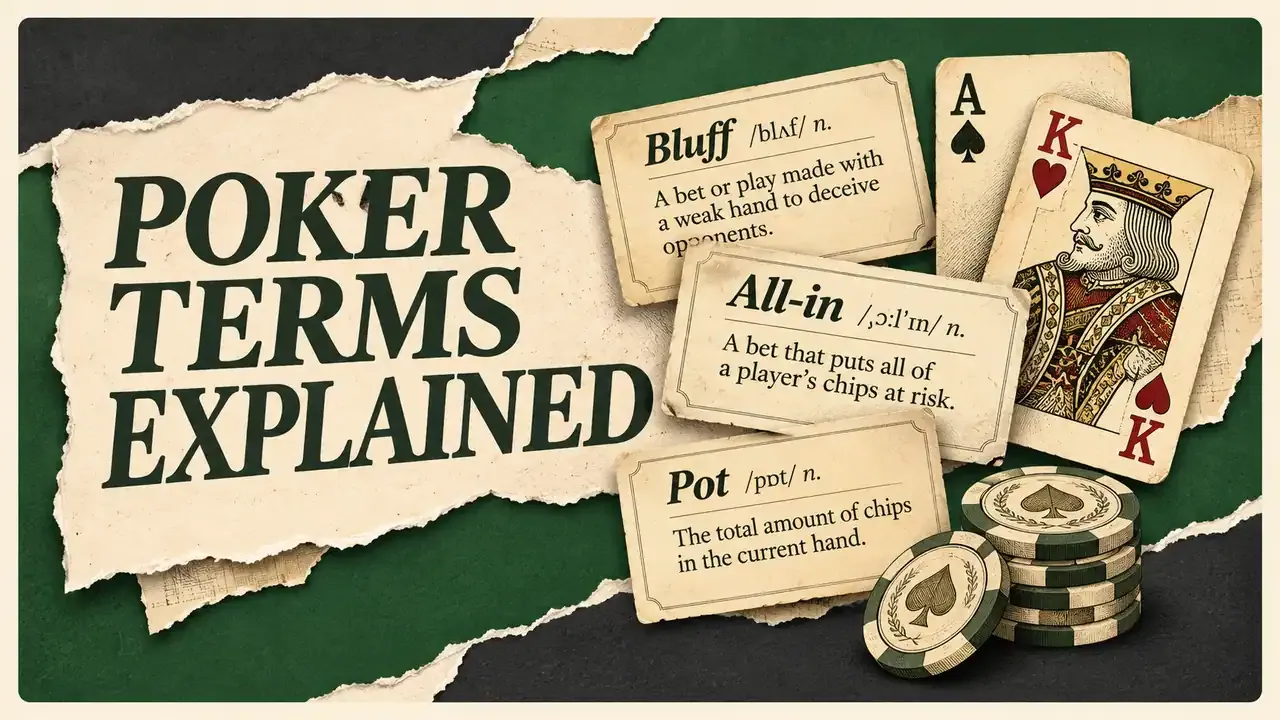
All-in: Putting every chip you have left into the pot. You can't bet more than what's in front of you, however big the other stack is.
Ante: A forced contribution before the deal. Tournament formats may use a big blind ante rather than a separate payment from every player.
Bad beat: Losing with a hand that was a big favourite until a later card ruined it. Every poker player has a story about one, and most will tell you it whether you ask or not.
Bankroll: The money you've set aside for poker overall, not just what you bring to one session.
Barrel: A bet on a later street after betting an earlier one. A second barrel generally means betting the turn after the flop.
Big blind (BB): The larger of the usual two forced bets. It is also the standard unit used to measure raises and stack sizes.
Blocker: A card you hold that removes possible combinations from an opponent's hand range. Holding the ace of hearts stops anyone else holding that card.
Bluff: Betting or raising to make a better hand fold. It only pays off if people fold often enough, which is why bluffing a player who calls everything is a fast way to lose chips.
Board: The shared community cards dealt face up in games such as Texas Hold'em and Omaha.
Bounty: An extra prize for eliminating another player in certain tournaments. The amount and payout method vary by format.
Bubble: The point just before a tournament starts paying out. One more elimination and everyone left is in the money, which is why play often gets very tight here.
Button (BTN): The dealer position, marked by a disc. It usually acts last after the flop, so you get to see what everyone else does first. That's why it's the best seat at the table.
Buy-in: The amount paid to enter a cash game or tournament. Tournament buy-ins may include an entry fee as well as a prize-pool contribution.
Call: Matching the current bet or raise to remain in the hand.
Cash game: Poker with chips representing money, usually with fixed blind levels and the option to leave between hands.
Check: Passing the action without making a bet when there is no outstanding wager you must call.
Check-raise: Checking, then raising after an opponent bets and the action returns to you on the same street.
Chop: Splitting a pot between equally ranked hands or in another permitted split arrangement.
Cold call: Calling a raise without having made a voluntary bet or raise on that street, rather than re-raising.
Continuation bet (c-bet): A bet by the previous betting round's aggressor, especially the preflop raiser betting on the flop.
Counterfeit: When a shared card makes an earlier part of your hand less useful, often by putting a higher pair on the board.
Cutoff (CO): The seat immediately to the right of the dealer button, generally a useful late position.
Poker terms D to H
Donk bet: A bet made out of position by a player who was not the previous street's aggressor. The big blind leading the flop after calling a preflop raise is a common example.
Draw: A hand that needs one or more further cards to make a stronger combination, such as a flush.
Drawing dead: Having no card remaining that could give you the winning hand against the opponent's actual holding.
Dry board: A set of community cards with relatively few obvious straight or flush draws, such as K♣ 7♦ 2♠.
Effective stack: The smaller stack available to be contested between opponents. If you have 200 chips and the other player has 60, you're really only playing for 60, because that's all they can match.
Equity: Your mathematical share of the pot over possible card outcomes, including ties. It's not money you've already won, however good your hand looks.
Expected value (EV): The average gain or loss a decision would produce over many comparable situations. A good decision can still lose, and a bad one can still win. EV tells you which was which over time.
Flat call: Calling rather than raising when a raise is available.
Flop: The first three community cards dealt together in Texas Hold'em and Omaha.
Fold: Giving up your hand. Whatever you've already put in the pot stays there.
Fold equity: The value of a bet coming from the possibility that your opponents fold, separate from the chance of winning when called.
Four-bet (4-bet): The re-raise after a three-bet. It is not a bet equal to exactly four big blinds.
Game theory optimal (GTO): A mathematically balanced strategy that's hard for opponents to exploit, at least within the model it's built on. It isn't a guarantee of profit, and against weaker players, exploiting their mistakes usually wins more.
Gutshot: A straight draw that needs one missing rank in the middle, such as 6-7-9-10 needing an eight.
Hand range: All the different hands an opponent could reasonably hold based on their actions, position and the board.
Heads-up: A hand with just two players. At a two-player table, the button posts the small blind and acts first preflop.
Hero call: Calling with a weak or medium-strength hand because you're convinced the other player is bluffing. Feels amazing when you're right.
Hijack (HJ): The seat two positions to the right of the button, just before the cutoff.
Hole cards: Private cards dealt to a player. Hold'em gives two; Omaha typically gives four and requires exactly two for the final hand.
Poker terms I to P
Independent Chip Model (ICM): A tournament model estimating how different chip stacks translate into possible prize-money outcomes. A tournament chip is not worth a fixed cash amount.
Implied odds: Extra chips you might win from an opponent on later streets if you complete your draw.
In position (IP): Acting after an opponent, allowing you to see their decision before making yours.
Kicker: A side card used to separate hands with the same main rank. A pair of kings with an ace kicker can beat the same pair with a queen kicker.
Limp: Entering the pot by calling the big blind before anyone has raised.
Muck: Discarding a hand without showing it where the rules permit. Once you muck, you've generally given up any claim to the pot, so don't do it too early at showdown.
Multiway pot: A pot still being contested by at least three players.
No-limit: A betting structure allowing wagers up to your available chips, subject to minimum-bet and raise requirements.
Nuts: The strongest possible hand on the current board. The nuts can change when a new card arrives.
Open-ended straight draw: Four connected ranks that can complete a straight at either end, such as 6-7-8-9 needing a five or ten.
Open-raise: The first voluntary raise preflop, rather than simply calling the big blind.
Out of position (OOP): Acting before an opponent and therefore deciding without knowing their action on that street.
Outs: Unseen cards that could improve your hand to a winner. Be careful, though: some cards that look like outs also help your opponent.
Pocket pair: Two hole cards of the same rank, for example 8♠ 8♦. One matching board card would make a set.
Polarised range: A range consisting mostly of very strong hands and bluffs, with fewer medium-strength hands.
Postflop: Betting and decisions after the first three community cards have been dealt.
Pot odds: The price offered for a call, based on its cost compared with the final pot you are contesting.
Preflop: The betting round after the private cards are dealt but before the flop appears.
Pot odds are much easier with numbers. Say the pot has 100 chips and your opponent bets 50. That's 150 in the middle, and it costs you 50 to call. Call, and the final pot is 200, so you need to win at least 50 ÷ 200 = 25% of the time for the call to break even (ignoring fees and any more betting).
The maths is the easy bit. The hard part is working out whether your hand really wins 25% of the time against what your opponent might have, and that's where ranges, outs, blockers and implied odds come in. They matter a lot more than memorising one formula.
Poker terms R to Z
Rainbow board: A flop showing three different suits, reducing immediate flush-draw possibilities.
Rake: The fee a poker room takes from play, commonly from cash-game pots up to a cap. Tournament entry fees work differently.
Raise: Increasing an existing wager. Players continuing in the hand must call the new total, raise again or fold.
Range: A shorter way of saying hand range, meaning the hands someone might plausibly have.
River: The fifth and last community card, followed by the final betting round.
Runner-runner: Making a hand by receiving helpful cards on both the turn and river, such as a backdoor flush.
Satellite: A tournament where the main prize is entry to another tournament.
Semi-bluff: Betting a hand that is probably not currently strongest but could improve if called.
Set: Three of a kind formed using a pocket pair and one matching board card.
Showdown: The stage where players remaining after final betting reveal the cards required to determine who wins.
Shove: Slang for moving all-in, usually with a bet or raise.
Side pot: A separate pot between players who wagered more than an all-in short stack could match. The short stack cannot win that extra amount.
Slow roll: Deliberately waiting to reveal a clearly winning hand when a reveal is required. It's one of the rudest things you can do at a poker table.
Small blind (SB): The smaller standard forced bet, posted immediately left of the button at tables with three or more players.
SPR (stack-to-pot ratio): The effective stack still available divided by the pot size, often measured on the flop. A 100-chip stack against a 50-chip pot means SPR 2.
Squeeze play: A re-raise after one player has raised and one or more have called, applying pressure to several players.
Stack: The chips available to a player. Your stack may be larger than the effective stack against a shorter opponent.
Straddle: An optional blind bet before the deal, usually in a cash game. It increases the stakes, and table-specific rules decide how it works.
Street: One stage of betting. In Hold'em there are normally four: preflop, flop, turn and river.
String bet: Attempting a bet or raise using separate motions without clearly announcing the intended amount. House rules may rule it a smaller action.
Suited connectors: Two consecutive hole-card ranks of the same suit, such as 9♥ 10♥. They can make straights and flushes, but they're nowhere near as strong as they look.
Three-bet (3-bet): A re-raise. Preflop the big blind is the first bet, the opening raise is the second, and the re-raise is the third.
Tilt: Playing worse because of frustration, anger or excitement, often right after a painful loss. Everyone does it. Good players notice and take a break.
Tournament: A poker competition using tournament chips and a defined prize structure, rather than cash-game chips with fixed money values.
Trips: Three of a kind made using one hole card plus a matching pair visible on the board.
Turn: The fourth community card, with another betting round after it.
Under the gun (UTG): The seat directly left of the big blind on a table with three or more players, acting first preflop.
Value bet: A bet made because weaker hands may call often enough to make it profitable.
Variance: Swings in results around the expected average. Even good play can lose over and over in the short term, which is why you need a bankroll that can ride it out.
Wet board: Shared cards with many possible straight or flush draws, such as J♥ 10♥ 9♣.
Four poker phrases that are easy to mix up
Three-bet isn't three times the stake
With blinds of 1 and 2, one player raises to 6. Another player makes it 18. The first is an open-raise and the second is a three-bet. Raise again and it's a four-bet. The names count raises, not multiples of the big blind, which trips up a lot of new players.
A set and trips are equally strong, but don't look the same
With 8♠ 8♦ in your hand and an 8♥ on the board, you have a set. With A♠ 8♦ in your hand and 8♥ 8♣ on the board, you have trips. Both are three eights, but in the second case everyone can see the pair on the board, so they're much more alert to you having trips. A set is far better hidden, and that's why players love flopping one.
Effective stacks matter more than who has the most chips
If you have 200 chips and your opponent has 50, you can't win 200 from them in one pot. The most you can win from them is their 50. When three or more players are in with different stack sizes, side pots sort out who can win what.
ICM is different from equity in a hand
Equity is your share of one pot. ICM is about what your tournament chips are worth in real prize money. Near the bubble, going all-in can cost you far more in prize money than the same call would cost in a cash game, because busting out there means walking away with nothing.
Poker vocabulary isn't interchangeable with casino-game terminology
Poker is different from most casino games because you're playing against other people, not the house. The room makes its money from a fee, not from a payout table stacked in its favour. Our blackjack basic strategy chart shows the other kind of decision-making: there, the dealer follows fixed rules instead of choosing how to play against you.
Same with RTP (return to player). That's a long-run payout percentage for house-banked casino games, and it has nothing to do with your equity against another poker player. Our guide to how RTP and volatility work in casino games explains the difference between a long-run return and the ups and downs of a session.
Live tournament rooms also run things differently from online games or a home table. The Poker Tournament Directors Association publishes tournament standards covering betting order, all-in actions and string raises, but whatever room you're playing in still has the final say.
How to start using these poker terms
Don't try to memorise this whole page before you play. Start with the button, the blinds and who acts when. Then get comfortable with check, call, raise, three-bet and fold. Once you can follow a normal hand without thinking about it, add pot odds, outs, ranges and the set versus trips difference.
Free-chip games are a good place to practise all of this. If you play for money, set a budget you can afford to lose, and remember that even the right decision loses plenty of individual hands.

Diego Morales
Global casino reviewer
Diego pays attention to the stuff players actually notice right away. How fast can you sign up? How easy is it to deposit, especially with crypto? Where are the hidden traps in the bonus offers? And does support actually help when something goes wrong, or do they just send generic replies? He turns complicated bonus rules and legal terms into plain English, so you know what you're agreeing to. He also has a sharp checklist for spotting the usual withdrawal problems like endless verification requests, unclear limits, and rules that aren't properly explained.
Share this article
Related articles
 Casino games
Mines Casino Game Explained: Rules, Odds and Strategy

 Casino games
Roulette Strategy: What Works, What Doesn't and the Real Odds
 Casino games
How to Play Poker: Texas Hold'em Rules for Beginners
 Casino games
Blackjack Basic Strategy Chart: Hit, Stand, Double or Split by Table Rules
 Casino games
Blackjack Rules: How to Play Blackjack
 Casino games
Crazy Time Strategy Guide: Odds, RTP and What Actually Matters