





Mines Casino Game Explained: Rules, Odds and Strategy
Learn Mines rules, calculate safe-tile odds and multipliers, compare RTPs and see why no clicking pattern or betting system beats the house edge.

Key Takeaways
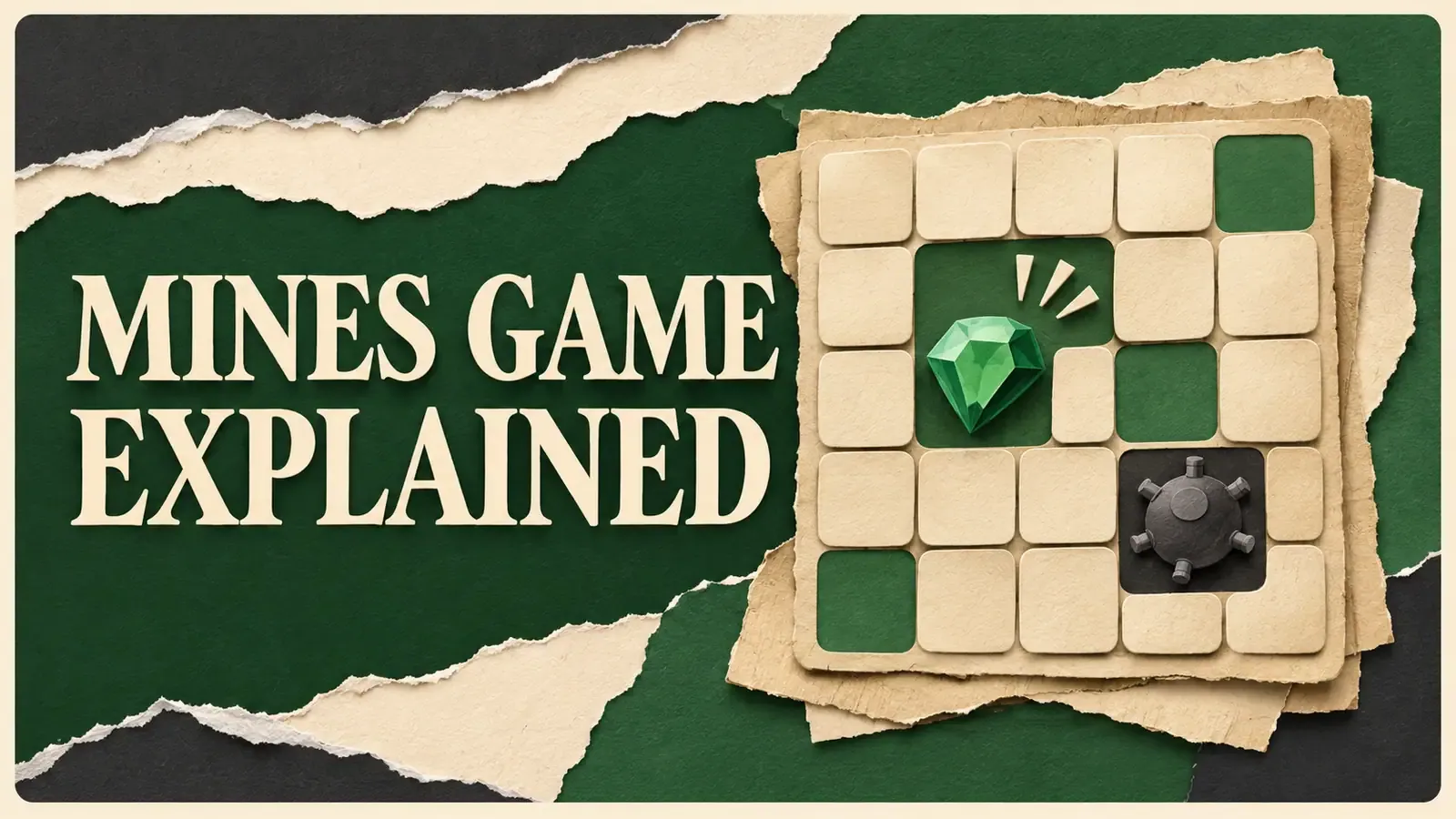
- Mines is simple: pick tiles, hope for gems and cash out before you hit a mine. On the usual 25-tile board, every gem pushes your multiplier up, and one mine takes the whole stake for that round.
- With three mines, your first click has an 88% chance of finding a gem. Reaching five safe clicks in the same round has only a 49.57% chance. No corner or tile pattern improves those odds on a properly random board.
- RTP varies between versions. Stake and Shuffle advertise 99% for Mines, while BC.GAME currently displays 98%. Cashing out sooner changes how swingy the game feels, not how much the house keeps.
With three mines hidden on a 25-tile board, your first pick is safe 88% of the time. Five safe picks in a row? Now your chance is just under 50%. And that's really what Mines is about: every safe click makes the payout bigger, but it also puts your whole stake back on the line.
It feels like a puzzle, like you're hunting for the right squares. But on a properly random board there are no clues at all. The only real decisions you make are how many mines to start with, how far to push your luck and when to take the money. Those choices decide how much risk you're taking. None of them gives you a way to beat the game.
How to play Mines, step by step
Most casino Mines games use a 5 by 5 board, so 25 hidden tiles. You pick how many of them are mines, and the rest hide gems (or whatever safe symbol that version uses). Stake and Shuffle both let you choose anywhere from one to 24 mines, though other versions can work differently.
- Choose your stake. That's what you lose if the round goes wrong.
- Choose the number of mines. Three mines leave 22 safe tiles; ten mines leave 15.
- Start the round. The game sets up a hidden board and you start clicking.
- Find a gem. Your multiplier goes up, and now you choose: cash out at that number or risk it on another tile.
- Hit a mine. The round's over and your stake goes with it, along with anything you hadn't cashed out yet.
Say you put $10 on three mines and your first pick is safe. In a 99% RTP model, that's worth roughly 1.13x. Cash out there and you get $11.30 back, but $10 of that was already yours, so the actual profit is $1.30. Keep going and hit a mine, though, and the $10 and the $1.30 you could have taken are both gone.
If you grew up playing Minesweeper, there's one big difference to get your head around. Minesweeper gives you numbers telling you how many mines sit around each square. Casino Mines doesn't. A safe tile tells you that one square was safe, and nothing at all about the tiles next to it.
Mines odds: how likely is a safe first click?
On a fair board, every unopened square is just as likely to hide a mine as any other. So before your first pick, your chance of a gem is simply the number of safe tiles divided by 25.
- 1 mine: 24 safe tiles, or a 96% chance.
- 3 mines: 22 safe tiles, or an 88% chance.
- 5 mines: 20 safe tiles, or an 80% chance.
- 10 mines: 15 safe tiles, or a 60% chance.
- 24 mines: only 1 safe tile, or a 4% chance.
That last one is worth remembering. With 24 mines, your first click loses 96% of the time. The payout is huge because winning is so rare, not because you've found some weak spot in the game.
The next click becomes riskier after each gem
Take a round with three mines. Your first pick is safe 22 times out of 25, so 88%. If it works, you've got 21 gems left among 24 covered squares, and your next pick drops to a 21 in 24 chance, or 87.5%.
Survive that and the third click is 20 safe squares out of 23, about 86.96%. Every gem you find comes off the board, but all three mines are still sitting there.
This is the bit people miss. Separate rounds don't affect each other, but picks inside the same round do, because the mix of gems and mines left on the board changes every time you find a gem. What it doesn't do is tell you anything about where the next mine is, corner or middle.
What about three or five safe clicks in a row?
With three mines, getting to three gems means surviving all three picks, so you multiply the chances together:
22 ÷ 25 × 21 ÷ 24 × 20 ÷ 23 = 66.96%
Push on to five gems with the same three mines and you're down to 49.57%, basically a coin flip. Here's the odd part: five mines and just three gems also comes out at 49.57%. The two runs feel completely different while you're playing, but the maths is identical.
If you like the maths, the general formula for any number of safe picks is C(25 − m, k) ÷ C(25, k), where m is the number of mines, k is the number of successful picks, and C means combinations. You don't need to memorise it. Just remember that every extra gem you aim for makes reaching that cash-out less likely.
How Mines multipliers work
The rarer a result is, the more it has to pay. On many Mines versions with a fixed RTP, the multiplier is worked out by flipping your chance of reaching that many gems upside down (one divided by the probability), then trimming off the house edge.
Theoretical cash-out multiplier = game RTP ÷ survival probability
Take a 99% RTP version and ignore rounding or payout caps for a second. Three mines and three gems gives you a 66.96% chance of surviving, so 0.99 divided by roughly 0.669565 comes out at a 1.48x multiplier.
Here's how that plays out across a few settings:
- 3 mines, 1 gem: 88% chance, about 1.13x.
- 3 mines, 3 gems: 66.96% chance, about 1.48x.
- 3 mines, 5 gems: 49.57% chance, about 2.00x.
- 5 mines, 3 gems: also 49.57% chance and about 2.00x.
- 10 mines, 3 gems: 19.78% chance, about 5.00x.
These are worked examples for a 99% model, not a paytable every casino uses. Real games can round the multiplier, cap the maximum win or run a different RTP altogether. So trust the numbers in the actual game's info panel and bet screen over any generic Mines calculator you find online.
What is the RTP of Mines? It depends on the game
There's no single Mines RTP. It depends on whose version you're playing. Stake's Mines page lists 99% RTP and a 1% house edge. Shuffle's own Mines rules also list 99%. Right now, BC.GAME's Mines listing displays 98% RTP and a 2% house edge. So two boards that look identical can pay you different amounts for exactly the same odds.
RTP stands for return to player. A 99% RTP means that, across a huge number of bets, the game is built to pay back an average of $99 for every $100 wagered. It doesn't mean you win 99% of rounds, and it definitely doesn't mean you'll get 99% of your deposit back.
The house edge is the other side of that number: what the casino keeps on average. A 99% RTP means a 1% house edge, and 98% means 2%. Our guide to how RTP differs from volatility explains why the average return and the actual experience of playing can look very different.
One extreme example makes the house edge obvious
Picture a board with 24 mines and one gem. You've got a 1 in 25 chance of picking it. With no house edge, a fair payout would be 25x. Take off a 1% edge and it pays 24.75x instead.
Bet $10 and find that one gem, and you receive $247.50 including your stake. Find a mine, which happens 96% of the time on a random board, and you lose the $10.
Over lots of rounds, 4% of $247.50 works out to an average return of $9.90 for every $10 you bet. That's a ten-cent expected loss per round. It says nothing about whether you'll hit on your next click, but it does show how a game can have a massive multiplier and a high RTP and still be quietly tilted towards the casino.
Going down to one mine instead of 24 gets you far more small cash-outs, but if the game uses the same RTP at every mine count, your expected return doesn't improve at all. What changes is volatility, meaning how wildly your results swing around that average.
Can a Mines strategy improve your chances?
Not by picking better squares, no. A random Mines board isn't a puzzle you can solve. There are no clues from neighbouring tiles, no lucky corners, and the bottom-left tile isn't any safer just because it paid out last time.
The choices that do matter are about how much risk you take on and how much money you put through the game, not about finding hidden information.
Lower mine counts mean smaller wins more often
A board with one mine gives you a 96% chance of a safe opening click, while ten mines gives you only 60%. That makes the low-mine board feel a lot friendlier, but you pay for it with much smaller multipliers on every click.
There's no secret best number of mines. Pick based on how much swing you're comfortable with, not on someone's claim that one setting beats the maths.
Cashing out earlier is a risk decision
Aim for one gem and you'll cash out far more often than if you insist on five. You just get a smaller multiplier for it.
On the usual fixed-RTP model, though, neither target changes the game's overall return. One gets you frequent small wins, the other gets you rarer, bigger ones.
There's still a good reason to decide your target before you start: that next multiplier always looks tempting, and it's easy to keep clicking. A stopping point you set in advance keeps a round from turning into an impulsive chase. It won't make the game profitable, though.
Doubling your bet does not locate a mine
The Martingale system says double your stake after every loss. That changes how much money you're risking, but it does nothing to the odds on the tiles.
Start with one unit and lose six in a row: 1, 2, 4, 8, 16 and 32. That's 63 units gone, and the system now wants you to bet 64 just to finish one unit ahead. A bad enough run will wipe out your bankroll or hit the betting limit long before that recovery shows up.
And be just as sceptical of Mines predictor bots. In a properly built provably fair game, there's no way for an outside app to know where the next mines are from your recent results or the board in front of you. Don't hand a predictor your login, wallet access or money for supposedly guaranteed tiles. That's how people get scammed.
What provably fair Mines actually proves
A lot of crypto casino versions of Mines are provably fair, meaning you can check the result yourself afterwards. The usual setup works like this: before you play, the casino locks in a secret server seed by publishing a scrambled fingerprint of it (a cryptographic hash). Your client seed and a number called a nonce, which changes with each bet, then help generate the board.
Later, once the casino reveals the original server seed, you (or a verifier tool) can check it matches that fingerprint and rebuild the exact mine layout using the published algorithm. Stake documents the whole server seed, client seed and nonce process, including the extra values it uses to place the mines.
That's useful. It lets you check that the mine layout matches what the casino locked in before you placed your bet.
But that's all it proves. Rebuilding a board doesn't show that every possible board was equally likely, that the paytable really pays the advertised RTP, that the casino is properly licensed or that your withdrawal will turn up. It's a consistency check, not a safety certificate for the whole casino.
Our step-by-step guide to verifying a provably fair result explains how to find the relevant seeds and bet data and check the outcome for yourself.
Can you play Mines for free?
Free play is handy for learning the buttons, seeing how the number of mines changes the multipliers and getting a feel for how fast a round can end. It won't teach you a tile pattern that works with real money, because there isn't one.
Whether you can play free depends on the casino. Shuffle lets you play its Mines with a zero stake, while Stake doesn't currently have a separate Mines demo. Other versions all do their own thing, so look for a proper practice mode rather than depositing just to figure out the controls.
What to check before risking real money
The checklist that matters is shorter than most so-called Mines systems:
- Check the exact game. Look at the provider, board size, number of mine options and cash-out rules.
- Read the RTP and paytable. Look for rounding, maximum returns and any special conditions that could affect the displayed multiplier.
- Check the casino separately. Provably fair verification is not a substitute for local legal access, licensing or payment reliability.
- Set a spending and time limit. Rounds are fast, especially on autoplay, and a surprising amount of money can go through the game before you notice.
That last one deserves an example. Bet $2 a round for 500 rounds and you've put $1,000 through the game, even if you only deposited a fraction of that. At a 1% house edge, the expected loss on that is $10. Your real session could end up ahead, or a lot further behind. Our crash-game strategy guide covers why total wagering matters more than the original deposit in similarly fast games.
Plinko uses a different probability structure, but the same rule holds across instant games: know what your risk setting changes, and don't mistake picking your volatility for having an edge over the casino.
Mines casino game FAQs
What is the safest tile in Mines?
There isn't one. On a properly random board, every unopened tile has the same chance of being safe. Corners, the centre and clicking patterns don't change that.
Is one mine the best Mines strategy?
One mine makes the first click safe 96% of the time, but the payout is tiny. If the game uses the same RTP at every mine count, you're not getting a better expected return, just smaller swings.
Does cashing out early increase Mines RTP?
No. On the usual fixed-RTP model, cashing out early just means more frequent, smaller wins. Going for more gems makes the swings bigger, not the average return. Check the payout rules for the exact version you're playing, though.
Are Mines predictor apps legitimate?
No. A predictor can't know a hidden random board from your previous bets or tile patterns. If one asks for your casino login, payment details or wallet access, treat it as a scam.
The bottom line
Mines makes a lot more sense once you stop trying to outguess the squares. More mines and more clicks mean rarer wins and bigger payouts, the odds are easy enough to work out, and the paytable decides how much the casino keeps.
If you play, fix your stake and session limits before you start, treat the money as entertainment spending and stop when you hit either limit. A provably fair board is nice transparency to have, but it still isn't a way to make money.

Diego Morales
Global casino reviewer
Diego pays attention to the stuff players actually notice right away. How fast can you sign up? How easy is it to deposit, especially with crypto? Where are the hidden traps in the bonus offers? And does support actually help when something goes wrong, or do they just send generic replies? He turns complicated bonus rules and legal terms into plain English, so you know what you're agreeing to. He also has a sharp checklist for spotting the usual withdrawal problems like endless verification requests, unclear limits, and rules that aren't properly explained.
Share this article
Related articles
 Casino games
Poker Terms Explained: A Practical Glossary for Beginners

 Casino games
Roulette Strategy: What Works, What Doesn't and the Real Odds
 Casino games
How to Play Poker: Texas Hold'em Rules for Beginners
 Casino games
Blackjack Basic Strategy Chart: Hit, Stand, Double or Split by Table Rules
 Casino games
Blackjack Rules: How to Play Blackjack
 Casino games
Crazy Time Strategy Guide: Odds, RTP and What Actually Matters