




Poker Hand Rankings: What Beats What in Poker
Poker hands ranked from royal flush to high card, with kicker and tie-break rules, real frequency figures, and where Omaha and short deck differ.

Share this article
Key Takeaways
- The ten hands run from royal flush down to high card, ranked purely by how many ways each can be dealt from a 52-card deck.
- A poker hand is always exactly five cards, which is what makes kickers decide pots and what breaks most Omaha beginners.
- Poker counts as gaming rather than betting under the Gambling Regulation Act 2024, so poker rooms serving Irish players hold overseas licences.
Poker hand rankings explained: what beats what
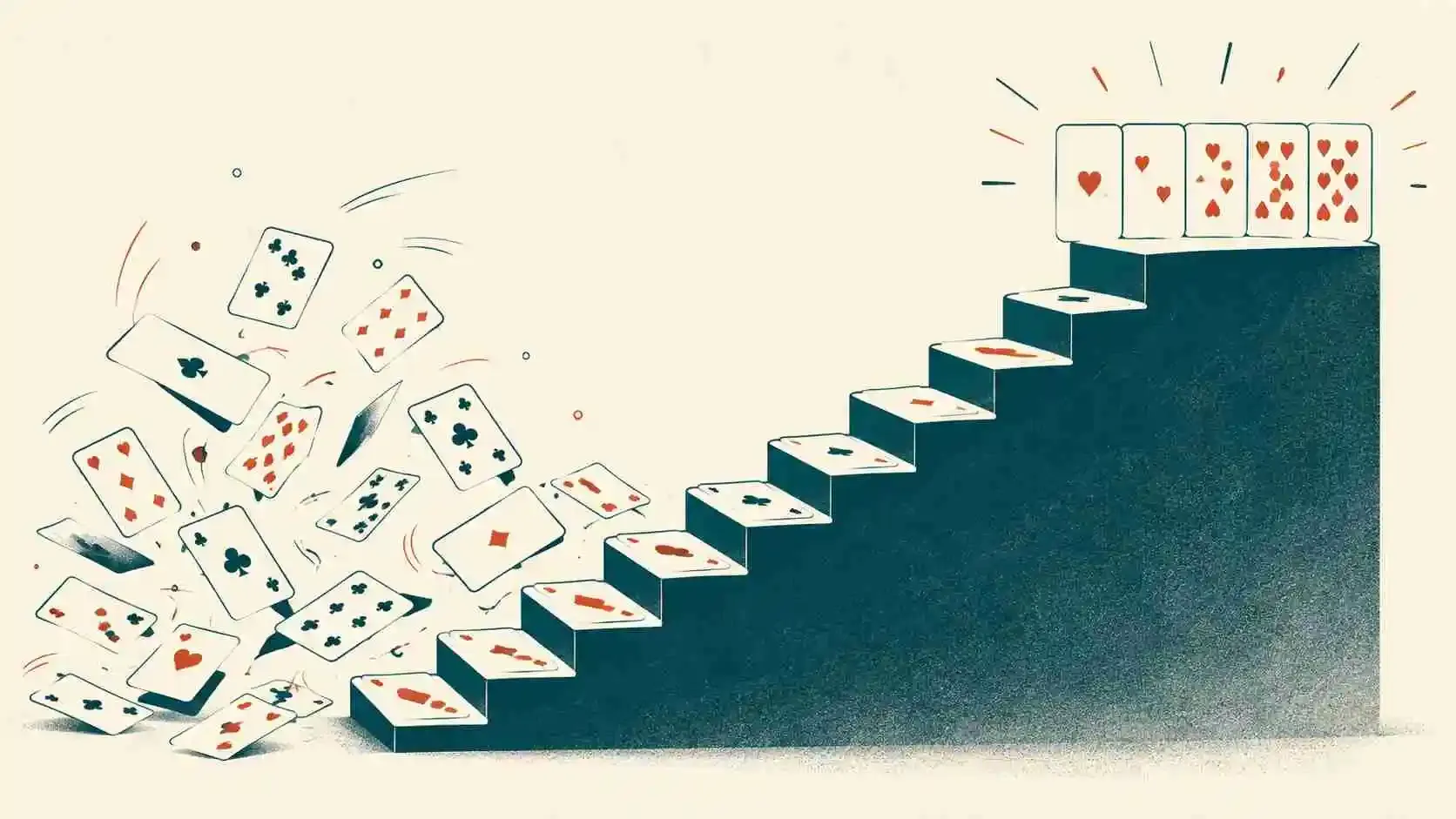
Ten hands, one order, and it almost never changes. A royal flush sits at the top, a high card at the bottom, and everything in between is ranked by how hard the hand is to make.
That part is easy. What actually costs people pots is everything around it: which of two flushes wins, what a kicker really does, when an ace counts as a one, and the Omaha rule that catches nearly everybody the first time they meet it.
Here is the full chart, the tie-break rules, how often each hand genuinely turns up, and the handful of games where the standard order gets rewritten.
The short version
Strongest to weakest:
-
Royal flush. Ace, king, queen, jack and ten, all in the same suit.
-
Straight flush. Five cards in sequence, all the same suit.
-
Four of a kind. Four cards of the same rank. Also called quads.
-
Full house. Three of a kind plus a pair.
-
Flush. Five cards of one suit, in no particular order.
-
Straight. Five cards in sequence, suits mixed.
-
Three of a kind. Three cards of the same rank. Trips, or a set.
-
Two pair. Two pairs of different ranks.
-
One pair. Two cards of the same rank.
-
High card. None of the above, so your highest card plays.
One rule sits underneath all of it: a poker hand is always exactly five cards. Not six, not seven. That single line quietly explains most of what follows.
Why the order runs the way it does
The ranking is not a matter of tradition. It is a straight count of how many ways each hand can be dealt.
There are 2,598,960 possible five-card hands in a 52-card deck. Exactly 10,200 of them are straights and only 5,108 are flushes, so the flush is the rarer hand and it wins. Four of a kind can be built 624 ways against 3,744 for a full house, which is why quads sit higher. Four hands in the whole deck are royal flushes, one per suit.
Worth holding on to, because it is exactly why the order gets rewritten in a couple of games further down. Change the deck or change the number of cards and you change the counting.
How ties get broken
Two rules do most of the heavy lifting here, and both catch people out.
Only five cards count. You see seven cards in Hold'em and nine in Omaha, but the hand is always the best five of them. A sixth card never breaks a tie, no matter how big it is.
Suits do not rank. No suit beats another in poker. Two players holding the same flush split the pot, full stop. Plenty of other card games do rank suits, which is where the confusion comes from, but poker is not one of them.
Inside each category, the tie-breaks run like this:
-
Pairs, trips and quads: the higher rank wins first. Three jacks beat three nines and nothing else gets looked at.
-
The kicker: the highest side card that fills the hand out to five. Say the board reads A-9-6-3-2. You hold A-K and someone else holds A-Q. You both have a pair of aces, but your king plays as the fifth card and their queen does not measure up. The pot is yours. Hold the same kicker and you split it.
-
Two pair: highest pair first, then the second pair, then a single kicker. Kings and threes beats queens and jacks, because the comparison starts at the top and stops as soon as it finds a difference.
-
Full house: the three-card part is compared first. Sevens full of twos beats sixes full of aces, no bother at all, because the pair never gets a look in.
-
Flush: compare the highest card, then the next, and keep going down until they differ.
-
Straight: only the top card matters. A nine-high straight beats an eight-high one.
There is one more that surprises people. If the best five cards available are the five sitting on the table, everybody still in the hand splits the pot. That is called playing the board, and in Hold'em you are never obliged to use either of your own cards.
The five things that trip people up
The ace counts at both ends, but it cannot wrap
Ace, king, queen, jack, ten is the best straight going. Ace, five, four, three, two is also a straight, known as the wheel, except there the ace plays as a one, so the hand is five-high and it is the weakest straight there is.
What is not a straight is king, ace, two, three, four. The ace sits at either end of the run and never in the middle.
A flush beats a straight
Straights feel harder because you are chasing specific ranks, while a flush only asks for a suit. The counting says otherwise: 10,200 straights against 5,108 flushes. Rarer wins.
Three of a kind beats two pair
This one goes the other way to instinct, because two pair uses four useful cards and trips only three. Again, it comes down to frequency. Two pair turns up more than twice as often as trips in a five-card deal, so it ranks below.
A full house is named from the trips down
"Sevens full of twos" means three sevens and a pair of twos, in that order, and that order is exactly how two full houses get compared. Get the naming right and the tie-break stops being a puzzle.
Two pair on the board is not your two pair
When the board itself pairs twice, everyone left in the hand has that two pair. The only thing separating you is the fifth card. A fair few pots get split here that somebody was already counting.
How often each hand actually turns up
These are the odds of finishing with each hand across all seven cards in Hold'em, worked out across every one of the 133,784,560 possible seven-card combinations. In practice you fold most hands long before the river, so read them as the shape of the game rather than a forecast for your night.
-
One pair: 43.8%
-
Two pair: 23.5%
-
High card, nothing at all: 17.4%
-
Three of a kind: 4.8%
-
Straight: 4.6%
-
Flush: 3.0%
-
Full house: 2.6%
-
Four of a kind: 0.17%, or roughly 1 in 595
-
Straight flush: 0.03%, roughly 1 in 3,590
-
Royal flush: 0.003%, roughly 1 in 30,940
Third on that list is the one worth a second look. Ending up with nothing at all is rarer than ending up with two pair. Seven cards is plenty for a pair to be the normal result and no pair to be the odd one out, which is precisely why a bare pair wins far fewer pots than a beginner expects it to.
There is a small oddity further down, too. Three of a kind shows up slightly more often than a straight over seven cards, yet the straight ranks higher. That is not an error. The ranking order is fixed by five-card frequencies, where a straight is genuinely the rarer hand, and the seven-card picture does not rewrite it.
Where the rankings change: Omaha, short deck and three card poker
The chart above holds for Texas Hold'em, five card draw, seven card stud and most of what you will meet. Four situations break it, and three of them break it in ways that are easy to walk into.
Omaha: the hands are the same, the building rule is not
Omaha uses the identical ranking chart. What changes is how you are allowed to assemble a hand: exactly two of your four hole cards, and exactly three from the board. Always both, always exactly.
So four hearts in your hand is not a flush and never will be, whatever the board does. Four hearts on the board plus one in your hand is not a flush either, because you have to bring two. This catches almost everyone once, and usually for money.
Short deck: the flush jumps the full house
Short deck, also sold as six-plus Hold'em, strips the twos through fives out and leaves a 36-card deck. Nine cards to a suit instead of thirteen makes a flush considerably harder to hit, while a full house gets easier, so the two swap places and a flush beats a full house.
Whether three of a kind beats a straight in short deck varies between operators. Read the table rules rather than assuming, because both versions are in circulation.
Three card poker: the straight jumps the flush
With only three cards to work with, the maths inverts. Out of 22,100 possible three-card hands there are 1,096 flushes and only 720 straights, so a straight beats a flush, and three of a kind beats the pair of them. Same principle as the main chart, different arithmetic.
Lowball: the chart upside down
Razz, and the low half of a hi-lo split game like Omaha Hi-Lo, hand the pot to the worst hand rather than the best. Which hands qualify as a low differs from game to game, so that is one to read at the table rather than carry in from elsewhere.
Where poker sits in Irish law right now
This is worth being precise about, because poker sits on a different side of a line that most coverage does not notice is there.
The Gambling Regulation Act 2024 defines a game as one of skill or chance, or partly of each, where a participant makes a payment and can win a prize of money or money's worth. Poker fits that squarely. Under Irish law, poker is gaming, not betting.
That distinction has a live consequence. The GRAI has been issuing remote betting licences since 1 July 2026, but gaming licences are a separate category under the Act and applications for them have not opened. The regulator's phasing puts gaming, along with lotteries, business-to-business suppliers and charitable licences, across 2027 and 2028.
So the sportsbook and the poker room behind the same brand can sit on opposite sides of that line today. The betting side holds an Irish licence. The poker room does not, and answers instead to whichever overseas regulator licensed it, most often the Malta Gaming Authority.
Two things follow and they pull in opposite directions, which is why both are worth saying. There is no Irish gaming licence to hold yet, so its absence tells you nothing at all about a given site. Equally, an Irish poker player today does not have the Irish statutory protections that an Irish betting customer now does. Both are true at once.
The rest of the position is settled enough. Eighteen is the legal age for every form of gambling in Ireland, and Citizens Information sets out that a remote licensee has had to verify a player's identity and age before registration since 1 July 2026. Winnings are not taxed for recreational players.
On the land-based side, poker rooms here have operated as private members' clubs, because commercial casinos have never been licensed in Ireland. The Act provides for in-person gaming licences that would change that, but that category has not opened either.
Frequently asked questions
What is the highest hand in poker?
A royal flush: ace, king, queen, jack and ten all in one suit. There are four in a 52-card deck, one per suit. Across seven cards in Hold'em you will land one about once in every 30,940 hands.
Does a flush beat a straight?
Yes. A flush is the rarer hand: 5,108 five-card flushes against 10,200 straights out of 2,598,960 possible hands.
Does a full house beat a flush?
Yes, in any standard 52-card game. The exception is short deck poker, where the smaller deck makes flushes harder and the two hands swap places.
What is a kicker in poker?
The highest side card used to fill a hand out to five when two players hold the same pair or the same trips. A-K and A-Q both make a pair of aces on an ace-high board, but the king outkicks the queen and takes the pot.
Do suits rank in poker?
No. No suit beats another. Two players holding the same hand split the pot, and it is never broken by spades over hearts.
Is A-2-3-4-5 a straight?
Yes. It is called the wheel, the ace plays low, and it is a five-high straight, so it is the weakest straight there is. The ace cannot sit in the middle of a run, so king, ace, two, three, four is not a straight at all.
Why does my flush not count in Omaha?
Because Omaha requires exactly two of your hole cards and exactly three from the board. Four suited cards in your hand can never make a flush, however the board falls.
Is online poker legal in Ireland?
Yes, for adults aged 18 and over. Poker counts as gaming rather than betting under the Gambling Regulation Act 2024, and remote gaming licences have not opened, so poker sites serving Irish players hold overseas licences. Applications for Irish gaming licences are expected across 2027 and 2028.
Do I pay tax on poker winnings in Ireland?
Not as a recreational player. Winnings from games with prizes are not chargeable gains under Irish tax law. The position for anyone gambling as a trade is a good deal less settled, and that is a question for a qualified adviser rather than for an article.
Safer gambling: knowing what beats what makes you a better player, never a winning one. If gambling is causing difficulty for you or someone you know, the National Gambling Helpline is free and confidential on 1800 936 725, 24 hours a day.

Alan Woods
Content Editor
Alan reviews Irish casinos the same way he used to assess security risks: nothing gets the benefit of the doubt until it holds up under scrutiny. His cyber security background means he checks the things most reviews overlook, like licensing, how a site handles your data, and what the withdrawal terms actually deliver once the welcome offer is out of the way. He’s a published author as well, so you get the verdict in plain English instead of a technical checklist.
Share this article