




Casino Hold'em Rules: How to Play the Live Casino Poker Game
Learn Casino Hold'em rules, including Ante and Call bets, dealer qualification, payouts, hand rankings and the basic strategy behind the live casino game.

Share this article
Key Takeaways
- Casino Hold'em uses Texas Hold'em-style cards, but you compete against the dealer rather than other players and make one main Call-or-Fold decision after the flop.
- Calling normally costs twice your Ante, while the dealer needs a pair of fours or better to qualify.
- Strategy matters, but optimal play calls far more hands than beginners often expect, so folding simply because a hand looks ugly can be expensive.
Casino Hold'em is basically what happens when Texas Hold'em gets turned into a casino table game.
You still get two hole cards.
There are still five community cards.
The poker hand rankings are the same.
But instead of sitting at a table trying to beat five other players, you are trying to beat one dealer hand.
And honestly, that makes Casino Hold'em much easier to understand than normal poker once you get past the slightly confusing name.
There are no bluffs.
No reading the guy across the table.
No wondering whether someone just shoved £400 with complete nonsense.
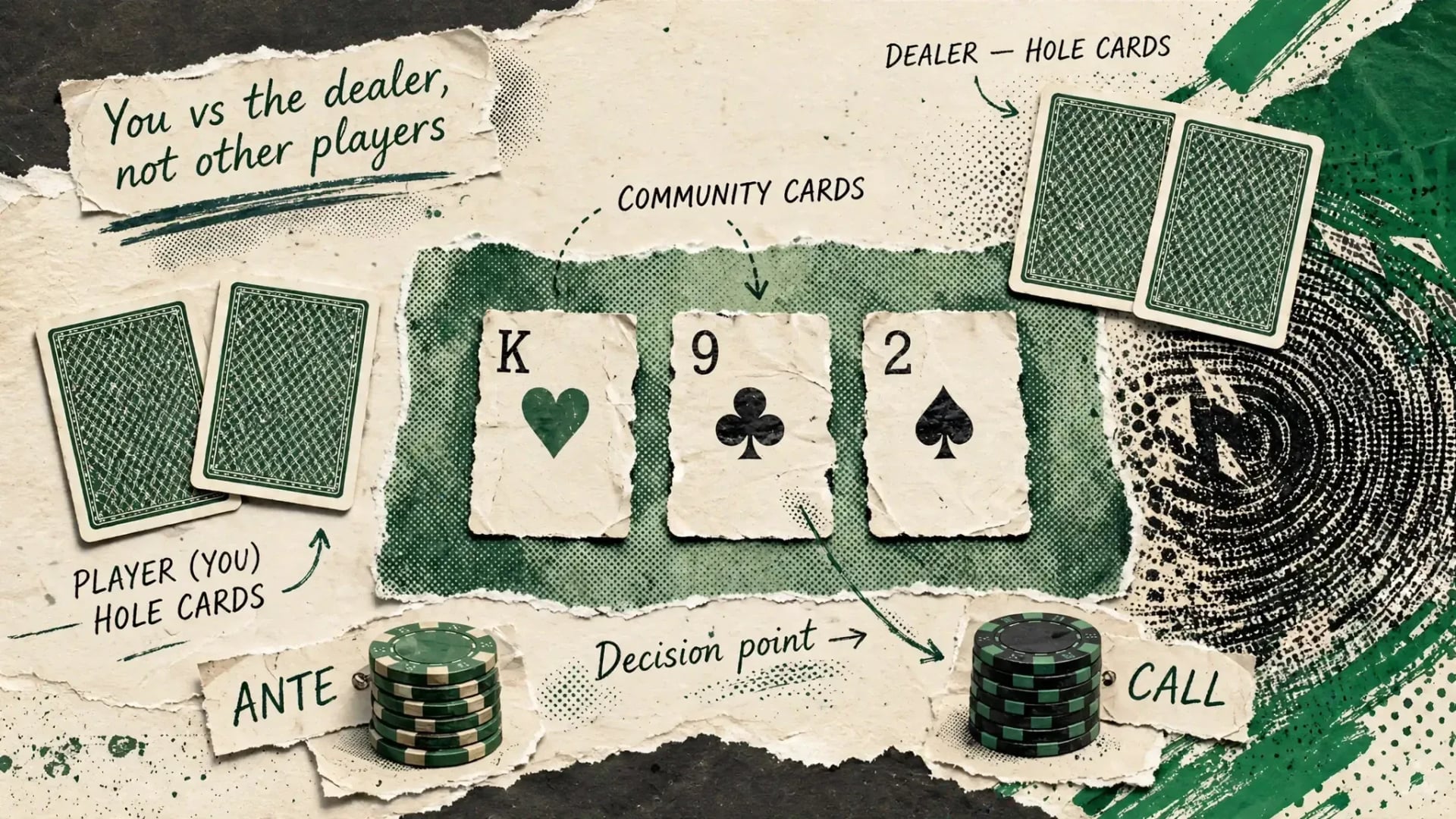
You make an Ante bet, see your cards and the flop, then decide whether the hand is worth continuing.
That is the core of the game.
What is Casino Hold'em?
Casino Hold'em is a house-banked poker game based on Texas Hold'em.
The important words there are house-banked.
In normal Texas Hold'em, players compete against each other and the poker room usually takes a rake.
In Casino Hold'em, every player is independently trying to beat the dealer.
Evolution describes the aim as making the best possible five-card poker hand using:
- your two hole cards
- the five community cards
The dealer does exactly the same.
Whoever has the stronger five-card hand wins, assuming the dealer qualifies.
That last part is where Casino Hold'em starts behaving more like a casino table game than traditional poker.
Casino Hold'em rules step by step
The standard version works like this.
1. Place the Ante
You start by placing an Ante bet.
Some tables also offer an optional side bet, often based on the strength of your first five available cards.
You do not need the side bet to play the main game.
2. You and the dealer receive two hole cards
You receive two private cards.
The dealer also receives two cards, which remain hidden.
3. Three community cards are dealt
The first three community cards, the flop, are placed face up.
At this point you can see:
- your two cards
- the three community cards
That gives you five visible cards to work with before making the game's main decision.
4. Call or fold
You now choose whether to continue.
If you fold, you give up the hand and lose your Ante.
If you call, the standard Call bet is normally twice the size of your Ante.
So if you started with a £5 Ante:
Call = £10
You now have £15 committed to the main game.
5. Turn and river are dealt
Two more community cards are added.
There are now five community cards in total.
The dealer reveals their two hole cards.
6. The best five-card hands are compared
Both you and the dealer make the strongest five-card poker hand available from the seven cards.
Then the dealer qualification rule comes into play.
What does the dealer need to qualify?
In the standard Casino Hold'em rules, the dealer needs:
a pair of fours or better
to qualify.
That can be:
- pair of fours or higher
- two pair
- three of a kind
- straight
- flush
- full house
- four of a kind
- straight flush
- royal flush
If the dealer has something weaker, such as ace-high with no pair, the dealer does not qualify.
And that changes how your bets are settled.
What happens if the dealer does not qualify?
If the dealer fails to qualify, your Call bet is normally returned.
Your Ante is then paid according to the table's Ante pay table.
That matters because Casino Hold'em does not necessarily pay every winning hand at simple even money.
Stronger poker hands can receive larger Ante payouts.
A common structure looks like this:
| Player hand | Typical Ante payout |
|---|---|
| Royal flush | Up to 100:1 |
| Straight flush | Around 20:1 |
| Four of a kind | 10:1 |
| Full house | 3:1 |
| Flush | 2:1 |
| Straight or lower qualifying hand | 1:1 |
The exact pay table can vary by game version.
So, as usual, read the actual table before betting rather than assuming every Casino Hold'em game uses identical maths.
What happens if the dealer qualifies?
Now your hand actually competes with the dealer's.
You beat the dealer
Your Call bet normally pays 1:1.
Your Ante is paid according to the Ante pay table.
Dealer beats you
You lose both the Ante and Call bets.
Which hurts a little more than losing one normal even-money casino bet because your Call is typically twice the size of the original Ante.
You tie
Both bets push and are returned.
How are Casino Hold'em hands ranked?
Exactly like normal high poker.
From strongest to weakest:
- Royal flush
- Straight flush
- Four of a kind
- Full house
- Flush
- Straight
- Three of a kind
- Two pair
- One pair
- High card
You are not creating some special casino version of a poker hand.
A flush still beats a straight.
A full house still beats a flush.
If both sides make the same type of hand, normal poker tiebreak rules apply.
For example, a pair of kings beats a pair of queens.
If both have the same pair, the kickers can decide it.
Casino Hold'em is not the same as Texas Hold'em
The cards make the two games look nearly identical.
The strategy absolutely is not.
In Texas Hold'em:
- you compete with other players
- betting happens across several streets
- bluffing matters
- position matters
- stack sizes matter
- opponents can fold better hands
In Casino Hold'em:
- you play against the dealer
- there is one major call-or-fold decision
- the Call amount is fixed
- bluffing does not exist
- dealer qualification matters
You are not trying to convince the dealer that your 7-3 offsuit is secretly pocket aces.
The dealer does not care.
The cards settle everything.
Casino Hold'em is also different from Ultimate Texas Hold'em
This one catches people out because the names sound so similar.
Ultimate Texas Hold'em is another casino version of Hold'em, but the betting structure is completely different.
In Ultimate Texas Hold'em, you can decide when to raise.
An early Play bet can be several times your Ante, while waiting until later reduces how much you can raise.
Casino Hold'em gives you a much simpler decision after the flop:
Call for twice the Ante or fold.
So if you have seen Ultimate Texas Hold'em before, do not assume the strategy carries straight across.
Is there a Casino Hold'em strategy?
Yes.
But it is not as neat as blackjack basic strategy.
There is no tiny rule like:
"Call with a pair, fold everything else."
The flop matters.
Your hole cards matter.
Straight and flush possibilities matter.
And because you are seeing five cards before deciding whether to continue, even fairly ugly hands can still have enough equity to justify the Call.
Detailed mathematical analysis of one commonly used Casino Hold'em pay table puts the house edge around 2.16% with optimal strategy.
That is not bad for a casino table game.
Our article on which casino game has the best odds gives that some context against blackjack, baccarat and roulette.
The interesting part is that optimal Casino Hold'em strategy continues with the large majority of hands.
One detailed analysis has the player calling roughly 82% of the time.
So if you find yourself folding half your flops because the cards "don't look great", you are almost certainly folding too often.
What should you generally fold?
The worst hands tend to combine several bad characteristics at once.
Think:
- two low hole cards
- no pair
- no meaningful straight draw
- no useful flush potential
- hole cards that interact badly with the flop
For example, something like two low disconnected cards on a high, uncoordinated flop can be a genuine fold candidate.
But this is where we would be careful with oversimplified strategy advice.
A hand that looks weak can still have enough ways to improve across the turn and river to justify calling.
So treat a simple rule of thumb as exactly that.
A rule of thumb.
Not an optimal strategy chart.
What is the Casino Hold'em Bonus bet?
Evolution's Casino Hold'em also includes an optional Bonus bet.
This is evaluated separately from the main Ante and Call game.
The bonus is based on the poker strength of the first five cards available to you, normally your two hole cards plus the flop.
A pair of aces or better can qualify for a payout.
Sounds fun.
But side bets should always be treated separately from the main game.
They usually create:
- bigger headline payouts
- higher volatility
- a different house edge
Adding a side bet because the main game has decent odds does not mean the side bet inherits those same odds.
This is the exact same trap we see in baccarat, blackjack and plenty of other table games.
The base game can be mathematically reasonable while the flashy side bet costs considerably more.
Should you always make the Bonus bet?
No.
If you want to play it because you like chasing bigger poker hands, that is one thing.
But there is no strategic requirement to add it.
The main Casino Hold'em decision is still the Ante, followed by whether to Call or fold.
We would understand that game first before adding extra bets around it.
Where can you play Casino Hold'em online in the UK?
Live Casino Hold'em is most strongly associated with Evolution, which launched its live version back in 2012.
That means Evolution-heavy live casinos are the obvious place to look.
Unibet currently has a large Evolution-powered live casino, while Betmaster also carries hundreds of live titles and a broad poker-style table-game section.
That does not mean every Evolution casino exposes every Evolution table at all times.
Game availability changes by operator.
If Casino Hold'em is specifically what you want, search the live lobby before depositing.
Our best live dealer casinos in the UK gives you the wider comparison.
The easiest way to understand Casino Hold'em
Forget the intimidating poker branding for a second.
The actual decision tree is pretty small.
You place an Ante.
You see your two cards and the flop.
You decide whether the hand is good enough to commit another two Antes.
Then the remaining cards come out and you compare against the dealer.
That is much closer to a normal casino table game than a six-player poker tournament.
Once you understand that distinction, Casino Hold'em becomes dramatically easier to follow.

Alan Woods
Content Editor
Alan reviews Irish casinos the same way he used to assess security risks: nothing gets the benefit of the doubt until it holds up under scrutiny. His cyber security background means he checks the things most reviews overlook, like licensing, how a site handles your data, and what the withdrawal terms actually deliver once the welcome offer is out of the way. He’s a published author as well, so you get the verdict in plain English instead of a technical checklist.
Share this article