

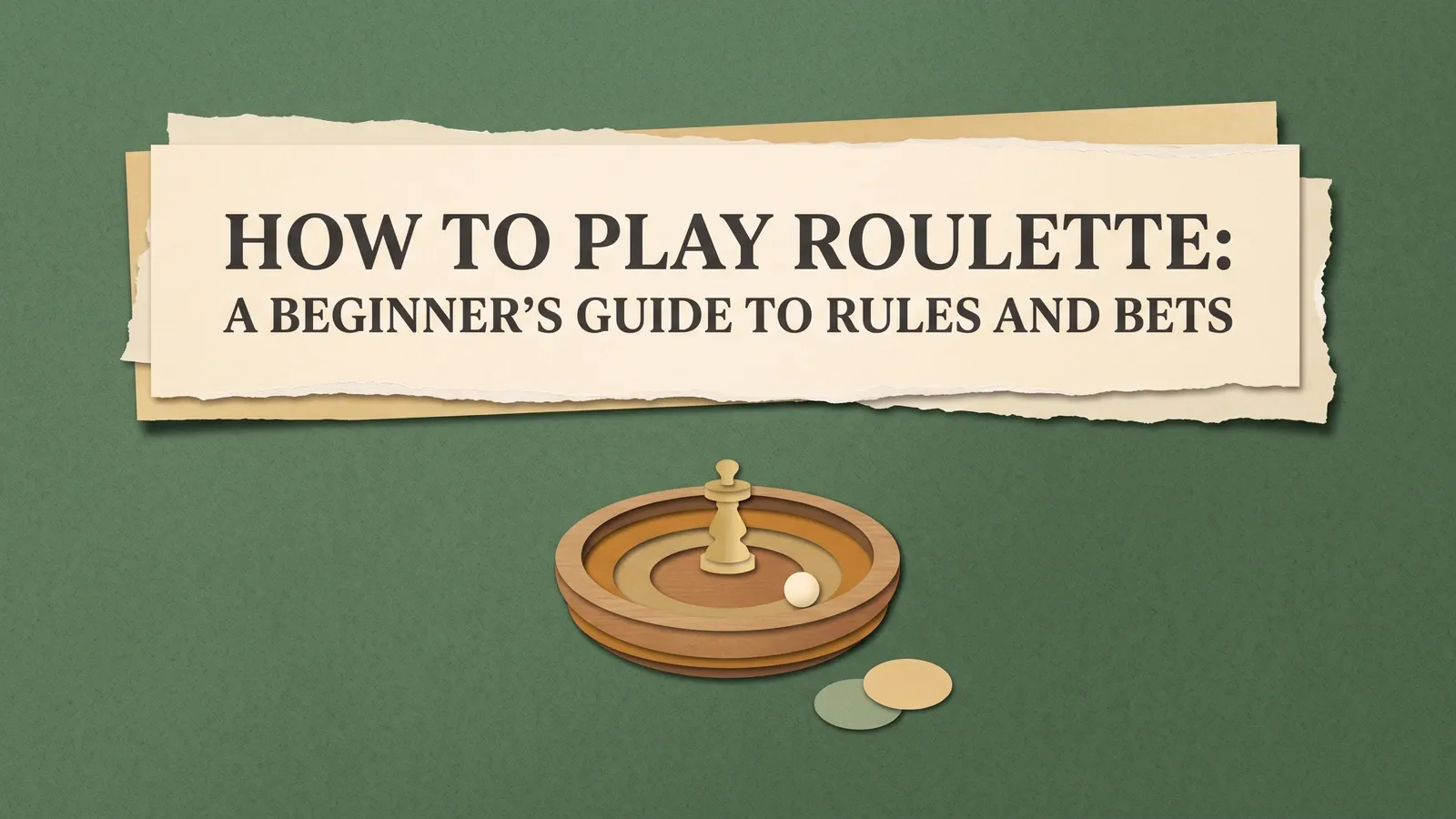
How to Play Roulette: A Beginner's Guide to Rules and Bets
New to roulette? Learn how European, American and French roulette differ, what every bet pays, and how the house edge works, plus tips for starting out online.

Key Takeaways
- European roulette uses one zero; American roulette adds a second zero and a higher house edge on standard bets.
- Inside bets cover fewer numbers at higher payouts, while even-money outside bets cover 18 numbers and exclude zero.
- La Partage reduces the house edge on qualifying even-money bets; betting progressions do not remove it.
How to play roulette: a beginner's guide
Roulette is one of the most accessible games you'll find in any casino. There's a wheel, a ball, a grid of numbers, and a moment of anticipation as you back where the ball might land. Half a minute later, the result is in. There are no convoluted strategies to learn, no worrying about hand rankings, and no mid-game twists to throw you off.
What does matter is knowing how the main roulette variants compare on odds, as one offers a much fairer deal than the rest. This guide walks through how each wheel works, what each bet pays, where the house advantage sneaks in, and a handful of points worth remembering for anyone taking their first spin at a UK online table.
The short version
There are three main types: European (one zero, 37 pockets, 2.7% house edge); American (two zeros, 38 pockets, 5.26% house edge); and French (same single-zero wheel as European, but with a rule that halves the casino's cut on even-money bets to 1.35%). European or French are the sensible choices for most players. American, with its extra zero, simply bumps up the house's advantage and gives nothing back in return.
Bets fall into two camps: inside (covering single numbers or small groups, with higher payouts) and outside (larger sections of the wheel, offering near-even-money returns). For newcomers, outside bets are the logical starting point. Set a budget upfront, then it's simply a matter of placing your chips and enjoying the ride.
The wheel: European, American and French
The version of roulette you're playing is decided by the wheel, not the table. All three main variants share a similar betting grid; the difference is in the pockets, as explained in our guide on how the roulette wheel and table layout work.
European roulette wheels come with 37 numbered pockets: 1 to 36 in red and black, and a single green zero. The zero is the house's edge in action. Every bet pays as if there are just 36 pockets, so the extra green slot quietly tilts the odds in the casino's favour. In practice, the house expects to pocket £2.70 for every £100 wagered - that's the 2.7% edge at work.
American roulette introduces a second green pocket - the double zero (00) - taking the total to 38. Payouts remain unchanged, but the extra pocket pushes the house edge up to 5.26%, nearly double the European standard. UK online casinos stick with European by default, so there's little reason to opt for American unless you're feeling particularly generous to the house.
French roulette sticks with the single-zero wheel but throws in a rule called La Partage ("the sharing"): if the ball lands on zero, any even-money bet gets half its stake back, rather than losing the lot. This one tweak slashes the house edge on those bets from 2.7% to 1.35% - the most player-friendly odds you'll see in mainstream roulette. There's also a related rule, En Prison, which works a touch differently but lands at the same effective edge. If there's a French table on offer and you're focusing on even-money bets, it's well worth making the switch.
How a round works
Every round plays out in the same order, whether you're at a bustling casino or playing online in your living room.
It starts with placing chips on whichever numbers or sections take your fancy. Online, it's a simple click or tap around the digital table. The croupier - or the software, if you're playing RNG - gives the signal when bets are open. You're free to add, change, or remove bets right up to the cut-off.
Once betting closes, the wheel spins one way and the ball the other. It rattles round the rim, slows, drops onto the wheel and bounces through the pockets until it finally comes to rest. The winning number is announced, the table marked, and losing bets swept away. Payouts are made, the marker is cleared, and then it all starts again.
At a land-based casino, a round typically takes 30 to 60 seconds. RNG roulette online is often brisker, while live dealer tables keep the pace closer to the real thing. Fancy taking it slow? Most live tables let you watch a few spins before getting involved, so there's no rush to dive in.
Your bets: inside and outside explained
The roulette table splits into two zones. Outside bets sit around the edge of the number grid; inside bets cover the numbered grid itself.
Outside bets cover sweeping sections of the wheel at lower odds. It's where most newcomers sensibly begin - and for good reason.
The even-money bets span nearly half the wheel and pay 1:1: red or black (18 numbers each), odd or even, and high (19-36) or low (1-18). None is a perfect coin toss, as the zero doesn't count for any of them. If zero drops, even-money bets lose - unless you're playing French roulette with La Partage. That's the tiny edge the house counts on for these bets.
Dozens and columns both pay 2:1 and cover 12 numbers each. Dozens cover 1-12, 13-24 or 25-36. Columns cover one of the three vertical runs of numbers down the table layout. Neither includes the zero.
Inside bets target specific numbers or small clusters, offering bigger payouts but with longer odds.
- Straight up - a single number: pays 35:1
- Split - two adjacent numbers, chip placed on the line between them: pays 17:1
- Street - three numbers in a horizontal row: pays 11:1
- Corner (or square) - four numbers meeting at a corner: pays 8:1
- Six line - two adjacent streets, covering six numbers: pays 5:1
American roulette also permits a five-number bet on 0, 00, 1, 2, and 3, which pays 6:1 but comes with a hefty 7.89% house edge. It's the worst bet available, really only worth knowing about so you can steer clear.
The house edge: how the numbers stack up
The house edge is the inbuilt mathematical advantage that, given enough spins, ensures the casino comes out ahead in the end. In roulette, it's not about any sleight of hand or trickery - it's simply the difference between the true odds and the payouts on offer.
Every bet in European roulette pays as though the wheel has 36 pockets. It actually has 37. The gap between a 36-pocket payout structure and a 37-pocket reality works out at 2.7% on every bet. Add a second zero and the wheel has 38 pockets, payouts stay the same, and the gap widens to 5.26%. French roulette with La Partage halves that gap to 1.35% on even-money bets only.
This edge is an average over the long haul, not a promise about any given session. Over a night, you might end up ahead or take a heavier loss than the numbers suggest - roulette is nothing if not unpredictable in the short term. The house edge only becomes reality after many spins.
What the edge does guarantee is that no betting system bends the maths. Doubling up after losses (the Martingale), using the Fibonacci sequence at the roulette table, or hopping between bets, none of it alters the 2.7% edge on a European wheel. The wheel doesn't remember a thing. Ten reds in a row won't make black due; every spin is its own event. Managing your bankroll carefully is always wise, but expecting a system to outwit the numbers is wishful thinking.
Playing online: RNG and live dealer roulette
Most UK players come to roulette through an online casino, and there are two distinct formats.
RNG roulette relies on a random number generator for each result. There's no physical wheel spinning - it's all software, with an animation to match. UK-licensed casinos are held to the Gambling Commission's strict standards for random outcomes, which means no game can adapt results based on your play or your history. Each spin stands alone, and every game must be independently tested before it's approved.
Live dealer roulette streams a real wheel and croupier direct to your screen. Bets are placed through the online interface, but the wheel itself is spun in real time. The odds and bets mirror those of RNG tables, but the atmosphere is closer to the real thing, with a social edge that some find appealing. RNG games are faster and often have lower minimum bets, making them a handy starting point for those getting to grips with the layout. For those who prefer the live touch, there's usually a good range of tables running round the clock on UK sites.
The £5 online-slot stake cap began on 9 April 2025; the £2 cap for players aged 18 to 24 followed on 21 May 2025. These caps apply only to online slots. Table and live casino games, including roulette, aren't covered by this law. Individual tables still set their own stakes, but there's no overarching limit as there is with slots.
UK-licensed sites verify age at sign-up; you need to be 18 or over to play. If you're still working out where to start, our comparison of licensed UK casino choices for everyday play covers the main UKGC-licensed options for UK players.
Tips for starting out
A few practical things that make a difference in the early sessions.
Choose the right wheel. European is the go-to for a reason: 2.7% house edge, and it's standard at practically every UK online casino. French with La Partage is a smart move for even-money bets, if you can find it. American? It's a poor deal across the board - that extra zero does players no favours at all.
Stick to outside bets at first. Even-money bets and dozens or columns let you cover a broad swathe of the wheel - payouts are modest, but you'll get a genuine feel for the game's tempo without chasing 35:1 hail marys. The house edge is the same no matter what you back, so there's no penalty for taking it steady until you're comfortable.
Take advantage of free-play. Most UK online casinos let you spin the wheel in demo mode - a great way to learn the ropes and get confident placing bets, without risking a penny. It's not quite the same as playing for real, but it's a solid starting point.
Set your limits before you get going. Roulette moves at a fair clip, and it's all too easy to keep chasing after a run of bad luck. Decide on a deposit limit and a session budget before you load up the table, so that the hard decisions are made in advance, not on the fly.
Check the small print on bonuses if you're tempted by a welcome offer. Roulette usually counts for very little (if at all) towards wagering requirements at UK casinos - most bonuses are geared towards slots. If a deal looks generous, it's worth seeing how table games are treated before you jump in.
Frequently asked questions
What is the best version of roulette for beginners?
European roulette is the sensible starting point: 37 pockets, a single zero, and a 2.7% house edge. French roulette with La Partage is better value for even-money bets, cutting the edge to 1.35%. Avoid American roulette; the second zero nearly doubles the house's advantage for no benefit to the player.
How do the bets work in roulette?
Bets split into outside (large sections of the wheel, lower payouts) and inside (specific numbers or small groups, higher payouts). Outside bets like red/black pay 1:1; a straight-up bet on a single number pays 35:1. The bets section above covers the full range.
What is the house edge in roulette?
On a European wheel, every bet carries a 2.7% house edge. French roulette with La Partage drops that to 1.35% on even-money bets. American roulette runs at 5.26%. The edge is built into the payout structure, not the result of any manipulation.
Can a betting system beat the house edge?
No. Systems like the Martingale manage how bets are sized over a session but cannot move the underlying mathematics. The house edge on a European wheel is 2.7% per spin regardless of what came before. The wheel has no memory.
Is online roulette fair?
At a UK-licensed site, yes. The Gambling Commission's random-outcomes standard requires all online casino games to produce genuinely random results and bans any game that adapts based on a player's history or past results. Games must be independently tested before release. You can verify that a casino holds a current UKGC licence on the Commission's public register.
Does roulette have a stake limit like online slots?
No. The £5 cap introduced on 9 April 2025 and the £2 cap for players aged 18 to 24 introduced on 21 May 2025 apply exclusively to online slot game cycles. Roulette and other table games are not subject to the same statutory limit, though individual tables set their own minimum and maximum bet amounts.
Safer gambling: Roulette's pace and those near-even bets can make it a little too easy to press on past a sensible stopping point. Set a budget before you start. If gambling is becoming a concern for you or anyone close to you, the National Gambling Helpline is available free, 24/7, on 0808 8020 133.

Alan Woods
Content Editor
Alan reviews casinos the same way he used to assess security risks: nothing gets the benefit of the doubt until it holds up under scrutiny. His cyber security background means he checks the things most reviews overlook, like licensing, how a site handles your data, and what the withdrawal terms actually deliver once the welcome offer is out of the way. He’s a published author as well, so you get the verdict in plain English instead of a technical checklist. In the UK edition, he focuses on UK Gambling Commission licensing, player protections and the terms attached to casino offers.
Share this article