

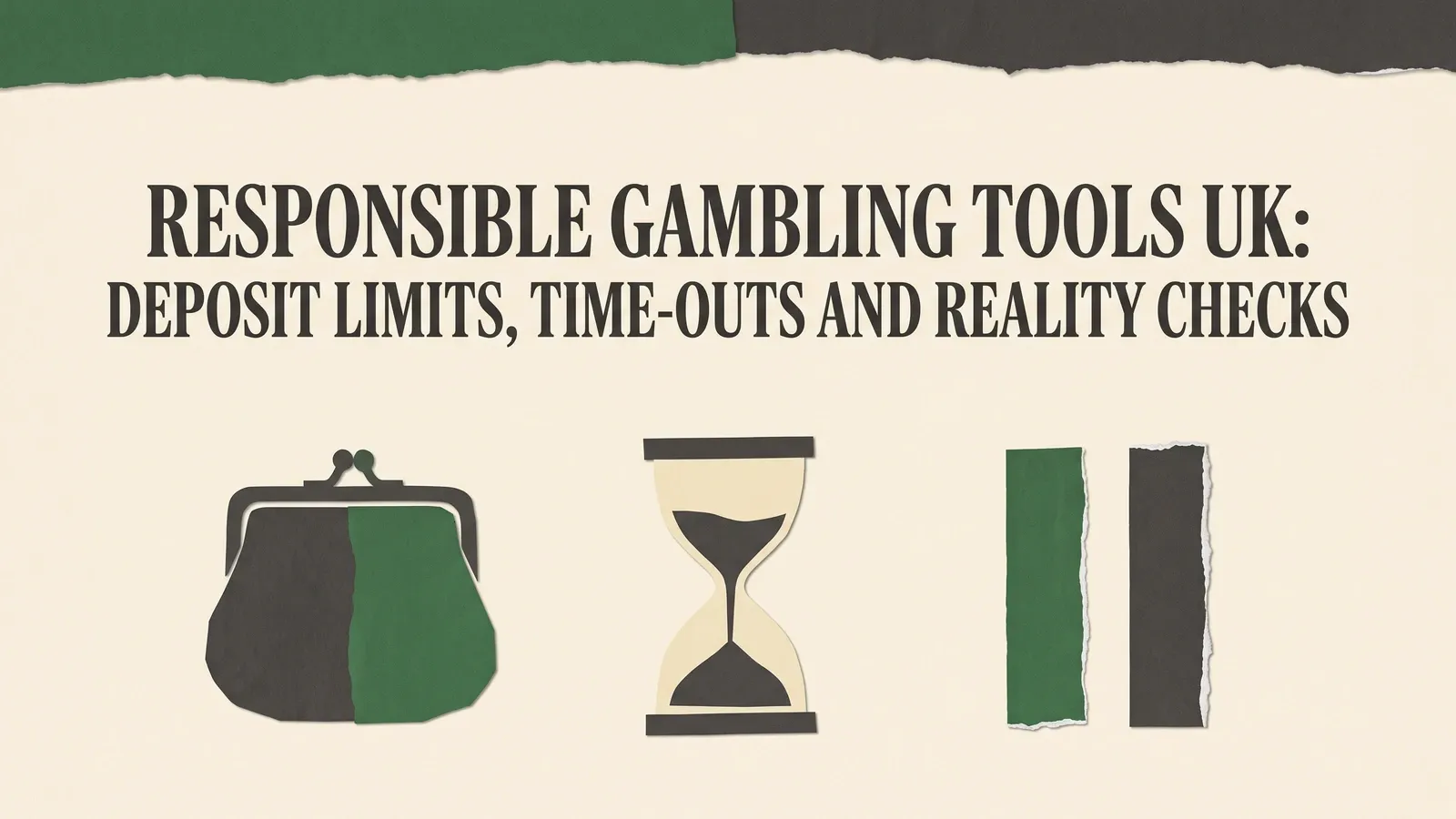
Responsible Gambling Tools UK: Deposit Limits, Time-Outs and Reality Checks
How deposit limits, loss and wager limits, reality checks, time-outs and self-exclusion work at UK casinos, plus the checks that apply automatically.

Key Takeaways
- A deposit limit caps money paid into an account, not the total amount you can wager.
- Raising a customer-set limit requires a cooling-off period and confirmation; reducing it is normally immediate.
- Time-outs pause one account, while GAMSTOP and blocking tools provide broader, complementary restrictions.
Responsible gambling tools: deposit limits, time-outs and reality checks
Every casino licensed in Great Britain is required to provide tools so you can stay in charge of your spending, your playing time, and when to call it a day. These aren't just nice-to-have features, nor does using them mean anything's amiss. They're part and parcel of your account, mandated by the regulator, and most can be set up in less than a minute.
This guide will walk you through the main options: deposit limits, loss and wager limits, reality checks, time-outs, and when a short pause turns into self-exclusion. We'll also clear up two background controls that tick away whether you've set anything or not-often mistaken for settings you choose yourself.
It's worth getting one thing straight from the outset: setting limits before you play is much more effective than trying to add them mid-session, when the urge to keep going is at its peak. These tools work best as your starting setup, not as a last-minute rescue.
What responsible gambling tools are, and why every UK casino has to offer them
Responsible gambling tools, sometimes called safer gambling tools, are the settings inside your account that let you cap your spending, limit your time, or block your own access for a while. The common ones are deposit limits, loss and wager limits, reality checks, time-outs and self-exclusion.
UK-licensed operators aren't offering these tools out of generosity. The Gambling Commission requires core safeguards through licence conditions and its Remote Technical Standards. Gross deposit limits are mandatory; additional loss and wager limits may also be offered. Any casino that fails to provide working tools is putting its licence on the line.
The rules have been tightened in recent times. Since 31 October 2025, operators have to prompt new customers to set a financial limit before making their first deposit, keep the limit controls easy to spot, and give you a nudge every six months to review your limits and activity. There's never any need to justify using these features, and they're always free to set up.
Deposit limits: the tool to set first
A deposit limit caps how much money you can pay into your account over a set period. You choose the amount and the timeframe, usually daily, weekly or monthly. Once you hit the cap, the site won't accept further deposits until the period resets.
To set one up, head to your account settings and look for the section marked "responsible gambling" or "safer gambling." Pick your amount and time period, confirm your choice, and it'll take effect across your entire account there and then. It isn't linked to just one game or payment method.
A deposit limit caps what you can pay into that gambling account during the chosen period; it does not cap spending across other accounts or your bank as a whole. It doesn't take notice of wins or losses-just the total amount you've paid in. For most, this is hands-down the most effective tool, and it's well worth setting up from day one.
Deposit, loss and wager limits: what's the difference
These three are easily mixed up, but each one protects you differently.
A deposit limit caps the money you pay in. A loss limit caps your net losses, so winnings count back towards the figure. A wager or spend limit caps the total amount you stake, win or lose, which matters because you can stake far more than you deposit if you keep recycling winnings back into play.
Since 30 September 2026, operators covered by RTS 12 must offer gross deposit limits and use the name "deposit limit" only for that type. Withdrawals do not replenish this allowance. Other financial limits may also be offered, but gross deposit limits must have at least equal prominence.
Changing a limit: why decreases are instant but increases are not
Lowering a limit takes effect immediately. The moment you reduce it, the new, tighter figure applies.
Raising or removing a limit is intentionally slower. Any increase comes with a cooling-off period of at least 24 hours before it kicks in. The delay is there for a reason: it stops you from raising your own ceiling in the heat of the moment and depositing more before you've had a chance to think it over. An increase also requires you to confirm the request after the cooling-off period; waiting alone does not activate it.
Reality checks and session reminders
A reality check is an on-screen nudge that shows how long you've been playing. Under the Commission's standards, every licensed casino must let you set these reminders, choose how often they pop up, and they have to interrupt the action until you acknowledge them. There's also a link to your account history, so you can see exactly what you've spent.
You set the frequency yourself. Most sites offer intervals such as every 15, 30 or 60 minutes. When the reminder pops up, you can carry on or close the session, but you have to respond to it first.
There's another feature you'll notice by default. Since 17 January 2025, every gaming session must display your net position-the running tally of wins minus losses since you started playing. It's a small detail that makes a real difference, showing you exactly where you stand rather than letting a few wins mask a losing streak.
Time-outs and cooling-off periods
A time-out is a short, enforced break. You lock yourself out of your account for a chosen period-anywhere from 24 hours up to six weeks-and during that time, deposits and play are off-limits. You can usually still log in to withdraw any remaining balance. The usual presets are 24 hours, seven days, and 30 days.
A quick note on terminology, because "cooling-off" gets used two different ways. One is the short break described here, sometimes called a cool-off. The other is the 24-hour delay on raising a deposit limit. Same phrase, different mechanisms, so it's worth checking which one a site means.
A time-out is the right call when you need a quick breather without signing up for anything longer term. If you find you're taking time-outs again and again, that's often the cue to look at the stronger option below.
Stake limits and checks that run in the background
The tools above are ones you turn on yourself. Two more controls, though, apply automatically, whether you do anything or not-and people often think they've triggered them by mistake. They haven't; these are simply rules that now underpin every UK-licensed site.
Stake limits on online slots
There's now a legal cap on how much you can stake per spin on online slots. If you're 25 or over, the top limit is £5 per spin (from 9 April 2025). For those aged 18 to 24, it's £2 per spin (since 21 May 2025).
The cap applies only to online slots, not to table games like blackjack or roulette. There's nothing you need to do-it's all automatic. If you've seen high-stake options vanish from slot lobbies lately, that's the reason.
Financial vulnerability checks
Since 28 February 2025, operators must run a light-touch financial vulnerability check if your net deposits go over £150 in any rolling 30-day period. Net deposits means your deposits minus withdrawals-so anything you've cashed out brings the figure back down.
This isn't the payslip-and-bank-statement check that makes the headlines. It's a frictionless background check using public information, mainly to pick up on serious issues like bankruptcy or large unpaid debts. It won't touch your credit score, and for most people, it's over in seconds and goes unseen. Once you're through, it usually lasts 12 months. Separate anti-money-laundering and safer-gambling checks may also apply; they are not limited to one universal high-loss threshold.
When the tools aren't enough: self-exclusion and support
If deposit limits and time-outs aren't enough, the next step up is self-exclusion. The national scheme for online gambling is GamStop. It's free, it's open to UK residents, and one registration blocks you from every gambling website and app licensed in Great Britain, including their marketing.
You choose a period of six months, one year or five years, and it becomes active within 24 hours. It can't be lifted early, by design. Our full guide to GamStop and self-exclusion covers how to register and what happens when the period ends.
GamStop does have one gap worth noting: it doesn't cover gambling sites licensed outside the UK. To block those as well, you can use device-level blocking software like Gamban (free via the TalkBanStop programme) or BetBlocker.
If gambling is causing you harm, there's no need to wait until things get serious before reaching out. The National Gambling Helpline is free, confidential, and open 24/7 on 0808 8020 133, run by GamCare. If you spot the warning signs in yourself or someone else, our guide on the signs of problem gambling and where to get help walks through what to do next.
Frequently asked questions
Do all UK casinos have to offer these tools? Yes, absolutely. Deposit limits, reality checks, time-outs, and self-exclusion are required under the Gambling Commission's licence conditions and technical standards. Any site not offering them isn't operating legally in Great Britain.
Will setting a deposit limit, or passing £150 in deposits, affect my credit score? No. Deposit limits are private account settings and aren't linked to credit. The £150 financial vulnerability check relies on public data, not a hard credit search, and won't affect your score.
Can I remove or raise a deposit limit straight away? No. Increases and removals are held back by a cooling-off period of at least 24 hours before they take effect. Decreases apply straight away.
How long can I take a break without self-excluding? A time-out typically lasts anywhere from 24 hours up to six weeks, locking you out of that one account for the period you pick. Self-exclusion via GamStop is the longer-term route, from six months upwards, and covers every UK-licensed site in one go.
What's the difference between a time-out and GamStop? A time-out is short and only applies to a single casino. GamStop is national self-exclusion-one sign-up blocks all GB-licensed sites and apps for six months, one year, or five years, and can't be undone before the period ends.
Safer gambling: this guide is general information about the tools available, not personal advice. If you're worried about your own or someone else's gambling, the National Gambling Helpline is free and open 24/7 on 0808 8020 133.

Alan Woods
Content Editor
Alan reviews casinos the same way he used to assess security risks: nothing gets the benefit of the doubt until it holds up under scrutiny. His cyber security background means he checks the things most reviews overlook, like licensing, how a site handles your data, and what the withdrawal terms actually deliver once the welcome offer is out of the way. He’s a published author as well, so you get the verdict in plain English instead of a technical checklist. In the UK edition, he focuses on UK Gambling Commission licensing, player protections and the terms attached to casino offers.
Share this article