




Which Casino Game Has the Best Odds? Comparing House Edge Across Casino Games
Compare the house edge of blackjack, baccarat, roulette, video poker, craps and slots to see which casino games offer UK players the best odds.

Share this article
Key Takeaways
- Full-pay 9/6 Jacks or Better video poker can reach about 99.54% RTP with optimal strategy, but good-rule blackjack is probably the most practical low-edge game for most UK casino players.
- Baccarat Banker has a house edge of roughly 1.06%, while French roulette with La Partage can cut even-money bets to about 1.35%.
- Always compare the exact rules, bet or RTP rather than just the game name. A small rules change can massively change the maths.
If you want the short answer, blackjack is probably the best realistic option for most UK casino players.
But there is a pretty massive asterisk attached to that sentence.
Full-pay video poker can actually have an even lower house edge than blackjack. Baccarat is surprisingly competitive. French roulette is much better than American roulette. And saying something vague like "blackjack has the best odds" becomes completely useless if the blackjack table pays 6:5 or you are making terrible decisions every second hand.
So let's actually compare these properly.
Not based on which game feels easiest to win.
Not based on which game gave somebody on Reddit a £4,000 payout last Tuesday.
Based on the thing that actually matters mathematically: house edge.
Casino games with the best odds
Here is the broad comparison.
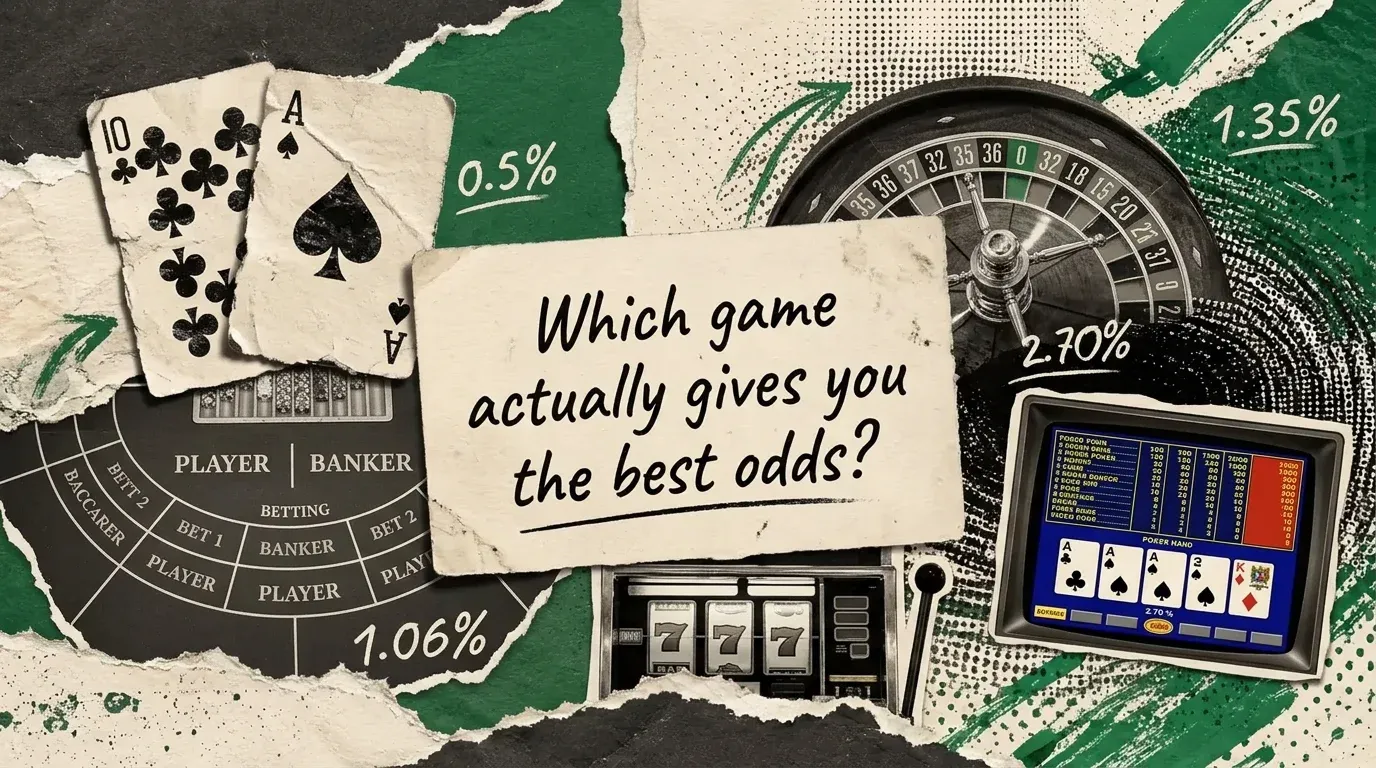
| Casino game / bet | Approx. house edge under favourable conditions | Approx. theoretical RTP | Main catch |
|---|---|---|---|
| Full-pay 9/6 Jacks or Better video poker | 0.46% | 99.54% | Requires the right pay table and near-perfect strategy |
| Blackjack | Around 0.5% under good rules | Around 99.5% | Depends heavily on rules and correct basic strategy |
| Baccarat Banker | 1.06% | 98.94% | Standard 5% commission applies |
| French roulette, even-money bets with La Partage | 1.35% | 98.65% | Only applies when the table actually offers La Partage |
| Craps Don't Pass | 1.36% | 98.64% | Less common online and rules can look confusing initially |
| Craps Pass Line | 1.41% | 98.59% | Still low edge, but not as widely offered as roulette or blackjack |
| European roulette | 2.70% | 97.30% | Single zero only |
| American roulette | 5.26% | 94.74% | The extra 00 almost doubles the standard roulette edge |
| Slots | Varies by game | Varies by game | You need to check the RTP of the exact slot |
And immediately, you can see why this question needs more than a one-sentence answer.
Technically, a strong video poker pay table can come out on top.
Practically, blackjack is probably the most useful answer for the average UK player because it is widely available and can offer an extremely low house edge if the table rules are good and you know how to play.
First, what does "best odds" actually mean?
This is worth clearing up because there are two completely different questions people tend to mix together.
Question one: Which game gives me the highest chance of winning one individual bet?
Question two: Which game costs me the least mathematically over a huge amount of play?
Those are not the same thing.
Take roulette.
Betting red on a European roulette wheel gives you an 18 in 37 chance of winning, or about 48.65%.
That sounds pretty decent.
Now compare that with a specific blackjack hand where you might only have a 30% or 40% chance of winning.
Does that mean roulette has better odds?
No.
Because blackjack allows different payouts, pushes, doubles and player decisions. Once you put the entire game together, a good blackjack ruleset played properly can have a house edge of around 0.5%.
European roulette sits at 2.70%.
So for this article, when we say best odds, we mean:
Which game has the lowest built-in mathematical advantage for the casino over the long run?
That is the house edge.
If a game has a 1% house edge, the casino theoretically expects to retain about £1 for every £100 wagered over a very large sample.
That does not mean you put £100 in and automatically lose £1.
You might double your money.
You might lose the whole thing.
The maths only starts becoming stable across a massive amount of play.
1. Video poker can technically have the best odds
This surprises a lot of people because video poker looks suspiciously like a slot machine.
You sit at a machine.
You press buttons.
Cards appear on a screen.
Surely this is basically just a slot with playing cards slapped on top?
Not really.
In video poker, your decisions affect the return.
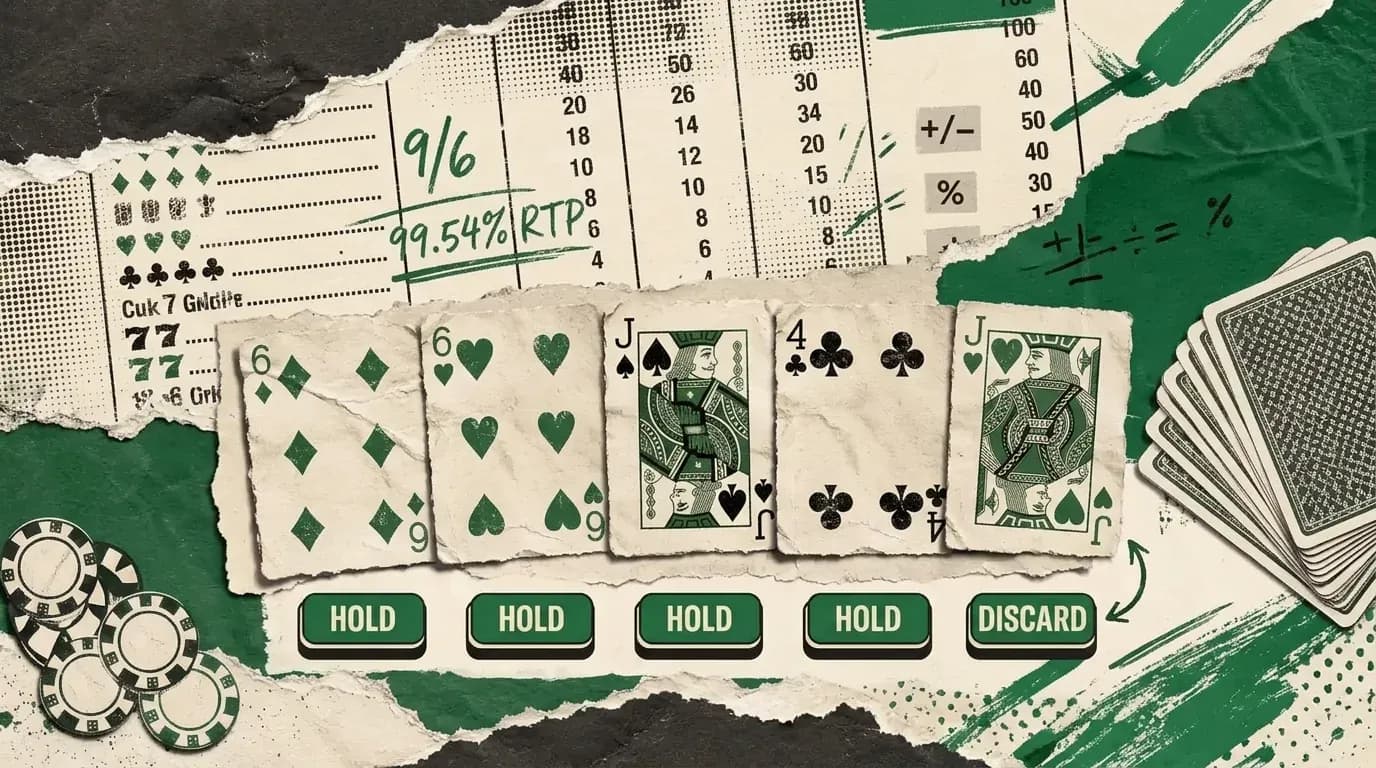
One of the classic examples is full-pay 9/6 Jacks or Better.
The "9/6" refers to two important payouts:
- Full house pays 9 for 1
- Flush pays 6 for 1
Under that pay table, using mathematically optimal strategy, the theoretical RTP is about 99.54%.
That means a house edge of only about 0.46%.
So technically, yes, video poker can beat most blackjack tables.
But there are two problems.
First, you need to actually find the full-pay version.
A machine paying 8 for a full house and 5 for a flush may look almost identical while giving you noticeably worse maths.
Second, you need to play the hands correctly.
Video poker is not a game where you can ignore strategy and still claim the 99.54% number.
We are writing a separate UK guide to video poker strategy and pay tables because this is one of those games where understanding the pay table genuinely matters.
2. Blackjack is probably the best practical answer
This is where I would put my foot down for most players.
If someone asks:
"Okay, cool, but what normal casino game should I actually play if I care about the odds?"
Blackjack.
Under a decent set of rules and with correct basic strategy, the house edge can sit around 0.5%, sometimes lower or higher depending on the exact table.
But the words correct basic strategy matter.
A lot.
Blackjack is unusual because you are actively making decisions that affect the maths.
You can hit.
Stand.
Double.
Split.
Surrender where available.
Make the right decisions and the game can be extremely competitive.
Start randomly standing on 12 against a dealer 10 because you have "a feeling", and the nice theoretical house edge starts disappearing.
Our UK blackjack basic strategy guide gives you the actual chart and explains when to hit, stand, double and split.
The table rules matter too.
For example, blackjack paying 3:2 is substantially better than a table paying 6:5.
The number of decks, whether the dealer hits soft 17 and whether you can double after splitting can all move the edge.
So don't just see the word Blackjack and assume every table is mathematically identical.
They aren't.
3. Baccarat is ridiculously simple for how good the odds are
Baccarat is probably the most underrated game in this entire comparison.
Why?
Because you barely need to do anything.
There is no 200-cell strategy chart.
No decision about whether to hit a 16.
No analysing five cards and deciding what to hold.
You basically choose:
- Banker
- Player
- Tie
Then the fixed game rules handle everything else.
On standard eight-deck Punto Banco baccarat, the Banker bet carries a house edge of about 1.06% after accounting for the usual 5% commission on Banker wins.
Player is only slightly worse at about 1.24%.
That is genuinely good for a casino game.
The Tie bet?
Completely different story.
At a standard 8:1 payout, the house edge jumps to about 14.36%.
So you have one of the lowest-edge bets in the casino sitting directly beside one of the worst mainstream bets.
Same table.
Very, very different maths.
If you haven't played before, our guide on how to play baccarat in the UK explains the scoring and drawing rules without making the game sound more complicated than it actually is.
4. French roulette can be surprisingly competitive
Normal European roulette has a 2.70% house edge.
That is already much better than American roulette at 5.26%.
But French roulette can go one step further.
Some French roulette tables use a rule called La Partage.
If you place an even-money bet such as:
- red or black
- odd or even
- 1 to 18 or 19 to 36
and the ball lands on zero, you lose only half the stake rather than all of it.
That cuts the house edge on those bets from 2.70% to roughly 1.35%.
Suddenly roulette is sitting remarkably close to Baccarat Banker.
And this is why saying "roulette has bad odds" is too simplistic.
Which roulette?
One green zero?
Two green zeroes?
La Partage?
Those tiny rule differences change the maths dramatically.
Our roulette odds and payouts guide breaks down the probabilities behind each bet in more detail.
5. Craps has excellent bets hidden inside a confusing table
Craps looks horrifying if you have never played it.
There are words everywhere.
Pass.
Don't Pass.
Come.
Don't Come.
Hardways.
Field.
Odds.
Numbers scattered across the table.
It looks like someone threw an Excel spreadsheet onto green felt.
But underneath all of that, a few bets are actually very strong mathematically.
The standard Pass Line bet carries a house edge of about 1.41%.
Don't Pass is slightly lower at around 1.36%.
And once a point is established, taking true odds behind a Pass or Don't Pass bet carries no additional house edge on that extra wager.
That does not make craps a beatable game overall.
It simply means there are very good bets sitting beside some absolutely terrible ones.
Which is another recurring theme here:
The specific bet matters more than the game name.
6. European roulette is decent, American roulette is not
If French roulette with La Partage is unavailable, normal European roulette is still respectable.
There are 37 pockets:
- numbers 1 to 36
- one green zero
Standard bets carry a 2.70% house edge.
American roulette adds another green pocket:
00
Now there are 38 possible outcomes.
The casino still pays 35:1 on a single-number win.
And the house edge jumps to 5.26% on most bets.
That is almost double.
You are basically playing an almost identical-looking game while voluntarily accepting much worse maths.
So if both are sitting beside each other in an online lobby, we see very little reason to choose the American version.
What about slots?
Slots are different because there is no single "slot house edge".
Every game can have its own RTP.
A slot with 96% RTP has a theoretical house edge of 4%.
A 94% RTP version has a 6% edge.
And, importantly, even the same slot title can sometimes exist in multiple RTP configurations.
So you actually need to open the game's information screen and check.
Our guide to what RTP means in slots explains why the figure is based on enormous long-run turnover rather than what you should expect back from one £100 session.
And this is also why comparing "slots versus blackjack" as if every slot is one game makes very little sense.
Blackjack has a ruleset.
A slot has its own individual mathematical model.
So which casino game actually has the best odds?
Let's separate the technical answer from the useful answer.
Technically: full-pay video poker
A full-pay 9/6 Jacks or Better game played with optimal strategy can return around 99.54%, leaving only about a 0.46% house edge.
That beats a lot of blackjack games.
But you need the right pay table and the right strategy.
Practically: blackjack
For most UK players, good-rule blackjack played with basic strategy is probably the best combination of low house edge, widespread availability and straightforward access.
You are looking at roughly 0.5% under favourable conditions.
That is extremely competitive for a mainstream casino game.
If blackjack is the one you actually want to play, our guide to the best blackjack casinos in the UK compares the wider casino platforms around the tables.
If you want almost no strategy: Baccarat Banker
You basically choose Banker and let the game run.
The house edge is around 1.06%.
Very simple.
Very respectable maths.
If you like roulette: find French rules
French roulette with La Partage gives even-money bets around a 1.35% house edge.
Normal European roulette is 2.70%.
American roulette is 5.26%.
That difference is enormous over time.
The part people get wrong about casino odds
There is no casino game where a low house edge suddenly means you should expect to win.
This is where people take a useful statistic and stretch it into something it never meant.
A 0.5% blackjack edge does not mean:
"Great, I basically can't lose."
You absolutely can.
Variance exists.
You could sit down at an excellent blackjack table, play every hand perfectly and get destroyed over the next 30 minutes.
The lower house edge simply means the mathematical cost of playing is lower over the long run.
And that, really, is the useful way to think about this.
If you are going to gamble anyway, knowing the house edge tells you what you are paying to play.
Some games charge very little.
Others charge a lot.
And sometimes two games that look almost identical, like European and American roulette, are quietly charging you completely different prices.

Alan Woods
Content Editor
Alan reviews Irish casinos the same way he used to assess security risks: nothing gets the benefit of the doubt until it holds up under scrutiny. His cyber security background means he checks the things most reviews overlook, like licensing, how a site handles your data, and what the withdrawal terms actually deliver once the welcome offer is out of the way. He’s a published author as well, so you get the verdict in plain English instead of a technical checklist.
Share this article