




Video Poker Strategy and Pay Tables Explained
Learn how video poker strategy works, what 9/6 Jacks or Better means, how pay tables change RTP and which cards you should hold or discard.

Share this article
Key Takeaways
- Full-pay 9/6 Jacks or Better can return about 99.54% with optimal strategy, but lower-paying versions can look almost identical while offering much worse odds.
- Video poker strategy is about holding the combination with the highest expected value, not simply keeping whichever current hand looks safest.
- Always match your strategy to the exact game and pay table because Jacks or Better, Deuces Wild and Bonus Poker can require very different decisions.
Video poker looks like a slot machine.
You press a button, cards appear on a screen, you choose what to keep, and then the machine gives you another set of cards.
So it's easy to assume the whole thing is basically slots with poker artwork.
It isn't.
The major difference is that your decisions actually change the return of the game.
Hold the right cards and a strong video poker pay table can have one of the lowest house edges in the casino.
Hold the wrong cards, or play a worse pay table that looks almost identical, and those good odds disappear surprisingly quickly.
That is why video poker has two things you need to understand:
- the pay table
- the strategy
You need both.
How video poker works
Most video poker games follow the same basic process.
- You place a bet.
- You receive five cards.
- You decide which cards to hold.
- The cards you discard are replaced.
- Your final five-card hand is compared with the pay table.
- If the hand qualifies, you are paid.
There is no dealer hand to beat.
You are simply trying to form one of the paying poker combinations.
A typical Jacks or Better game pays for:
- Pair of jacks, queens, kings or aces
- Two pair
- Three of a kind
- Straight
- Flush
- Full house
- Four of a kind
- Straight flush
- Royal flush
This also means video poker is very different from the player-against-player games covered in our best online poker sites in the UK.
Same cards.
Completely different game.
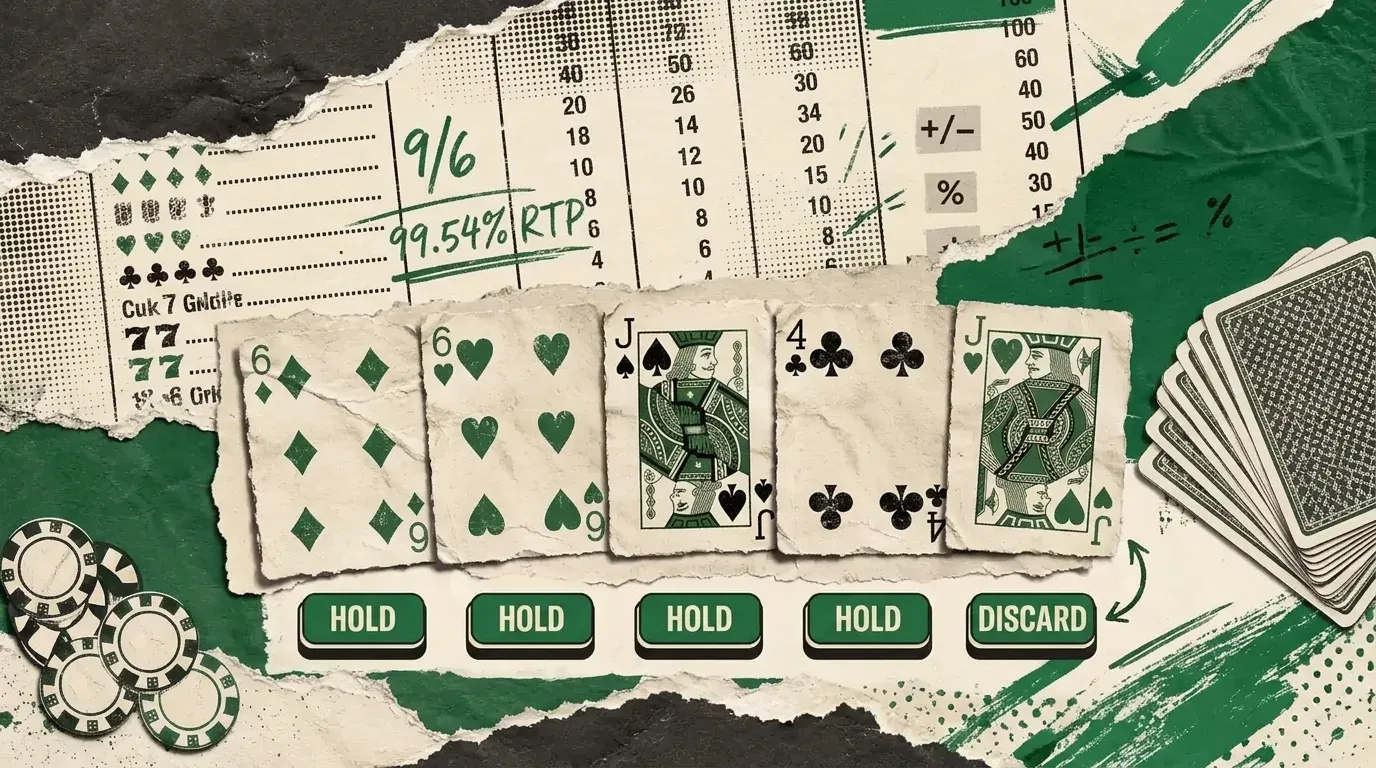
What does 9/6 Jacks or Better mean?
This is probably the single most useful thing to understand about video poker.
The numbers 9/6 describe two payouts in the pay table.
In full-pay Jacks or Better:
- Full house pays 9 for 1
- Flush pays 6 for 1
That is where "9/6" comes from.
A standard full-pay table looks roughly like this:
| Hand | Payout per unit |
|---|---|
| Royal flush | 800 |
| Straight flush | 50 |
| Four of a kind | 25 |
| Full house | 9 |
| Flush | 6 |
| Straight | 4 |
| Three of a kind | 3 |
| Two pair | 2 |
| Jacks or better | 1 |
Played with optimal strategy, this version returns about 99.54% RTP.
That leaves a house edge of around 0.46%.
Which is ridiculously low for a casino game.
But again, there is a catch.
You need the right pay table.
Why the pay table matters so much
Imagine two Jacks or Better games sitting beside each other.
Same cards.
Same graphics.
Same rules.
One is 9/6.
The other is 8/5.
That tiny-looking difference means:
- Full house drops from 9 to 8
- Flush drops from 6 to 5
Doesn't sound catastrophic, right?
Except the long-run return drops from about 99.54% on 9/6 Jacks or Better to roughly 97.30% on an 8/5 version, assuming appropriate strategy.
That is a massive difference.
Your theoretical house edge has gone from around 0.46% to around 2.70%.
The game barely changed visually.
The maths changed completely.
This is exactly why we keep hammering the same point across casino games: read the rules before you play.
Our guide to what RTP actually means explains why a couple of percentage points make a meaningful difference once you start putting large amounts of turnover through a game.
The basic video poker strategy
Video poker strategy is basically one question:
Which cards should I keep before drawing replacements?
The answer depends on which possible final hand gives you the highest expected value.
You are not simply holding whatever looks strongest right now.
Sometimes it is better to break an existing hand to chase something much more valuable.
For full-pay Jacks or Better, a simplified priority list looks something like this:
- Royal flush, straight flush or four of a kind
- Four cards to a royal flush
- Full house, flush, straight or three of a kind
- Four cards to a straight flush
- Two pair
- High pair, jacks or better
- Three cards to a royal flush
- Four cards to a flush
- Low pair
- Four cards to an open-ended straight
- Two suited high cards
- Other promising straight-flush draws
- High cards
- Discard everything if the hand has no useful value
That is deliberately simplified.
There are edge cases where suit, card rank and exact draw structure change the correct decision.
But this gets you much closer than just staring at the cards and guessing.
Example: low pair vs four to a flush
Let's say you receive:
3♠ 3♦ 6♥ 9♥ Q♥
You have a pair of threes.
You do not have four cards to a flush, so keeping the pair is obvious.
Now imagine:
3♥ 3♦ 6♥ 9♥ Q♥
Now you have a low pair, but you also have four hearts.
Which do you keep?
In full-pay Jacks or Better, four cards to a flush ranks above a low pair in the standard strategy hierarchy.
So you break the pair and chase the flush.
That feels strange at first.
You are throwing away a made hand.
But video poker strategy is based on expected value, not on whether your current hand looks comforting.
High pairs vs low pairs
This distinction matters a lot.
A high pair means:
- Jacks
- Queens
- Kings
- Aces
A high pair already gives you a paying Jacks or Better hand.
A low pair does not.
So high pairs normally sit higher in the strategy hierarchy.
If you have:
K♣ K♦ 4♠ 7♥ 9♣
you hold the kings.
You are not throwing one away because you can vaguely imagine making a straight.
Keep the paying pair.
Do you ever break a made hand?
Yes.
This is one of the parts of video poker that feels wrong until you understand the maths.
Suppose you already have a straight, but four cards also form a royal flush draw.
The royal flush draw can sometimes be worth breaking the straight for because the payout is so much larger.
But you should not randomly destroy paying hands just because a royal flush is possible.
The exact hierarchy matters.
That is why proper strategy charts exist.
Stop chasing the royal flush
This is probably the easiest way to ruin otherwise decent video poker play.
The royal flush payout is enormous.
So naturally people start seeing royal flushes everywhere.
You get two suited high cards and think:
"Well, technically..."
No.
You cannot spend the whole game sacrificing stronger hands for tiny royal flush chances.
The royal is important to the theoretical RTP, but optimal strategy only chases it in specific situations where the expected value actually supports doing so.
The game does not reward optimism.
It rewards maths.
Does betting the maximum matter?
Check the pay table.
Traditional video poker machines often give a disproportionately large royal flush payout when the maximum number of credits is wagered.
A common structure might pay 250 credits per credit for a royal flush at lower stakes, then jump to the equivalent of 800 per credit when the maximum bet is used.
If your game works like that, playing fewer credits changes the effective RTP.
Online versions do not all handle this identically.
So before assuming "maximum coins" is mandatory, look at the exact pay table.
Never increase your stake blindly because somebody told you video poker always requires max bet.
Video poker strategy depends on the game
Jacks or Better is only one version.
Other common variants include:
- Bonus Poker
- Double Bonus Poker
- Double Double Bonus Poker
- Deuces Wild
- Joker Poker
The strategy changes because the pay table changes.
In Deuces Wild, for example, all twos act as wild cards.
That completely changes which hands you should keep.
So a Jacks or Better strategy card should not be dragged into an entirely different game.
If you are comparing casinos partly by game quality and RTP, our highest payout casinos in the UK look at the wider casino rather than one video poker machine.
Can strategy remove the house edge?
Usually, no.
This is important.
Optimal strategy does not magically make every video poker game profitable.
It lets you achieve the return built into that specific pay table.
If the table returns 99.54% under perfect play, playing perfectly gets you close to 99.54%.
It does not turn it into 105%.
And if you choose a terrible pay table, perfect decisions cannot rescue the underlying maths.
You need:
Good pay table + correct strategy
Not one or the other.
Video poker vs slots
This is where video poker becomes genuinely interesting.
On a normal slot, you press spin and the game does the rest.
There is no decision halfway through that lets you improve the RTP.
Video poker gives you meaningful control over which cards are held.
That makes it much closer to blackjack than a traditional slot from a strategy perspective.
The trade-off is obvious:
If player decisions can improve the return, player mistakes can also reduce it.
So someone playing 9/6 Jacks or Better terribly is not actually getting the headline 99.54% RTP.
That figure assumes optimal decisions.
Where can you play video poker in the UK?
Video poker is a smaller online category than slots, roulette or blackjack, so availability varies quite a bit between casinos.
The easiest approach is to search the game lobby for terms such as:
- Jacks or Better
- Deuces Wild
- Bonus Poker
- Power Poker
- Video Poker
Do not confuse those with actual multiplayer poker rooms.
If your goal is casino games rather than poker tournaments or cash tables, start with our UK online casino guide rather than assuming a poker-branded site automatically has the best video poker selection.
The simplest way to think about video poker
Video poker is one of the rare casino games where the player can make a real mathematical difference.
But you cannot just memorise "video poker has 99.5% RTP" and stop there.
Ask two questions:
Which pay table am I playing?
Am I using the correct strategy for that pay table?
If either answer is wrong, the headline return is irrelevant.
That is the game.

Alan Woods
Content Editor
Alan reviews Irish casinos the same way he used to assess security risks: nothing gets the benefit of the doubt until it holds up under scrutiny. His cyber security background means he checks the things most reviews overlook, like licensing, how a site handles your data, and what the withdrawal terms actually deliver once the welcome offer is out of the way. He’s a published author as well, so you get the verdict in plain English instead of a technical checklist.
Share this article