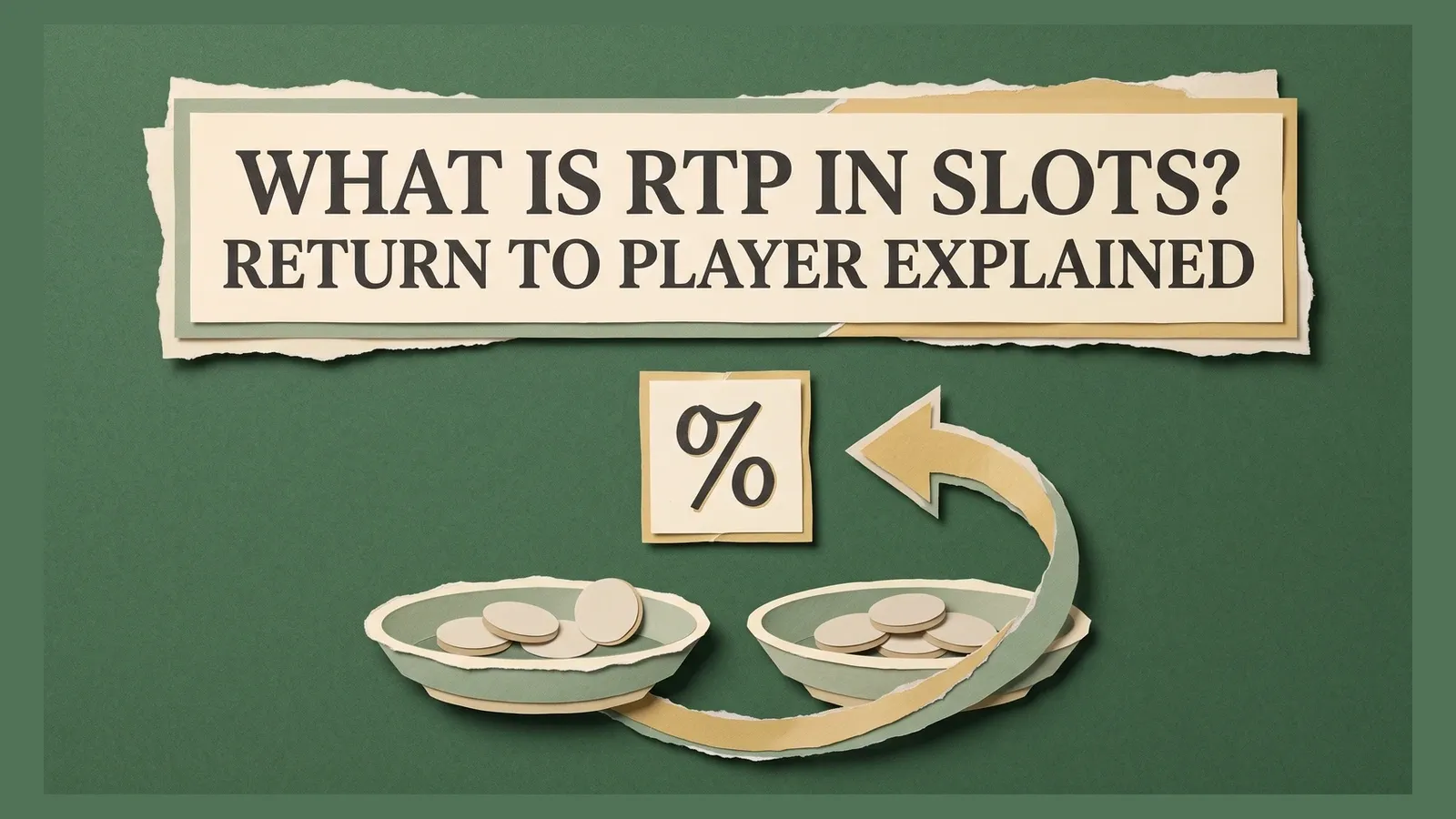
What is RTP in slots? Return to player explained
RTP is the percentage a slot returns over millions of spins - not your session. How it works and why the same game can have different RTPs at different casinos.

Key Takeaways
- RTP is a theoretical long-run percentage of total stakes, not a promise about your deposit or session.
- At 96% RTP, the theoretical house edge is 4%; short-term results can differ sharply from that average.
- Check the RTP of the casino's actual game version and assess volatility separately.
RTP in slots, short for return to player, is the share of stakes a slot pays back as winnings across an enormous number of spins, hundreds of millions rather than a single Friday night. At a 96% RTP, the average return is £96 for every £100 wagered, and the casino keeps the remaining £4. That 4% is the house edge.
RTP is a long-run average, not a promise for your next session. In 2026 there is an extra wrinkle: unless you check the game's own info screen, the RTP advertised elsewhere may not match the version running at your chosen casino.
How is RTP calculated in slots?
RTP is calculated as the total amount returned divided by the total amount staked, not as a share of losses. Multiply the RTP by your total stake to find the expected return: put £200 through a slot with a 96% RTP and, on average, £192 is returned, leaving £8 as the typical long-run cost of play. A 96% RTP means you lose about 4p per £1 staked on average; at 92%, it is 8p.
Every bet you place counts, whether you win or lose that round. Stake £1, win £5, then stake £1 again, and you have wagered £2 in total, regardless of what you took home on that one lucky spin.
RTP and house edge
House edge and RTP are two sides of the same figure, so a 96% RTP equals a 4% house edge. For comparison, European roulette usually sits at about 97.3% RTP (2.7% edge), while blackjack played with solid strategy can drop below a 0.5% edge. Most UK slots fall between 94% and 96% RTP, though lower versions, covered below, now run as low as 88.51%. A £5 spin at 92% RTP carries an expected cost of 40p per go, before luck or variance enter the picture.
What is the difference between theoretical and actual RTP?
Theoretical RTP is the certified figure the game is programmed to return over an immense number of spins, and actual RTP is what a real sample of play returns. Theoretical RTP is the certified percentage in the game's info screen, which operators must make available by regulation. Actual RTP is the amount returned divided by the total staked in the sample being measured.
As the sample grows, actual RTP tends towards theoretical RTP, but there is no fixed number of spins at which the two must match. Across a typical 200-spin session they can be worlds apart. That is not a bug or a sign something is amiss; it is statistical variance at work.
A losing streak on a 96% slot is not evidence the game is dodgy, and a lucky spell on a 92% slot does not mean it is suddenly generous. Neither outcome reveals much about the underlying payback.
How does volatility differ from RTP?
Volatility describes how a slot pays, while RTP describes how much it pays back over the long run. Two slots can both have a 96% RTP and play out completely differently, because of how slot volatility and variance work.
A low-volatility slot pays out regularly in smaller amounts, keeping your balance ticking over with steady, modest returns. A high-volatility slot can hold onto your cash for ages before delivering bigger and rarer wins. Even with the same RTP, your session budget can disappear much quicker on a high-volatility game.
If stretching out your session is a priority, a low-volatility slot with a 95% RTP usually lasts longer than a high-volatility slot at 96%. Volatility shapes the journey; RTP sets the destination.
Why can the same slot have different RTPs at different casinos?
Major slot developers, such as Pragmatic Play, Big Time Gaming and Nolimit City, supply each game in several RTP configurations, and the operator chooses which version to run. You might find the same slot at 96%, 94%, or even 88.51%, all from the same developer. The reels, features and graphics remain unchanged; only the long-term payback shifts.
Running a lower version is not underhanded as long as the version in play is clearly shown in the game's info screen, as required by the Gambling Commission's technical standards. The Gambling Commission (UKGC) is the regulator that licenses online gambling in Great Britain.
Why operators are lowering RTPs in 2026
Remote Gaming Duty, the tax on online casino gross gaming yield, jumped from 21% to 40% in April 2026, almost doubling what operators owe. Industry analysis from April 2026 shows UK operators have switched to lower-RTP versions of slots after the duty rise to protect their margins, with some games moving from 96% to 94% or as low as 88.51%. The visuals do not change, but the payback does.
Never rely solely on RTP figures from review sites or general listings, which often show the highest certified variant. The only figure you can trust is the RTP shown in the game's info screen at your chosen casino.
How do you find the RTP of any slot?
Open the info screen inside the game itself, usually marked with an (i) or (?) icon in the corner. It shows which RTP version your casino is running.
RTS 3C (the UKGC's technical standard on game rules and the likelihood of winning) requires accessible information about the chances of winning before play, which may be expressed through RTP, house edge or relevant probabilities. Check the rules for the exact slot version you open. If a UK-licensed casino fails to provide this, it is a compliance issue worth flagging.
You can also check the game's help page, the developer's official site, which lists all certified RTP variants, or the operator's own game info pages. The developer's page shows every version available, not necessarily the one your casino has chosen, so cross-reference with the in-game figure.
Does RTP actually matter?
RTP matters little over one evening and a lot over a year of regular play. For the casual player who pops in once a week, variance overshadows any effect of RTP over a handful of spins, and the gap between 94% and 96% RTP is about £2 per £100 staked.
For anyone who plays regularly, the difference adds up. At £100 of play per week, a 96% slot racks up expected losses of roughly £200 a year; switch to a 92% slot and that cost jumps to £400. RTP is also handy for comparing casinos: one that is upfront about its RTP versions, or defaults to higher ones, is sending a positive signal.
RTP can never predict a specific result. No percentage, high or low, tells you what is coming next, so treat it as a rough cost guide over time, not a guarantee. Slots are built to pay out less than they take in, and any entertainment comes from the play itself, not the prospect of profit. Set a budget before you start, double-check the in-game RTP rather than relying on headlines, and choose a volatility that matches your budget.
Where to find higher-RTP slots at UK casinos
Higher-RTP play starts with choosing a casino that shows its RTP versions openly. Our ranking of highest payout casinos in the UK orders sites by RTP, and the best slot sites in the UK list covers where to play. For a fairness view of how outcomes are generated, read whether online slots are rigged, and see which casino game has the best odds for RTP across other games. To keep your spend in check, use responsible gambling tools such as deposit limits.
Safer gambling: RTP is a useful measure, but no percentage makes losses worthwhile. If gambling is becoming a concern for you or someone you know, the National Gambling Helpline is free and available 24/7 on 0808 8020 133.

Alan Woods
Content Editor
Alan reviews casinos the same way he used to assess security risks: nothing gets the benefit of the doubt until it holds up under scrutiny. His cyber security background means he checks the things most reviews overlook, like licensing, how a site handles your data, and what the withdrawal terms actually deliver once the welcome offer is out of the way. He’s a published author as well, so you get the verdict in plain English instead of a technical checklist. In the UK edition, he focuses on UK Gambling Commission licensing, player protections and the terms attached to casino offers.
Share this article
Frequently asked questions
RTP stands for return to player, the percentage of all stakes the game is designed to pay back as winnings over a very large number of spins. A 96% RTP means the casino keeps 4p from every £1 staked on average, calculated across millions of game rounds.
It is broadly in line with the UK market average. The range on licensed UK slots runs roughly from 88% at the lower end to around 99% at the top. For regular players, a few percentage points add up over time: 95% costs roughly twice as much per £100 staked as 97.5%.
No. Each spin is independent: the RNG (random number generator) generates a fresh result every time with no memory of what came before. RTP is a statistical property built into the game's maths, not a meter that fills or resets. A run of losses does not make the next win more likely.
Not on individual spins. RTP tells you the long-run expected payback across millions of plays; it says nothing useful about what will happen on your next spin or your next session.
Actual results differ from the advertised RTP because of variance. In the short run, whether that is one session or several months of play, results can land well above or well below the theoretical figure. Over a very large number of spins, actual results converge on theoretical RTP. Your session is not large enough for that to show.
Yes. Every casino game has a house edge, which is RTP expressed the other way round. European roulette has an RTP of around 97.3%. Blackjack with correct strategy typically sits above 99%. Table and live games generally carry higher RTPs than most slots, though they are not subject to the UK's online slot stake limits, which apply to slots only.
Related articles

How to Win at Slots: The Honest Guide for UK Players

Mega Moolah Slots and Jackpot Guide: How the Progressive Jackpot Works
Megaways Slots Explained: How They Work and UK Rules

Sweet Bonanza Slot Guide: How the Game, Free Spins and CandyLand Work

Starburst Slots Guide: How the Classic NetEnt Slot Works

Eye of Horus Slots Guide: RTP, Free Spins and How the Game Works