

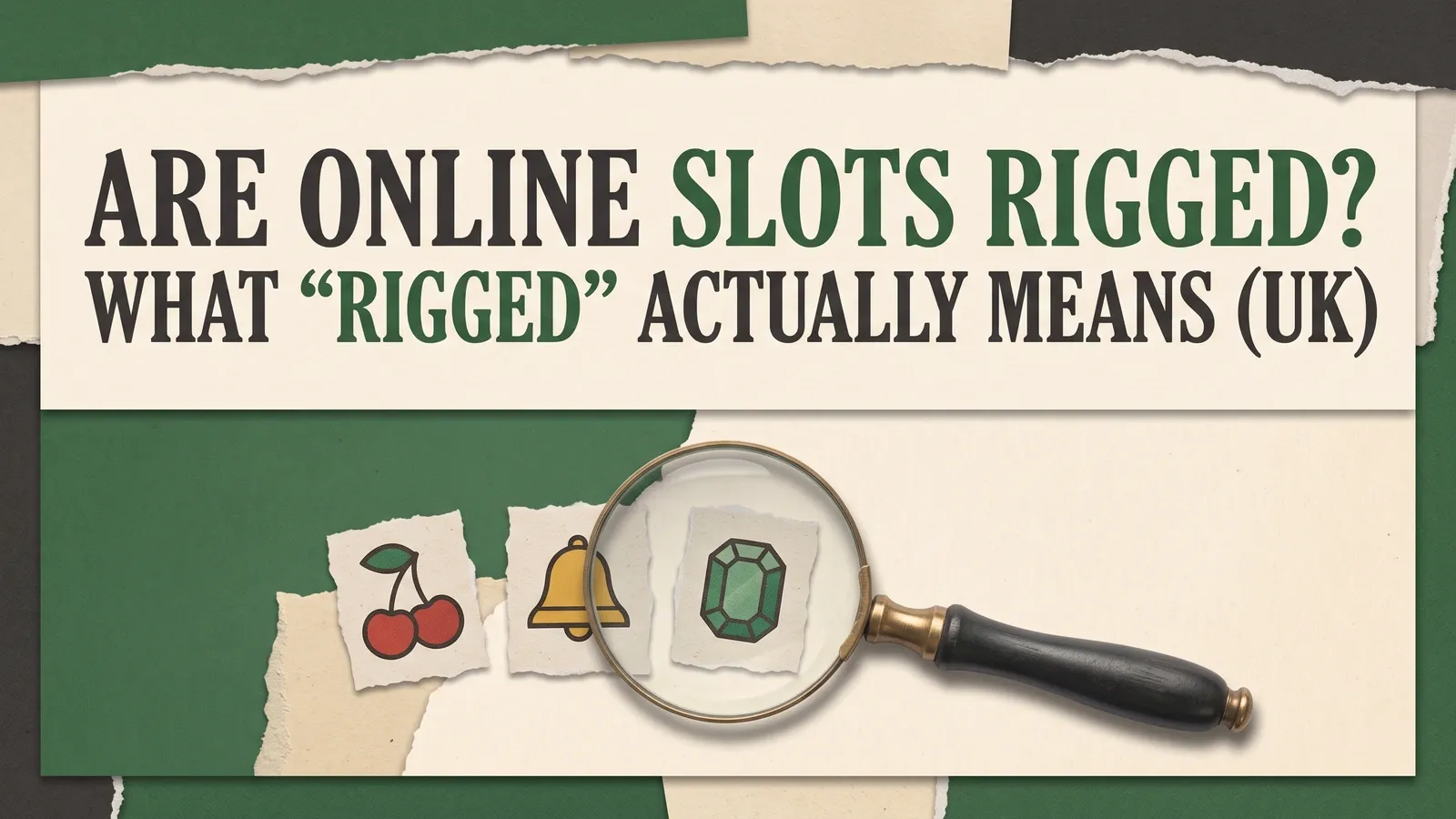
Are Online Slots Rigged? What "Rigged" Actually Means (UK)
How UK slot fairness really works: independent RNG testing, the ban on games that adapt to your results, certified RTPs, and the unlicensed sites to avoid.

Key Takeaways
- UK rules require acceptably random outcomes and prohibit compensated games that adapt to past results.
- RTP is a long-run expected return, not a promise for your session.
- Different certified game versions can have different RTPs, so check the rules at the site you use.
Are online slots rigged? What "rigged" actually means
UK-licensed online slots must meet randomness and fairness requirements, including a ban on compensated games that adjust outcomes to past results. Those safeguards are not a guarantee that a fault or breach can never occur; a disputed result still needs evidence and investigation.
But "not rigged" doesn't mean "not built to profit". Slots are upfront about making money, and the maths behind it is right there in black and white. Most debates start with muddling up these two very different ideas.
This guide walks through how every spin is decided, who keeps an eye on proceedings, why losing streaks can feel suspicious even when they're not, and the single place where genuine rigging can still take place.
What "rigged" would actually mean
A rigged game is one that cheats: outcomes stitched up against you, results shifting after you've had a decent run, a machine that somehow "knows" when it's time to pay out or hold back. That's the accusation - and at licensed UK sites, every bit of it is both banned outright and routinely checked for.
A house edge is another matter entirely. It's simply the part where the game returns slightly less than it takes in - by design, and for all to see, with the exact percentage set out in the game's info. There's nothing sneaky or scandalous here; it's the cost of playing, just as a bookmaker's odds always build in a little for the house.
Here's the blunt but honest truth: casinos don't need to fix anything. The maths already guarantee their margin - legally, out in the open. Cheating would mean risking a licence worth millions, just to pinch what the house edge already brings in.
How a spin is actually decided
Every slot result is produced by a random number generator - software that churns out outcomes which, under Gambling Commission rules, must be "acceptably random" and able to prove it through statistical testing.
Two things matter most for the "rigged" debate. First, each spin is truly independent: the game neither knows nor cares if you've just won, lost, or spent hours playing. Second, the same rulebook explicitly bans what's called 'adaptive behaviour' - so-called "compensated games" that change their results to claw back a big win or hit a target. These aren't just missing from UK casinos; they're banned by name.
That one line in the rulebook quietly puts most rigging theories to bed. A slot that "tightens up after a jackpot" isn't just a myth here - it's outright illegal.
Who checks, and how
Before a game even lands in front of UK players, it's put through its paces by an independent test house approved by the Gambling Commission - labs that have to hold serious international credentials. Only then does the test report go to the regulator's register ahead of launch.
Testing is far more thorough than most imagine. Labs hammer the games with millions of automated spins to check that the actual return sits within a fair range of what's advertised. They even simulate rare events - like jackpots and max wins - to make sure they do turn up, and play through manually to check every payline and feature behaves as promised. Big updates mean more retesting, suppliers face annual games audits, and operators have to pass yearly independent security checks. Even live dealer studios are held to their own strict standards and inspections.
None of this means slots are a smart way to make money. But it does put to rest the idea that "the games are fixed" is why players lose.
The house edge: how slots profit without cheating
Every game has a return to player percentage on UK slots, which is usually between 94% and 96%. If a game has a 96% RTP, it means that, in theory, across millions of spins from all players, it pays back £96 for every £100 staked and keeps £4 for itself.
The crucial point: that's a long-term average across the whole crowd, not a guarantee for your own session. In a single evening, anything can happen - a doubled balance or a wiped-out one - and both fit perfectly with a fair 96% game. How a slot's volatility rating works is what shapes the experience: two slots with identical RTP can feel worlds apart, one trickling out little wins, the other paying rarely but in lump sums.
This is the honest heart of the matter. Slots cost players money over time - not because anyone's meddled with the outcome, but because that's how they're built, openly and at a declared rate.
The number worth checking, and why it differs between casinos
Here's the legitimate reason why "the same slot pays differently at different sites" - because it does. Providers often release several versions of a game, with different RTPs: a 96% build, a 94% one, sometimes even lower, each using its own maths model. It's up to the casino to pick which version to offer.
There's nothing underhanded about it: every version is tested, and the numbers are right there in the info screen. But it does mean that the well-known slot you've played at 96% might be running a leaner build where you are. At UK sites, game rules and return details have to be available - so it's worth a quick look before you settle in. Our guide to UK casinos with visible title-level RTP keeps track of which casinos run the more generous builds.
Why losing streaks feel rigged
The feeling is real, even when the fix isn't, and there are solid reasons for it. Random results come in clumps, so even a fair game can throw up streaks that feel anything but fair. We expect randomness to balance out over a night, when in truth, the maths only smooths out over millions of spins.
Memory does the rest. A rough losing streak, or a bonus round that pays out pennies at the worst possible moment, lingers in the mind far more than the steady stream of ordinary wins - so our impression of a slot is often gloomier than its real record. This isn't a failing; it's simply how all our brains handle chance. Which is exactly why "it feels rigged" and "it is rigged" need separating, and why all that testing above exists - to settle things with data, not hunches.
If playing sessions regularly leave you frustrated or chasing losses, it's worth treating that as a nudge about the habit - not the software. The tools for keeping your play in check are there for exactly this reason.
Five beliefs, checked against the rulebook
"Demo mode plays looser than real money." Not according to UK rules. Free-play games must use the same rules and odds as the real thing - and a demo that pays out differently would be a breach. The difference most people feel comes down to stakes: losing in demo mode doesn't sting, so the whole thing feels luckier.
"Slots run hot and cold." Streaks do happen, but it's just randomness, not the machine "changing its mind". Each spin is independent, and if a game's odds did shift with results, it would break that strict ban on adaptive behaviour.
"It tightens up after a big win." Same answer again - this is the textbook example of a compensated game, and it's banned outright by the standards.
"They pay better at night, or when it's busy." There's simply no mechanism for this. The RTP belongs to the certified game build - not some dial the pit boss fiddles with after dark.
"The casino can quietly change the odds." Not quietly, no. Switching a game to a different RTP means loading up a separate certified version with published figures, and any big change means a fresh round of retesting. It's worth checking the numbers at each site, as above - because "disclosed" only helps those who check.
It's also worth noting what UK slots are now barred from doing, since the rules tightened in October 2021: no autoplay, no turbo modes, no features pretending to give you control, a minimum 2.5 seconds per spin, and no flashy sounds or animations when a "win" is actually a loss in disguise. British slots are, by law, slower and more honest about losses than the games many old myths were built on.
Where rigging genuinely can happen
All of the above applies to licensed Great Britain sites. Without a GB licence, those safeguards for player funds and fair casino games do not apply. Another jurisdiction may have its own rules, but that is not equivalent to UKGC oversight or a UK complaints route.
Unlicensed and offshore casinos are where the horror stories start - and where some of them are actually true. There's no real way to tell a fair unlicensed game from a crooked one, which is exactly why it pays to check any casino against the Commission's public register before depositing. Our guide to UK gambling law and how to verify a licence walks you through the sixty-second check.
If you think a game misbehaved
Genuine malfunctions are rare, but they do happen - software is still software, after all. Start by checking your game history, which records every spin and result in your account. If something seems off, contact the operator's support team in writing. If you're not satisfied with their answer, every UK-licensed casino has to offer you a free route to an independent dispute resolution body.
What's worth escalating is a clear discrepancy - a result that showed one thing but paid another, or a feature that didn't work as promised in the rules. "I lost more than felt fair" isn't evidence of a fault, and drawing the line between those two is, in the end, what this whole article aims to clear up.
Frequently asked questions
Are online slots rigged in the UK? No. At UK-licensed casinos, every game's RNG is independently tested before launch, results must be statistically random, and games that adapt outcomes are explicitly banned. The house makes its profit through a published margin, not manipulation.
Do slots remember whether you've won or lost? No. Each spin is independent, and technical standards ban "compensated" games that adapt to previous results. Streaks are simply part of randomness.
Is demo mode the same as the real game? At UK-licensed sites, yes - the rules say so. Free-play versions have to use the same rules and odds as the real thing.
Can a casino change a slot's RTP? Casinos can pick between certified versions of a game with different RTPs, which is why the same slot might pay differently at different sites. Every version is tested and the figure is always shown in the game's info screen - so it pays to check before you play.
How do you know a slot site is fair? Look up the operator on the Gambling Commission's public register before depositing. A licence means tested games, certified RTPs, annual audits, and a free dispute resolution route. Without a licence, none of those protections exist - and that's where genuine rigging happens.
Safer gambling: even fair games will cost money over time - that's how they're built. Only play with what you can afford to lose, set boundaries before you begin, and if gambling ever stops feeling enjoyable, the National Gambling Helpline is open 24/7 on 0808 8020 133.

Alan Woods
Content Editor
Alan reviews casinos the same way he used to assess security risks: nothing gets the benefit of the doubt until it holds up under scrutiny. His cyber security background means he checks the things most reviews overlook, like licensing, how a site handles your data, and what the withdrawal terms actually deliver once the welcome offer is out of the way. He’s a published author as well, so you get the verdict in plain English instead of a technical checklist. In the UK edition, he focuses on UK Gambling Commission licensing, player protections and the terms attached to casino offers.
Share this article