

What Is a Push in Blackjack? Ties, Stakes and the Rules That Matter
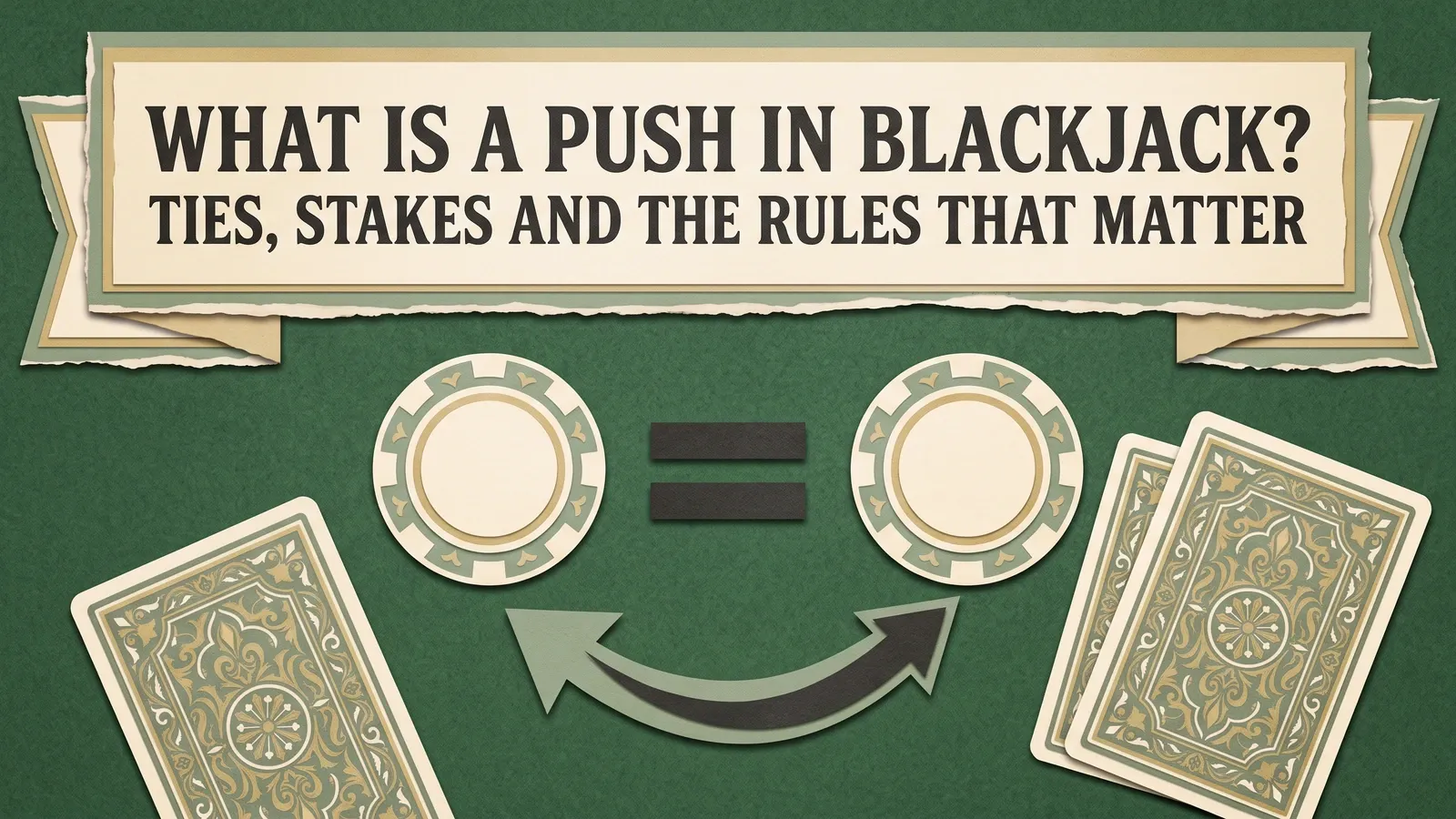
A push in blackjack is a tie: your stake is returned in full. Around 9% of hands end this way. Here's what counts as a push and the key exceptions to know.

Key Takeaways
- A standard push returns your stake without a win or loss.
- A natural blackjack beats an ordinary 21, while two natural blackjacks push.
- Check the table rules and bonus contribution terms before playing.
What is a push in blackjack? Stake back, no strings
A push in blackjack is what happens when your hand and the dealer's land on exactly the same total. It's a draw, plain and simple: your original stake is handed straight back and the round ends there - no winner, no loser, and no chips changing sides.
That's the straightforward bit. The real challenge comes in recognising exactly when a push applies - because a player's 21 and a dealer's blackjack are not the same, even if both add up to 21. Mixing those up can be costly.
The short version
A push - sometimes called a tie or standoff - means your bet is returned, with neither a win nor a loss. Expect it to turn up in about 8 or 9 hands out of every hundred, most often when both sides finish on 20. The next hand begins with your bankroll untouched.
What counts as a push
Any time you and the dealer finish a hand with the same total, it's a push - whether that's 17, 18, 19, 20 or 21. It must be an exact match; being close doesn't count.
Most pushes happen at the higher end - 20 leads the pack, as both players and dealers tend to stand there. Nineteen and 18 tie up much of what's left. Seventeens, however, don't push as often as you might think. That's down to most UK blackjack tables sticking with the "dealer stands on soft 17" rule, though a hard 17 against a hard 17 will still see your chips returned.
The rarest push? That's when both you and the dealer are dealt a natural blackjack - an ace and a ten-value card each, right from the off. In that case, there's no 3:2 payout; just your stake quietly returned, nothing more.
What happens to your bet
Your chips go right back where they began. The round wraps up, cards are swept away, and it's on to the next deal. At a live dealer table, the croupier slides your chips back; in an online game, your balance is topped up automatically and a "Push" or "Tie" message pops up. The end result: your bankroll hasn't budged.
One thing a push doesn't do is help with any bonus wagering requirements. If you're replaying the same chips, the casino doesn't count that as fresh staking for bonus purposes - there's nothing extra to log. More detail on this below, in the wagering section.
How often pushes happen
Expect a push in roughly 8 to 9% of blackjack hands - about one in every eleven or twelve. The precise odds can shift a little, depending on the table rules:
Dealer stands on all 17s: more dealer 17s hang around, nudging the push rate up just a touch. This is the standard at most UK online and live tables.
Dealer hits soft 17: pushes on 17 become less common, as the dealer is more likely to take a card and move off that total, which brings the tie rate down a notch.
Number of decks: honestly, the impact here is tiny. Whether you're playing a single-deck table or a six-deck shoe, the difference in push rate is barely noticeable - just a fraction of a percent, not enough to shape your decisions.
Spanish 21: in this variant, any player 21 beats the dealer's 21, so the usual push rules are out the window and ties are even rarer.
For most UK players sitting at a standard multi-deck table, expect about one hand in twelve to end level. It's all part of the ebb and flow of a typical session.
The exception everyone needs to know
This is the big one to watch for: a dealer blackjack is not the same as a dealer 21.
A blackjack is a natural: an ace plus any ten-value card as the opening two cards. If the dealer has one of these and the player reaches 21 with three or more cards, the dealer wins. The hands are only equal in number, not in type, and the dealer takes the pot. That's a loss for the player - not a push.
The reverse holds as well. If a player lands a blackjack and the dealer makes 21 with more than two cards, the natural wins. If both sides have a two-card 21 in the same round, that's a push - stakes are returned, no questions asked.
UK blackjack: the no-hole-card rule
Under the European no-hole-card rule, the dealer starts with one card and takes the second after the players have acted, which is part of how the dealer's rules vary across blackjack games. Other games, including some live-dealer versions, deal a hole card, so a UK licence does not tell you which dealing rules apply.
This doesn't affect what counts as a push - same total, same outcome - but it does shift the risk if you double down or split against a dealer showing a ten or ace.
In American blackjack, the dealer takes a peek at the hole card right away if they're showing a ten or ace. If they've got blackjack, the round ends there - only your original bet is at risk. In the UK, it's the other way round: you act first. Double down on 11 against a dealer ten, and if the dealer then draws to a blackjack, both your original and double bets are lost. That's a simple loss - not a push.
Check whether a dealer blackjack can take additional split or double stakes before choosing a strategy chart. Use a chart for that table's actual rules, not simply one labelled European or UK. The standard house edge in the UK sits at around 0.5% with proper basic strategy - up by about 0.11% compared to a game where the dealer peeks. Still, these are competitive odds for a casino game.
Pushes and basic strategy
A push doesn't require any change of tack. There's no frustration to manage, no strategy adjustment needed - the hand resets to zero and it's on to the next deal.
Pushes influence strategy in a quieter, structural way. Take standing on a hard 17 against a dealer 10: the classic UK cheat sheet for blackjack basic strategy says to stand, not because it's likely to win, but because hitting 17 busts more often than it helps. In these spots, a push is often the best result on offer, and the chart factors that in.
The same logic holds for standing on 19 or 20 in most spots. Standing makes sense because these totals either tie or win more often than not, and drawing another card risks a bust for little upside. The push rate is baked into the house edge - it's a steady part of the maths, not an outlier, and certainly not a loophole to exploit.
Pushes, bonuses and table game weighting
Anyone eyeing up a welcome bonus at the blackjack table needs to check one number before playing: the game contribution rate.
Blackjack usually only counts for 0 to 10% towards bonus wagering at UK casinos, while slots are counted in full. A 10x wagering requirement on a £50 bonus - the legal maximum since the Gambling Commission's January 2026 cap - means £500 in qualifying stakes if you're playing slots. On blackjack at a 10% rate, you'd need to wager £5,000 to clear the same bonus. Always double-check the contribution table in the terms before you start a bonus-linked session.
That's not a reason to steer clear of blackjack altogether. It's just a reason to keep bonus play and blackjack play separate: clear your wagering on slots where it counts, then enjoy blackjack with clean funds. Our guide to wagering maths and bonus terms covers all the fine print in detail.
For those on the hunt for the right place to play, our review of blackjack sites, rules and reward contributions highlights which UK-licensed casinos offer the fairest conditions for table game players. LeoVegas is a solid pick for live blackjack - a well-established site with a full UKGC licence and an excellent live dealer offering.
Frequently asked questions
What is a push in blackjack? A push is a tie: your hand and the dealer's hand finish on the same total, and your original bet is returned in full. Neither side wins or loses. It's also called a standoff or a tie.
Does a push mean I lose my bet? No. A push returns your original stake with no deductions. Your balance is unchanged when the round closes and you carry into the next hand with the same chips.
What happens if both the player and dealer get blackjack? Both holding a natural (ace plus a ten-value card as the opening two cards) results in a push. You get your stake back rather than the usual 3:2 payout, but you don't lose anything.
Is a player 21 the same as a dealer blackjack? No, and this is the most important exception to know. A dealer blackjack - ace plus a ten-value card dealt as the first two cards - beats a player hand of 21 made from three or more cards. That's a loss, not a push. A push only occurs when both hands finish on the same total and are of the same type.
How often does a push happen in blackjack? Around 8 to 9% of hands, or roughly one in eleven or twelve. Most pushes land on totals of 20, with 19 and 18 producing the bulk of the rest.
Can I still win if we both have 20? No. Both finishing on 20 pushes - your stake comes back, and nobody wins. A player total of 21 beats a dealer 20, whether it is a natural blackjack or an ordinary 21 made with more cards.
Do pushes count towards my bonus wagering requirement? Generally no. Replayed chips on a push aren't counted as new stakes for bonus tracking. Separately, blackjack typically contributes only 0 to 10% towards wagering even on genuine played hands - check the bonus terms before mixing bonus play with blackjack sessions.
Safer gambling: blackjack carries one of the lowest house edges in a UK casino, but the edge holds over time and no outcome on any single hand changes that. Set a deposit limit before you play. The National Gambling Helpline is free and available 24/7 on 0808 8020 133 if gambling ever becomes a problem.

Alan Woods
Content Editor
Alan reviews casinos the same way he used to assess security risks: nothing gets the benefit of the doubt until it holds up under scrutiny. His cyber security background means he checks the things most reviews overlook, like licensing, how a site handles your data, and what the withdrawal terms actually deliver once the welcome offer is out of the way. He’s a published author as well, so you get the verdict in plain English instead of a technical checklist. In the UK edition, he focuses on UK Gambling Commission licensing, player protections and the terms attached to casino offers.
Share this article