

Non-Sticky Casino Bonuses Explained: How They Differ from Sticky
Understand sticky and non-sticky bonus terms, UK rights to withdraw your cash balance, wagering limits and the conditions that still affect withdrawals.

Key Takeaways
- UK withdrawal protections apply to the remaining deposit balance even while a bonus is active.
- Check whether bonus principal becomes cashable or is deducted at withdrawal; this is separate from access to your own funds.
- Bonus wagering, game contributions and withdrawal consequences still matter, and money staked can be lost.
Non-sticky casino bonuses explained: the difference from sticky and why it matters in the UK
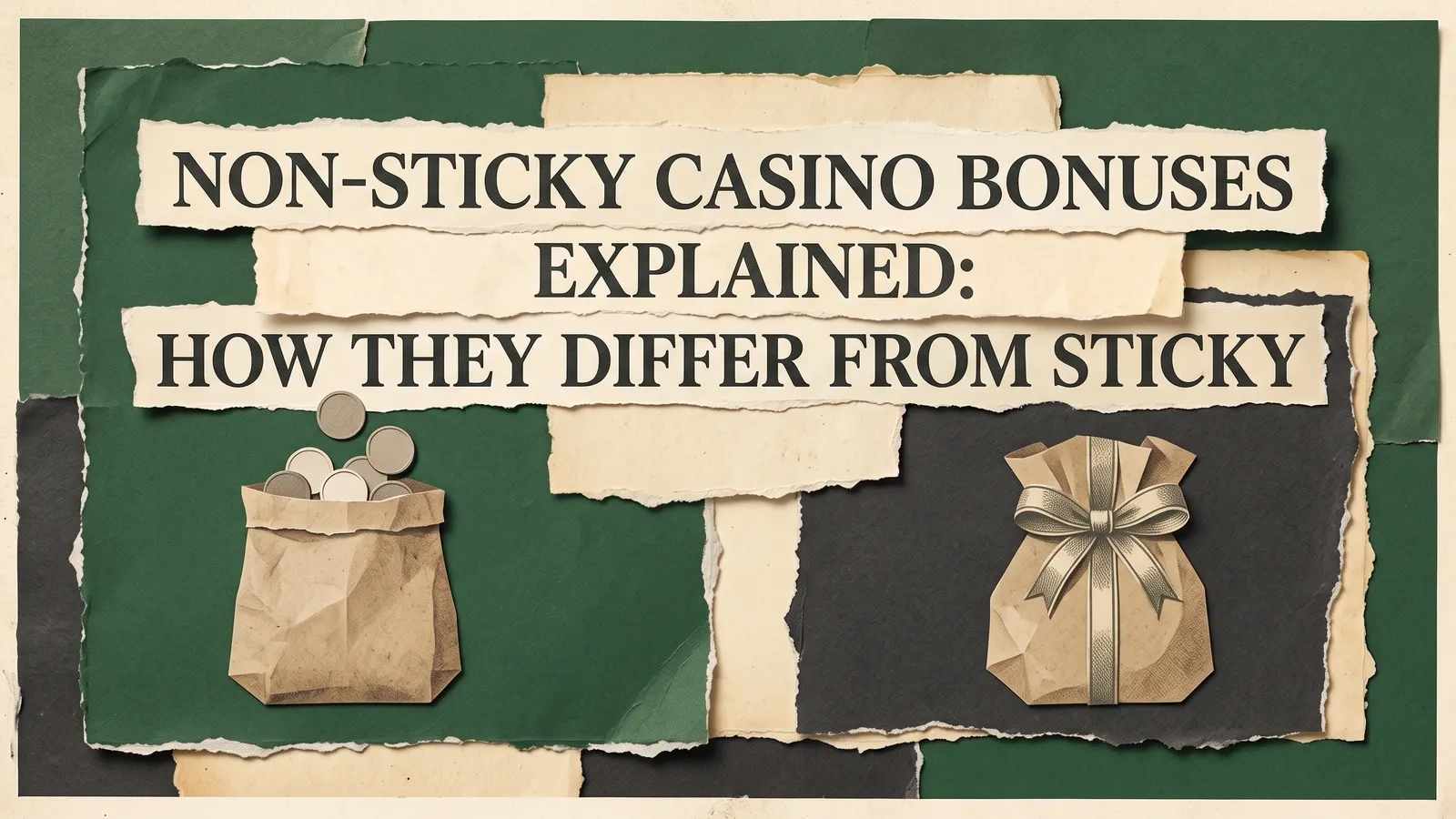
Ever noticed the phrase "non-sticky bonus" tucked away in the terms of a UK casino welcome offer and wondered what it's all about? In a nutshell, your deposit and the bonus sit in separate pots: your money is always yours to take back, while the bonus funds come with wagering requirements. Your real cash remains just that-real and never tied up by the fine print.
Then there's the sticky bonus-the opposite approach. Here, the bonus credit is glued to your account for good; it can't ever be withdrawn as cash. If you manage to score winnings from it and meet the terms, those winnings are yours, but the bonus amount itself is always removed when it's time to cash out.
Truth be told, in the UK, the sticky versus non-sticky debate is mostly a relic. The Gambling Commission makes sure that UK-licensed casinos keep your deposit separate and accessible at all times. So, whether the site shouts about "non-sticky" or not, every proper UK casino runs this way. Still, it pays to know how this works in real life, since a few sneaky variations can still trip people up if you're not paying attention.
What is a non-sticky bonus?
With a non-sticky bonus, your real money and bonus funds are kept in two distinct buckets. Put in £50 and get a £50 bonus, and your account will show both: your cash (which you can withdraw whenever you like), and bonus credit (which needs to be played through before it's yours).
Most UK casinos use a deposit-first arrangement. Your own cash is played first, so if you win while your real money is in action, that's all yours-full stop. Only when your deposit is gone does the bonus step in, and that's when the wagering requirement comes into play. These days, UKGC rules cap the playthrough at 10x the bonus value. So, a £50 bonus means you won't be asked to wager more than £500 before any winnings from the bonus are released.
The real highlight is what happens if you change your mind. You can pull out your deposit at any stage-even halfway through a promotion. Any leftover bonus funds are forfeit, but your cash was never locked away to begin with. That protects access to your remaining cash balance; it does not protect money you choose to gamble from being lost.
What is a sticky bonus?
A sticky bonus flips the script. The bonus funds land in your account, but they're permanently non-cashable-hence the "sticky" label. When it's time to cash out, the casino takes back the original bonus, and you keep whatever is left above that line.
Suppose you grab a 100% sticky bonus on a £100 deposit, giving you £200 to play with. Let's say you turn that into £350 during a lucky run and decide to cash out. The casino will strip out the £100 bonus first, leaving you with £250. The bonus helped keep your session going, and your winnings are real cash-but the bonus itself was always destined to vanish at withdrawal.
Sticky offers are still fairly common outside the UK and can look tempting-a bigger headline bonus gives you more playtime. But because the operator always reclaims the bonus funds, these deals are often designed to keep players spinning longer than non-sticky ones. For those playing in the UK, sticky bonuses are mostly just a piece of casino history.
Why non-sticky is the UK standard
The Gambling Commission's stance on withdrawing deposits couldn't be clearer: operators must let you take back your deposit at any time, even if a bonus is live. Deposit and bonus balances must always be shown separately, and wagering requirements can't touch your own funds. It's as straightforward as that.
That's why true sticky bonuses-where deposit and bonus get lumped together and neither can be touched until you've met the wagering-just aren't allowed under a UK licence. If a casino tries to lock up your deposit until you've played through a promotion, it's breaking the rules. The Commission simply doesn't allow wagering to be applied to your real money.
In practice, UK-licensed casinos must protect access to the deposit balance. Whether the bonus principal itself is cashable is a separate term, so the sticky/non-sticky label does not by itself establish compliance. "Non-sticky" isn't something you'll often see splashed across offers-it's just the default. These UKGC licence protections for complaints and safer gambling are built into the licence conditions, not left for operators to market as a special feature.
The 10x cap and how it applies
Non-sticky bonuses have been the UK standard for years. The January 2026 rule change reined in the maximum allowed wagering on the bonus portion. Before this cap, non-sticky offers could still come with 30x, 35x, or even 40x playthrough requirements. Now, under the Gambling Commission's rules, operators can't ask for more than 10x the bonus value in qualifying bets before winnings are released.
For a £50 non-sticky bonus, that's a maximum of £500 in play. By contrast, a 40x requirement on the same bonus used to mean £2,000 of wagering. That kind of number could do real damage-thankfully, it's now off the table.
Of course, the cap fixes the multiplier, not the small print. Game weighting is still very much in play: slots usually count 100% towards clearing the requirement, but table games and live casino are often weighted at 20% or less. That can turn a 10x requirement into a much steeper climb for anyone who prefers those games. There's a full breakdown of how it all works, including the quirks covered in our guide to wagering requirements and game-weighting rules.
Combined wagering: the variation worth knowing about
Within the non-sticky setup, there's one variation that tends to catch people out: combined wagering. Here, the requirement is worked out on your deposit plus the bonus, instead of just the bonus.
For example, deposit £50 and get a £50 bonus, and the offer might say "5x deposit + bonus". That's five times £100, so £500 in total play required. A "10x bonus only" requirement on the same offer would ask for the same amount. The two can look different but land in the same place-but the requirement must still comply with the 10x bonus cap.
The language really does matter. "10x the bonus" and "5x deposit + bonus" might look similar at first, but the results can be very different depending on the maths. Any offer that includes your deposit in the wagering calculation deserves extra scrutiny. Always check whether the terms say "bonus only" or "deposit plus bonus" before jumping in.
Non-sticky vs sticky: which is better?
For UK players, the comparison is mostly academic, as some form of non-sticky is what you'll get at any licensed site. Still, it's worth being clear-eyed about the value, especially if you ever find yourself looking at non-UK options or reading up on global bonus types.
Non-sticky comes out ahead on just about every front that matters. Your remaining deposit balance is not locked behind bonus wagering, but any money you stake can be lost, wagering on the bonus is now capped at 10x, and you can cut your losses and take back your cash at any stage. There's no situation where your own money gets tied up because of some fine print you missed.
Sticky offers can seem more generous at first glance-a 150% or 200% sticky bonus looks like a lot more firepower than a 100% non-sticky match. But that headline number is misleading, as the bonus credit is always going to vanish at cashout. In reality, you're just getting a bigger balance to play with, but the end result is much the same as a smaller non-sticky offer. In short, non-sticky is the honest deal.
Within the world of non-sticky offers, though, there's still a wide range in quality. The best are no-wagering deals, where any bonus winnings are paid out as cash with nothing to play through-about as straightforward as it gets. Our guide to UK casino welcome bonuses and reward types takes a closer look at the current UK offers by structure, so you can see clearly what's actually worth considering.
How to tell which type you're looking at
UK casinos rarely label their offers as "sticky" or "non-sticky". What actually matters is the small print in the terms.
You're looking at a non-sticky structure if the terms mention things like: "your deposit will be used before your bonus funds", "your deposited balance isn't subject to wagering requirements", or "you may withdraw your deposit at any time". Your account should also show two separate balances-one for real money, one for the bonus. If both are clear, that's the non-sticky setup.
A sticky-type structure pops up if the terms include phrases like: "bonus funds are non-cashable", "the bonus will be removed from your balance on withdrawal", or "only winnings from the bonus can be withdrawn". At any UK-licensed casino, even these offers should keep your deposit separately accessible-your real cash must never be locked in, only the bonus credit itself is non-cashable. If you're in doubt, check that your balances are shown separately, and don't hesitate to ask support if something looks off.
What you should never see at a UK-licensed site is a single, merged balance where your deposit and bonus are bundled together and there's no way to access your deposit separately. If that crops up, it's a sign to get in touch with the operator before you play-and to double-check the licence is valid via the UKGC public register before anything else.
Before claiming any offer, set yourself a clear deposit limit. No bonus structure, no matter how fair, is worth playing beyond what you intended.
Frequently asked questions
What does non-sticky mean in a casino bonus? It means your deposit and bonus funds are kept in separate balances. Your deposit is real cash you can take out whenever you like. Only the bonus comes with a wagering requirement, and at UK-licensed sites that's now capped at 10x.
What is a sticky bonus? That's where the bonus credit can never be withdrawn-it's non-cashable for good. When you cash out, the casino removes the original bonus amount, so you only keep any winnings above that. Old-school sticky bonuses, where your deposit is also locked until you meet the wagering, don't fit with UK licensing rules anymore.
Are sticky bonuses allowed at UK casinos? Not in the traditional sense. The Gambling Commission insists that deposit and bonus balances are always shown separately, and you must be able to withdraw your deposit at any time-even with an active bonus. Any structure that locks up your deposit doesn't comply. Some UK operators do run "non-cashable" bonuses where only the bonus can't be withdrawn, but your own cash still has to be accessible.
Is non-sticky always better? For the vast majority of players, yes. Your remaining deposit balance is not locked behind bonus wagering, but any money you stake can be lost, the wagering is capped, and you can walk away from the bonus if it's not working for you. Sticky offers might look bigger on paper, but the bonus always gets deducted at cashout, so the real value is limited.
What is combined wagering on a casino bonus? That's where the playthrough is calculated on your deposit and bonus together, rather than just the bonus. A 5x combined requirement on a £50 deposit and £50 bonus means £500 in total play, which is the same as 10x bonus-only. The combined calculation must still comply with the 10x bonus cap, and wagering conditions cannot restrict your deposit balance.
How do I know if my bonus is non-sticky? Look for two clear balances in your account-one for real cash, one for bonus funds. The terms should say your deposit isn't subject to wagering and can be withdrawn at any time. If you only see one merged balance, or the terms don't mention separate access to your deposit, ask the casino's support before playing.
Safer gambling: bonuses should help you decide where to play, never be a reason to play more. If gambling is causing concern for you or someone you know, the National Gambling Helpline is free and available 24/7 on 0808 8020 133.

Alan Woods
Content Editor
Alan reviews casinos the same way he used to assess security risks: nothing gets the benefit of the doubt until it holds up under scrutiny. His cyber security background means he checks the things most reviews overlook, like licensing, how a site handles your data, and what the withdrawal terms actually deliver once the welcome offer is out of the way. He’s a published author as well, so you get the verdict in plain English instead of a technical checklist. In the UK edition, he focuses on UK Gambling Commission licensing, player protections and the terms attached to casino offers.
Share this article