

How Open Banking and Pay by Bank work at UK casinos
How Open Banking and Pay by Bank work at UK casinos: the deposit flow, withdrawals, security model, bonuses, and what the financial check means for players.

Key Takeaways
- Pay by Bank lets you authorise a payment through your bank rather than entering card details at the casino.
- Fast deposits do not guarantee fast withdrawals; check the casino’s supported payout route.
- Bank login credentials and payment account details are different, and bonus eligibility still depends on the terms.
How Open Banking and Pay by Bank work at UK casinos
Pay by Bank is now a standard option in UK casino cashiers, and it's earning its place there for concrete reasons. It's faster than a traditional bank transfer, keeps your card details entirely out of the picture, and in most cases lets you deposit and collect winnings without ever setting up a third-party wallet. This guide explains what's actually happening under the bonnet, how the security works, what it means for the financial checks that now apply to UK gambling, and the handful of things worth checking before you use it.
What Open Banking actually is
Open Banking launched in the UK on 13 January 2018 and is regulated by the Financial Conduct Authority under the Payment Services Regulations 2017. The short version: it's a secure, legally mandated framework that lets banks share your financial data with approved third-party providers, but only when you explicitly tell them to. No authorisation, no access. Ever.
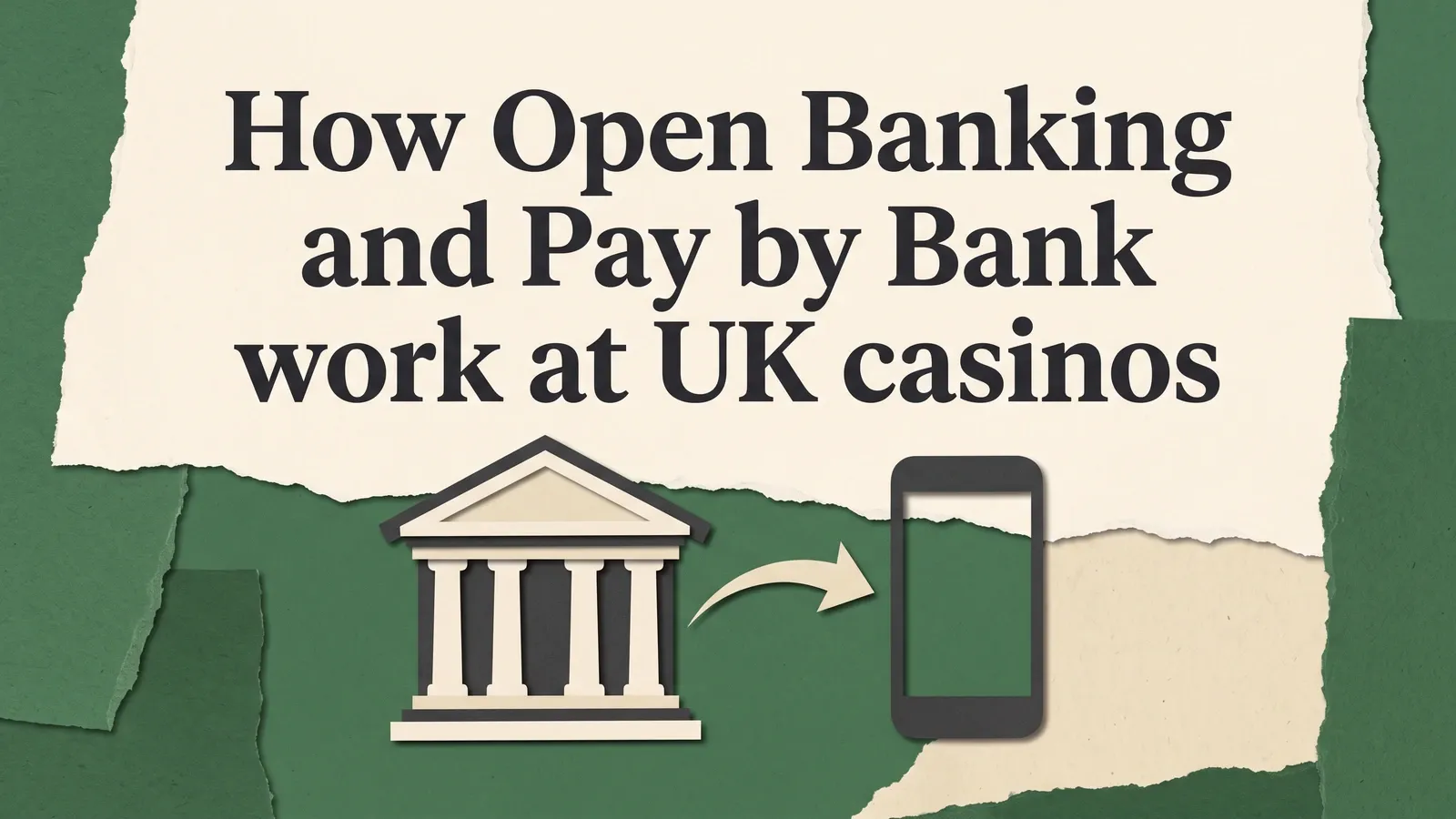
The consumer-facing label "Pay by Bank" is just a name for a payment initiated through this infrastructure. Rather than entering your card number into a casino cashier or logging into a separate e-wallet, you choose your bank from a list, get redirected to your own banking app or browser login, and approve the payment there using your biometrics or passcode. The money moves via Faster Payments, which is the same instant bank-transfer system behind a standard online banking payment between friends or bills.
The scale tells you this isn't a niche option. By early 2026, Open Banking had over 16 million active UK users. In 2025, the system processed 351 million payments - up 57% on the year before. Amazon added Pay by Bank at its UK checkout in 2026 via a TrueLayer partnership. This infrastructure is firmly mainstream.
What happens when you pay at a casino with Open Banking
The flow is short and takes place almost entirely inside your bank's environment, not the casino's.
At the cashier, you select Pay by Bank (or Open Banking, or whatever label the operator uses - it's the same thing), enter your deposit amount, and choose your bank from a list of participating institutions. You're then redirected: either to your bank's mobile app or to a browser login page. There, you review the payment details - amount, recipient - and confirm using Face ID, fingerprint, or a secure passcode. Your bank sends the payment instantly via Faster Payments, and you're returned to the casino site with the deposit confirmed and the funds in your balance.
You authorise the payment through your bank rather than giving the casino your banking password. That is different from keeping all account details private: the payment integration or receiving bank statement may reveal the payer's name, sort code and account number.
Deposits and withdrawals: the real-world speeds
Deposits via Open Banking are near-instant. Because Faster Payments clears in seconds, funds appear in your casino balance almost immediately after you confirm in your banking app. This puts it on a par with a debit card deposit and well ahead of a standard bank transfer, which can take one to five working days.
Withdrawals are where the picture gets slightly more nuanced, and it's worth understanding before you choose your payment method. At operators that have built two-way Open Banking into their cashier, payouts can complete in seconds to around two hours once the operator approves the request - roughly comparable to an e-wallet. At operators that only use Open Banking for deposits and still route withdrawals through a standard bank transfer, the 1-5 business day window applies as normal.
For context: e-wallets such as PayPal, Skrill, and Neteller typically process withdrawals within 0-24 hours. Debit cards take 1-3 business days. Standard bank transfers run from 1-5 business days. Open Banking fills the middle ground on withdrawals, depending on how the operator has implemented it. Checking the cashier or payments page before you play is the only reliable way to know which version you're getting.
Credit cards, for completeness, have been banned for gambling at all UKGC-licensed operators since April 2020 and aren't an option here.
Bank login credentials and payment details are different
This is one of the most practically important differences between Open Banking and older ways of paying online, and it's worth understanding rather than just taking on trust.
Under the Payment Services Regulations, any company initiating a payment on your behalf - TrueLayer, Trustly, or whichever provider sits between the casino and your bank - must be authorised by the FCA to do exactly that, and nothing more. The legal term is a Payment Initiation Service Provider, or PISP. They're licensed to initiate a single payment you've explicitly approved. They are not licensed to log into your account, store your credentials, or request your balance without a separate permission you'd have to grant separately.
When a payment initiates, a temporary, scoped connection opens between your bank and the provider. When the payment completes, it closes. Your banking password is never transmitted to the casino or the payment provider. Payment account details can be available through the integration or bank statement, so do not assume the casino cannot receive or retain them.
In practice, this means that a data breach at the casino - which does happen in the industry - wouldn't expose your bank account credentials, because they were never there to expose. Open Banking fraud sits at just 0.013% of transactions, according to Open Banking Limited data covering March 2024 to September 2025, compared to 0.045% for industry-average bank transfers.
Open Banking and the financial vulnerability check
There's a less-obvious connection between Open Banking and the financial safety layer that UK casinos now operate, and it's worth knowing about.
Since 28 February 2025, operators must run a light-touch financial vulnerability check when a player's net deposits in a rolling 30-day period pass £150. This check uses publicly available data - bankruptcy records, county court judgements, and similar markers of financial distress - rather than your income or bank balance. It doesn't affect your credit score, and for the overwhelming majority of players it completes invisibly in the background.
At much higher spending levels, a deeper financial risk assessment for UK players can apply. This is where Open Banking becomes directly relevant. Traditionally, that kind of check required sending bank statements by email or post. With Open Banking, a player can instead grant temporary read-only access to their account for a matter of seconds; once the check completes, access is revoked. The same consent model that powers Pay by Bank applies, just in a different direction.
What it's important to understand is that your choice of payment method doesn't affect when or whether the check triggers. The £150 threshold is based on your net deposits across all methods. Setting a deposit limit from the outset is a straightforward way to stay comfortable with your spending and keep your deposit activity where you want it.
Bonus eligibility: will a bank payment count?
The direct answer: yes, in most cases. Pay by Bank is generally treated as a bank transfer deposit rather than an e-wallet, and that distinction matters because the e-wallet exclusion that many operators apply specifically targets Skrill and Neteller. Those two methods are carved out because of their historical association with anonymous accounts and bonus abuse - Open Banking deposits, being verified bank-to-bank transfers tied to your real account, don't carry the same flag.
That said, operators set their own bonus terms, and a small number do list specific payment providers as excluded. The rule is the same as for any deposit method: check which payments are listed as eligible before depositing if you're aiming to claim a welcome offer. If you want a full breakdown of the other terms that determine whether a bonus is genuinely worth taking, such as game weighting, expiry windows and win caps, our guide to the terms that decide bonus value covers all of them.
The providers you'll see at the cashier
The Open Banking infrastructure behind the "Pay by Bank" label at UK casinos is usually one of four providers: Trustly, TrueLayer, Tink, or Token.io. The casino's cashier typically shows a generic label rather than naming the provider.
Trustly has the longest track record at European gambling sites and covers banks across multiple markets. TrueLayer is UK-focused, connects with over 99% of UK banks, and powers deposits at a number of Flutter-group operators. Tink (owned by Visa) and Token.io are appearing more frequently at operators that rebuilt their payment infrastructure during 2025 and 2026.
From a player's perspective, which provider powers the transaction makes very little practical difference. The flow is the same, the security requirements are the same (all are FCA-authorised and use SCA-compliant authentication), and the underlying Faster Payments rail is the same. The variation sits on the operator side.
Things to check before using Pay by Bank at a casino
Four questions answer most of what you need to know before you deposit.
Does the operator use Open Banking for withdrawals as well as deposits? Not all do. If withdrawals revert to a standard bank transfer, the fast-payout benefit disappears. The cashier or the operator's payments FAQ usually says.
Is there a minimum deposit? Some operators set higher minimums for bank-based methods than for cards - a £10 minimum is typical, but a handful go higher.
Does your chosen bonus list it as eligible? Open Banking usually qualifies, but a quick look at the terms before depositing costs 30 seconds and avoids a frustrating rejection afterwards.
Is the operator UKGC-licensed? Open Banking's FCA-regulated security framework applies to the payment technology, not the operator. A casino that isn't UKGC-licensed doesn't have to follow the same rules on fair games and player funds regardless of how you deposit. Check the UKGC public register, or start from our list of licensed UK online casinos vetted for payments and support if you want operators that have already been checked.
Frequently asked questions
Is Pay by Bank safe at online casinos? Yes, provided the casino holds a UKGC licence and the payment provider is FCA-authorised. Your bank credentials are never transmitted to the casino. Authentication takes place inside your own bank's environment using Strong Customer Authentication - biometric or passcode plus device possession.
How long does a Pay by Bank deposit take? Near-instant. The underlying Faster Payments transaction clears in seconds, and funds typically appear in your casino balance within moments of confirming the payment in your banking app.
Can I withdraw winnings with Open Banking? At operators that have built two-way Open Banking into their cashier, yes, and payouts can complete in seconds to around two hours once the operator approves them. At operators where only deposits use Open Banking, withdrawals still go via standard bank transfer and take 1-5 business days.
Will Pay by Bank affect my bonus eligibility? In most cases it won't. Open Banking deposits are treated as bank transfers rather than e-wallets, so the Skrill and Neteller exclusions that appear in many bonus terms don't typically apply. Always check the specific offer's eligible payment methods before depositing.
Does the casino see my bank account details? Bank login credentials are not the same as payment account details. You authorise the payment through your bank, but the integration or receiving bank statement may provide your account name, sort code and account number.
Does using Pay by Bank trigger the financial vulnerability check? No more than any other payment method. The UKGC's light-touch check triggers at £150 in net deposits over a rolling 30 days, regardless of which method you use to deposit.
Safer gambling: faster deposits make it easier to move quickly - which is a good reason to set a deposit limit before you start, not after. The National Gambling Helpline is free and available 24/7 on 0808 8020 133.

Alan Woods
Content Editor
Alan reviews casinos the same way he used to assess security risks: nothing gets the benefit of the doubt until it holds up under scrutiny. His cyber security background means he checks the things most reviews overlook, like licensing, how a site handles your data, and what the withdrawal terms actually deliver once the welcome offer is out of the way. He’s a published author as well, so you get the verdict in plain English instead of a technical checklist. In the UK edition, he focuses on UK Gambling Commission licensing, player protections and the terms attached to casino offers.
Share this article