





Roulette Wheel and Table Layout Explained
What the number sequence is, why the green zero matters, and how the roulette table layout maps to the wheel - European, American and French compared.

Share this article
Roulette wheel and table layout explained
Roulette has an air of simplicity when viewed from afar: a wheel spins, a ball lands, and the outcome is either in your favour or not. Step closer, though, and there's much more beneath the surface. The arrangement of numbers on the wheel is anything but random, the green zero is quietly responsible for the house's advantage, and the table layout mirrors the wheel's pockets with purpose rather than chance. Grasping how these elements connect won't alter the odds, but it does make it far easier to see exactly what you're staking each time.
This guide explores the sequence of numbers on the wheel, the thinking behind their arrangement, the real impact of the green zero on the game's maths, and how the table layout links every wager to a specific pocket.
European, American and French: which wheel you're actually at
There are two main types of wheel you'll see in practice. The European wheel comes with 37 pockets: numbers 1 to 36, and a single green zero. The American version adds one more, with a second green pocket for double zero (00), bringing the total to 38.
That single extra pocket is what shifts the balance. On a European wheel, the house edge sits at 2.7%. On an American wheel, it jumps to 5.26%. The payouts stay identical - straight-up bets remain at 35:1 - so the American version just gives you less value for every pound staked, over time.
French roulette uses the same single-zero wheel as its European cousin, but introduces a rule called La Partage. This rule cuts the house edge even further on even-money bets, down to 1.35%. More on that shortly.
In UK online casinos, European roulette is the standard. American wheels are offered at plenty of sites, but when given the choice, there's little reason to opt for the version with a steeper house edge.
The number sequence: there's a method to it
The sequence of numbers on a European wheel doesn't simply run from 1 to 36. Instead, starting at zero and moving clockwise, you'll find: 0, 32, 15, 19, 4, 21, 2, 25, 17, 34, 6, 27, 13, 36, 11, 30, 8, 23, 10, 5, 24, 16, 33, 1, 20, 14, 31, 9, 22, 18, 29, 7, 28, 12, 35, 3, 26.
The American wheel, on the other hand, has its own order: 0, 28, 9, 26, 30, 11, 7, 20, 32, 17, 5, 22, 34, 15, 3, 24, 36, 13, 1, 00, 27, 10, 25, 29, 12, 8, 19, 31, 18, 6, 21, 33, 16, 4, 23, 35, 14, 2.
This apparent jumbling is intentional. The design spreads red and black, odd and even, and high and low numbers as fairly as possible around the wheel. Numbers 1-36 alternate red and black throughout; the zero stands out in green. No matter where you look, any third of the wheel contains a balanced mix. On the European layout, opposite pockets across the diameter nearly always add up to 37 - a clever touch that stops high and low numbers from piling up together.
This becomes especially important if a wheel develops a physical bias. Were the numbers simply arranged in order, any mechanical quirk would make it easy to spot a 'hot' section. Instead, the scrambled sequence ensures that no stretch of the wheel conveniently favours, for example, a run of high red numbers. Spotting patterns becomes far trickier as a result.
The green zero: where the house gets its edge
Zero is the quiet lever behind the house's advantage, and the logic holds across every roulette variant.
All the even-money outside bets - red or black, odd or even, 1-18 or 19-36 - cover 18 numbers and pay 1:1. Zero sits just outside all of them. When the ball lands on zero, every one of those bets loses, even though the payouts are set as if there were only 36 possibilities.
Inside bets aren't exempt either. A straight-up bet on a single number pays 35:1. Yet there are 37 possible outcomes on a European wheel, not 36. The gap between the payout and the true odds - 2.7% - is the house edge, and it applies to every single wager, no matter which you pick.
The American double zero doubles that gap. With 38 pockets but still a 35:1 payout on a straight number, the edge climbs to 5.26%.
There's one American-specific quirk that stands out: the basket bet, which covers 0, 00, 1, 2 and 3 at once, carries an even steeper house edge of 7.89%. The payout doesn't quite keep up with the wider coverage. It's the only bet at the table that offers worse value than all the rest - a rare distinction, and not one to seek out. Our guide to roulette odds and payouts gives the full bet-by-bet figures.
The roulette table layout
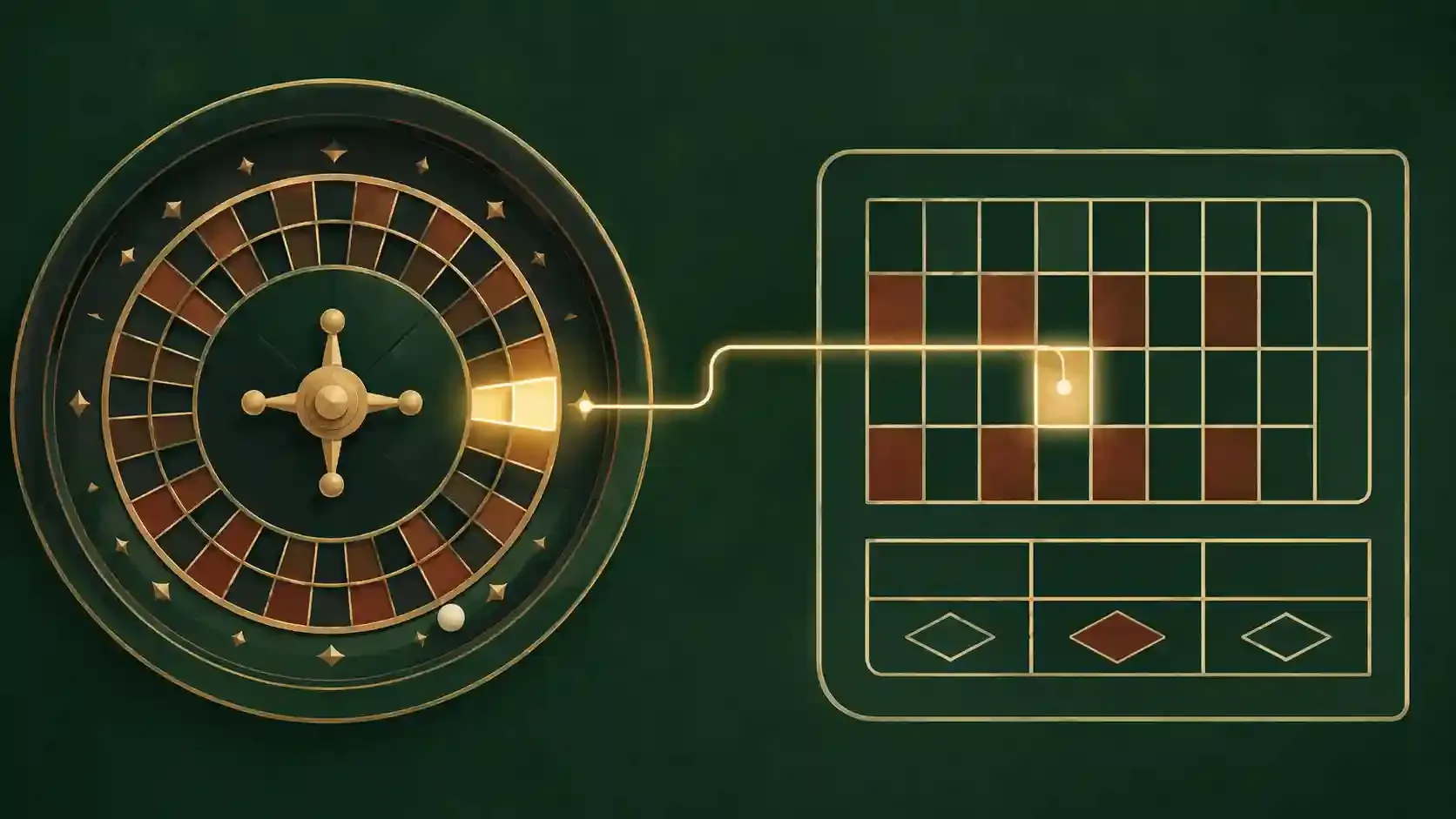
The table acts as a flat map of the wheel. Each pocket on the wheel is matched to a precise spot on the felt.
The main grid - the inside betting area - shows all 37 numbers in three columns and twelve rows. Column one runs 1, 4, 7, 10, 13, 16, 19, 22, 25, 28, 31, 34. Column two runs 2, 5, 8, 11, 14, 17, 20, 23, 26, 29, 32, 35. Column three runs 3, 6, 9, 12, 15, 18, 21, 24, 27, 30, 33, 36. The green zero sits above the grid at the top of the table.
Surrounding that grid is the outside betting area: boxes for colour, odd/even and high/low, as well as the dozens and columns.
A common stumbling block: the numbers in the table grid don't follow the wheel's order. On the table, 17 sits between 16 and 18, while on the wheel, its neighbours are 34 and 6. Placing a chip on the split between 16 and 17 on the felt doesn't actually cover adjacent wheel pockets. Numbers that sit side by side on the table can be miles apart on the wheel, and vice versa.
Inside bets: higher risk, higher reward
Inside bets are placed on or between the numbers inside the main grid. They cover fewer pockets, so the payouts are higher - but the odds of landing a winner are slimmer.
A straight-up bet covers just one number. It pays 35:1 - the highest payout you'll see on the table.
A split covers two adjacent numbers, with your chip straddling the line between them. This pays 17:1.
A street covers a horizontal row of three numbers, with the chip perched on the outer edge of the row. That one pays 11:1.
A corner bet covers four numbers meeting at a single corner. This pays 8:1.
A six line covers two adjacent rows of three numbers each, with your chip on the shared edge. That's six numbers covered, paying 5:1.
On a European wheel, the house edge remains 2.7% for every inside bet. Higher payouts for straight-up bets don't mean better value than, say, a six line - they just reflect how much less frequently those bets win. The maths always leads back to that same 2.7%.
Outside bets: wider cover, lower payouts
Outside bets are placed in the areas surrounding the main grid. They cover wider groups of numbers, so wins come more often, but the payouts are lower in return.
Red or black, odd or even, or 1-18 versus 19-36 all pay 1:1, each covering 18 numbers. On a European wheel, you win these bets about 48.6% of the time. The green zero stops it from being a real coin toss - that 1.4% difference is the house edge in action.
Dozens cover 12 numbers each (1-12, 13-24, or 25-36) and pay 2:1.
Columns also cover 12 numbers each - one of the three vertical columns in the grid - and pay 2:1.
Most newcomers start with outside bets - the near 50/50 appeal of red or black is simple to grasp. The odds do feel close: you'll win just under half the time on a single-zero wheel. Yet it's the 2.7% edge, chipping away with every spin, that builds up quietly over time, no matter how you spread your chips.
French roulette and La Partage
French roulette keeps the same single-zero wheel and identical table grid as European. Where it differs is La Partage - the key rule that sets it apart.
When the ball lands on zero and you've placed an even-money bet - red/black, odd/even, or high/low - La Partage gives you half your stake back on the spot. No need to do anything; it's automatic. There's also a related rule, En Prison, which holds your full stake for the next spin, giving you a chance to claw it back in full.
This half-refund on zero brings the house edge on even-money bets down from 2.7% to 1.35%, making French roulette the lowest house edge version you'll find at most UK online casinos. If you're mostly playing even-money outside bets and French roulette is available, it's well worth a look over the European variant.
Each spin is independent
The wheel doesn't remember a thing. Ten reds in a row doesn't tip the scales towards black on the next spin. Each result stands alone, with the probability reset every time. Past outcomes have no say over what's up next.
This is the catch that undermines most flawed betting systems. The Fibonacci betting system runs into the same problem: changing the stake does not change the odds. Strategies that double up after a loss rest on a 'catch-up' effect in the maths that simply isn't real. The same logic sits at the heart of how all online casino games approach randomness, not just roulette. For online play, the Gambling Commission's RTS 7 rules insist that outcomes are "acceptably random" and ban any system that adapts results based on prior spins.
[IMAGE 4 | LIVE SCREENSHOT | placement: in "Each spin is independent"] Capture: the UK Gambling Commission's RTS 7 page at gamblingcommission.gov.uk, framed on the page heading and the lines establishing the requirement for acceptably random outcomes and the ban on adaptive/compensated results. Authority page only, no operator content in shot.
Which version should you play?
For UK players, the pecking order is straightforward. French roulette comes first - especially if you favour even-money bets. European is next in line. American should only be a last resort; that 5.26% edge means you'll pay about twice as much to play in the long run.
Most UK-licensed online casinos offer American, European and French roulette. When weighing up where to play, it's worth checking what variants are on hand, how the live dealer tables are run, and what the table limits are. Our best online casinos guide goes into detail on the sites reviewed.
Frequently asked questions
How many numbers are on a roulette wheel? A European or French wheel has 37 pockets: numbers 1 to 36 plus a single green zero. An American wheel has 38 - the same numbers plus a double zero (00).
What is the number sequence on a European roulette wheel? Starting at zero and reading clockwise: 0, 32, 15, 19, 4, 21, 2, 25, 17, 34, 6, 27, 13, 36, 11, 30, 8, 23, 10, 5, 24, 16, 33, 1, 20, 14, 31, 9, 22, 18, 29, 7, 28, 12, 35, 3, 26. On the American wheel, the sequence differs because the double zero requires a different spacing arrangement.
Why is the green zero green? Green distinguishes zero from the numbered red and black pockets. Zero sits outside all even-money bets (red/black, odd/even, high/low), so it needs to be visually distinct. On American wheels, the double zero shares the same green colouring.
What does the green zero do to the odds? It's the source of the house edge. Even-money bets pay 1:1 but only cover 18 of the 37 numbers on a European wheel. When zero hits, those bets lose. On a straight-up number, the payout is 35:1 despite there being 37 possible outcomes. The gap between the true odds and the payout is 2.7%, and that percentage is the house edge.
What's the difference between inside and outside bets? Inside bets sit on or between specific numbers in the main grid. They cover fewer pockets and pay more - up to 35:1 for a single number. Outside bets cover broader groups: colours, odd/even, high/low, dozens, columns. They win more often but pay 1:1 or 2:1. The house edge is 2.7% across all of them on a European wheel.
Does the table layout match the wheel sequence? No. On the table, numbers are in a logical grid (1-36 in three columns of twelve). On the wheel, those same numbers are in a deliberately scrambled sequence. A split bet on 5 and 6 on the table covers two grid neighbours, but 5 and 6 are far apart on the wheel.
What is La Partage? It's a French roulette rule that returns half your stake when the ball lands on zero, but only on even-money outside bets. It cuts the house edge from 2.7% to 1.35% on those bets, making French roulette the most player-friendly variant available.
Does past spin history affect future results? No. Each spin is completely independent. The wheel has no memory of where it's landed before, and no run of results changes the probability of any outcome on the next spin.
Safer gambling: Even-money roulette bets can seem almost like a coin toss, but the house edge is always there, no matter the version. Set a deposit limit before you start, and treat your session budget as entertainment, not an investment. If gambling is becoming an issue for you or someone close, the National Gambling Helpline is free and open round the clock at 0808 8020 133.

Alan Woods
Content Editor
Alan reviews Irish casinos the same way he used to assess security risks: nothing gets the benefit of the doubt until it holds up under scrutiny. His cyber security background means he checks the things most reviews overlook, like licensing, how a site handles your data, and what the withdrawal terms actually deliver once the welcome offer is out of the way. He’s a published author as well, so you get the verdict in plain English instead of a technical checklist.
Share this article